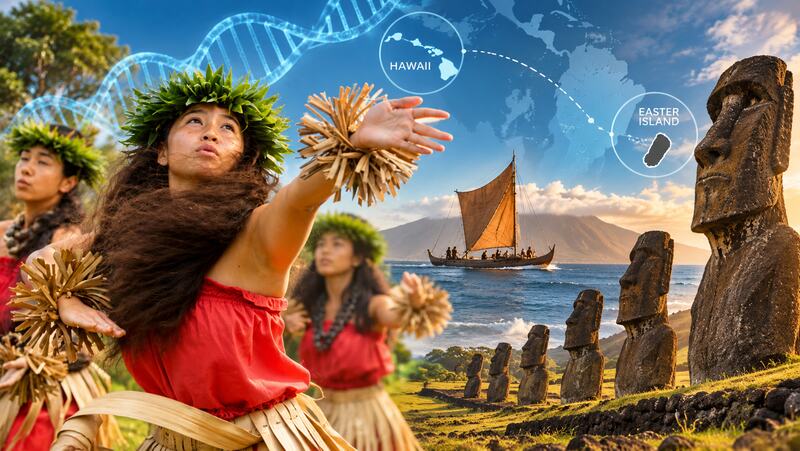
Hawaii and Easter Island sit on opposite edges of the Pacific, roughly 7,100 kilometres (about 4,400 miles) apart. A new genetic study says the people who first settled them were close kin. The research, published in the journal Science, concludes that Native Hawaiians and Easter Islanders descend from the same group of “ultravoyager” Polynesians who crossed huge stretches of ocean to reach remote islands.
A cover study built on more than 1,000 genomes
The paper appeared on October 8 and made the journal’s cover. It analyses whole-genome sequences from 1,050 people across Polynesia. The sample included 317 Native Hawaiians, 12 people from Rapa Nui (the Indigenous name for Easter Island) and 8 Mangarevans, along with participants from the Society, Tuamotu, Marquesas, Austral, Samoan and Tongan islands.
Stanford computational geneticist Alexander Ioannidis and Keolu Fox, a genomic scientist at the University of California, San Diego, led the work as co-senior authors. Fox is himself Native Hawaiian.
The method rests on shared stretches of DNA. The researchers compared the length of chromosome segments that people from different islands have in common, and longer shared segments point to a more recent common ancestor. From that, the team rebuilt thousands of family trees for the islands.
Hawaii and Rapa Nui kept turning up together
The result surprised even the people who ran the analysis. In 61% of the reconstructed trees, Hawaii and Rapa Nui were paired with each other. Fox said the team checked the finding four different ways because they could hardly believe it at first.
Mangareva, a small island group in French Polynesia, sits behind both populations. Mangarevan ancestry was the second strongest signal in Native Hawaiians, after Easter Island ancestry. The data suggest people reached Easter Island in the 1200s after sailing more than 2,400 km from Mangareva, and that a subset of them later set out for Hawaii.
The authors call this voyaging population Holomoana Nui, which translates from Hawaiian as “great ocean voyaging”.
What the voyages involved
The crossings were made in double-hulled canoes, with no instruments and no guarantee of land at the end. Ioannidis noted that the sailors carried what they needed to start over. Their canoes held bananas, taro, sweet potato and chickens.
Hawaii is the only Polynesian island group in the Northern Hemisphere, which makes the journey even harder to picture. Native Hawaiians and Easter Islanders also share cultural threads typical of eastern Polynesia, including related Austronesian languages and similar foods.
Fox argued the story deserves a bigger place in how history is told. He suggested it may be time to rethink who gets called an explorer, since Polynesians were crossing and settling the Pacific centuries before European ships followed.
The study also looked closely at Tahiti, where the team had the most genomes. They estimated that about 800 founders arrived there around the year 1070. LinkedIn comments from Ioannidis’s group add that the population then grew quickly before shrinking by about 40 percent roughly nine generations ago, a drop the researchers link to diseases introduced during European colonial contact.
Ioannidis reasoned that the longer trip to Hawaii probably involved a founding group no bigger than Tahiti’s, and perhaps smaller.
A health finding with real consequences
Each time a small group left one island to settle another, only part of the original gene pool went with them. Repeat that across several islands and rare genetic variants can become common by chance. The team calls these “nested founder effects.”
The study found the founder effect among Native Hawaiians is more than 10 times larger than in the Amish, Finns and Ashkenazi Jews, groups for which doctors already use standard genetic screening. Fox put the gap plainly: “Why not Hawaiians?”
The researchers identified variants linked to kidney disease and blindness that appear at surprisingly high frequencies in French Polynesia. They say Native Hawaiians likely carry clinically important variants as well. Ioannidis’s group points out that Native Hawaiians number about 700,000 in the United States, roughly twice the Amish population, yet remain far less studied. Large global gene databases have also underrepresented Pacific Islanders, which can leave clinicians without reliable reference data.
What the DNA cannot say
The authors are open about the limits. The genome cannot show which island settled which, and it cannot reconstruct individual voyages. Other evidence points in different directions. A 1966 language tree grouped Hawaii with Mangareva and the Marquesas, and DNA from Pacific rats carried on canoes also links Hawaii to the Marquesas. Several news reports described the Easter Island group as Hawaii’s first settlers, but the paper’s own claim is narrower: the two populations share unusually close ancestry.
The work also builds on earlier findings. A 2020 Nature study showed contact between Polynesians and Native Americans during the same medieval period, from this same corner of the Pacific. A 2024 Nature paper on ancient Rapa Nui genomes rejected the popular theory that islanders caused their own population collapse before Europeans arrived.
The research drew on contributions from Indigenous and Pacific Islander communities in Hawaii, Rapa Nui and French Polynesia. The university’s account describes the study as designed around trust, a notable point given the history of Indigenous genomic research.
For Native Hawaiians, the result adds a genetic chapter to oral traditions of long-distance voyaging. For doctors, it argues for screening tools that reflect Pacific ancestry. And for anyone looking at a map of the Pacific, it shows an ocean that served as a highway for the people who knew how to read it.