A Lagos court has stepped between the Economic and Financial Crimes Commission (EFCC) and one of the best-known vehicle brands in Nigeria. The ruling in the Honda Manufacturing Nigeria EFCC case came in the first days of November 2026, and it has left the auto industry, Honda dealers across the country and legal watchers asking the same thing: what is going on?
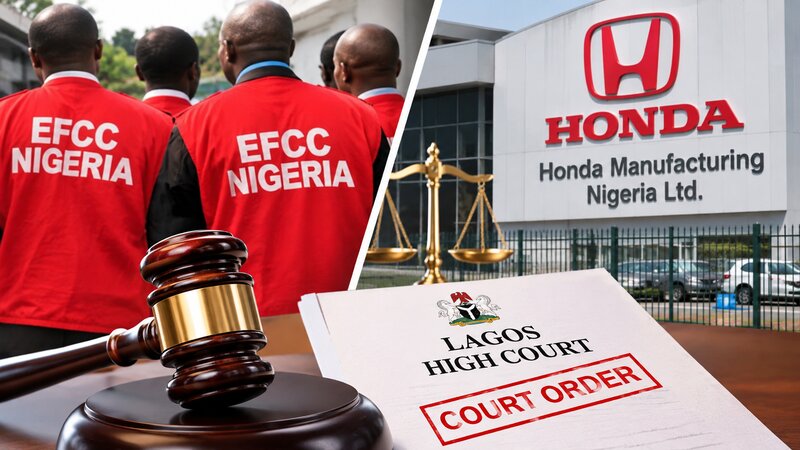
The Lagos State High Court restrained the EFCC from arresting or detaining executives of Honda Manufacturing (Nigeria) Limited, Honda Automobile West Africa Limited and more than 200 individuals and businesses in connection with an ongoing investigation by the agency.
What the Lagos court ordered
Justice Olukayode Ogunjobi made the order while ruling on an application filed by the two companies, their executives, dealers, distributors and other business associates. Two reports put the date of the interim injunction at October 28, 2026, with the story reaching the wider press days later.
The order is narrower than some headlines suggest. It stops the EFCC from arresting, detaining or otherwise taking away the personal liberty of the applicants or their officers over the subject matter of the investigation, pending the hearing of the main motion. The judge also pressed for a quick hearing. He noted that a fundamental human rights action ought to be heard expeditiously.
One request was turned down. The court refused to order the EFCC to return original documents allegedly taken from Honda Manufacturing (Nigeria) Limited during a visit to its premises on September 24, 2026. The applicants had asked that the commission photocopy the papers and hand the originals back. According to the relief sought, those documents included original records relating to the company’s importation.
What the fundamental rights suit is about
The applicants did not file a defence to criminal charges, because none has been reported. They went to court under Nigeria’s fundamental rights enforcement procedure. The suit, marked LD/22659MFHR/2026, was brought under Sections 34, 35, 37, 40, 43 and 46 of the 1999 Constitution and the African Charter on Human and Peoples’ Rights (Ratification and Enforcement) Act. Those sections cover dignity of the person, personal liberty, privacy, freedom of association, protection of property and the right to approach the court for enforcement.
They say the EFCC investigation has unlawfully interfered with their liberty, freedom of movement and privacy. In practical terms, they wanted protection from a series of summonses that kept widening. They asked the court to stop the commission from forcing them or their officers to report to its office, from issuing more invitations to company executives, dealers and distributors, and from threatening arrest. They also asked that no individual applicant be arrested or detained merely for failing or being unable to honour further invitations. And they want any action touching their liberty to follow the 1999 Constitution, the Administration of Criminal Justice Act 2015 and other applicable laws.
Who are the Honda Nigeria executives and dealers involved?
The list of applicants is long, and the full roll has not been published. The names that have appeared in court reports are:
- Individuals: Two Japanese nationals, Tetsuya Kawai and Mita Daisuke, alongside Nigerian executives, motorcycle dealers and other business people. Others named include Olayemi Adebiyi, Olabade Badejo and Lanre Akinsola.
- Companies: H3 Motors & Industries Limited, Movack Services Nigeria Limited, Tony Moore Nigeria Enterprises and Hardé Global Motorcycle Venture, among several others.
- Lead counsel: Bolaji Ayorinde, SAN, led the applicants’ legal team, with Wale Rokosu.
Reports do not state each person’s exact job title, so it is unclear who among the named individuals holds which position at the Honda companies.
Who are Honda Manufacturing Nigeria and Honda Automobile Western Africa?
The two companies do different jobs. Honda’s own history says its motorcycle business in the country grew out of negotiations with Leventis Motors, a local distributor, and with Nigerian government officials, leading to Honda Manufacturing (Nigeria) Limited, a joint venture to sell motorcycles and power products. The company says it began motorcycle production and sales in Nigeria in 1980.
The car arm is younger. Honda announced Honda Automobile Western Africa Ltd. (HAWA) in Lagos in September 2013 as a wholly owned subsidiary for importing and selling automobiles and parts. It began local production of the Accord sedan on July 10, 2015, at a plant with an annual capacity of 1,000 units, the first Honda car factory in Africa.
The EFCC matter is not the only legal fight around Honda in Nigeria this year. In May, workers and the local management team at HAWA went to the Federal High Court in Lagos over the planned merger of Honda Manufacturing (Nigeria) Limited and HAWA, asking to set aside a court-approved order. The sanction order they want set aside was granted on May 12, 2026. There is no public link between that dispute and the EFCC investigation.
What the EFCC has said
At the time of writing, no EFCC statement on the matter has surfaced in the reports reviewed. The commission has also not publicly spelt out the allegation behind its inquiry, and the court coverage does not either. That gap matters, because it means the public does not yet know whether the probe concerns import documentation, tax, customs, dealer transactions or something else.
What the ruling does not mean
An interim injunction is a holding measure. The order does not determine the merits of the EFCC investigation or the substantive rights claims. It does not clear anyone of wrongdoing, and it does not shut down the probe. It does not invalidate the investigation or decide whether the applicants’ rights were actually violated. The EFCC can still investigate, and it can still press its case when the main suit is argued.
For dealers and distributors who have been receiving invitations, the order offers breathing room. The real test comes at the full hearing, where the judge will weigh the commission’s powers to investigate against the constitutional right to liberty.
The matter was adjourned to November 13, 2026, for further proceedings, a date repeated by several outlets. Vanguard, however, reported November 23, 2026. The court’s cause list will settle which is right.
Until then, the Honda Manufacturing Nigeria EFCC case stands as a reminder of how often Nigerian business disputes with the anti-graft agency end up in the courtroom, with each side claiming the law is on its side.