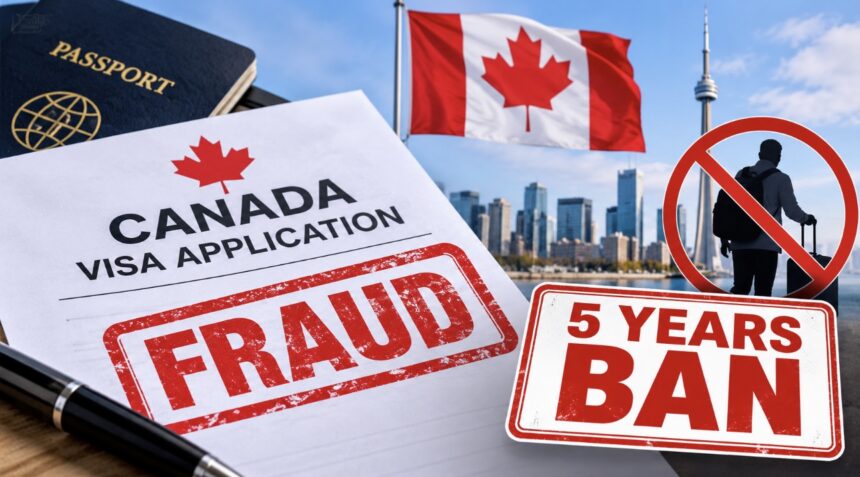
Canadian immigration authorities have cautioned prospective travellers against submitting forged or altered documents during visa applications, warning that offenders could face a minimum five-year ban from entering the country.
The Immigration, Refugees and Citizenship Canada disclosed this in a post on its official X account on Thursday, explaining that document fraud could lead to serious immigration and legal consequences.
The agency listed several documents commonly required for immigration applications, including marriage certificates, language test results, passports, academic records, visas and divorce papers, as items whose falsification could amount to fraud.
Information published on the IRCC website also indicates that providing false details about a medical condition to a panel physician during an immigration medical examination is considered fraudulent.
NINE CATEGORIES OF DOCUMENTS THAT MUST NOT BE FALSIFIED
The Canadian authorities identified the following documents and records as those whose falsification could constitute immigration fraud:
1. Passports and other travel documents.
2. Visas, as well as entry and exit stamps.
3. Language test results.
4. Employment evidence and job offers.
5. Admission letters from educational institutions, tuition payment receipts and academic transcripts.
6. Diplomas, university degrees, apprenticeship certificates and trade qualifications.
7. Relationship records, including birth, adoption, marriage, divorce, annulment, separation, death and custodianship certificates.
8. Police clearance certificates and court documents.
9. DNA test results.
The IRCC also warned that applicants could commit fraud by misrepresenting the period they or another person had physically stayed in Canada when applying to renew a permanent resident card or obtain citizenship.
“Lying about how long you or someone else has been physically present in Canada while applying for a permanent residency (PR) renewal or citizenship is also considered fraud. Learn more about PR card residency obligations and physical presence,” the agency stated.
POSSIBLE CONSEQUENCES OF IMMIGRATION FRAUD
According to the IRCC, anyone found guilty of immigration or citizenship fraud could have their application rejected and face a ban from Canada for at least five years.
Other possible penalties include having a permanent fraud record with the agency, losing temporary or permanent resident status, or having Canadian citizenship revoked.
Offenders could also be barred from applying for citizenship for five years or removed from Canada.
The agency said its objective was not to punish people who had been affected by fraudulent activities but to identify and hold those responsible accountable.
WARNING OVER MARRIAGE AND RELATIONSHIP FRAUD
The IRCC further cautioned Canadian citizens and permanent residents against entering into relationships primarily to help another person secure immigration status.
It described a relationship of convenience as a marriage, common-law partnership or conjugal relationship entered into mainly for the purpose of immigrating to another country.
The agency warned that Canadians or permanent residents involved in such arrangements could face criminal charges.
It also said immigration officers were trained to identify sham marriages and fraudulent common-law or conjugal relationships through document verification, home visits and interviews with applicants and their sponsors.
“Our officers are trained to recognise genuine immigration applications. They know how to detect false marriages and common-law or conjugal relationships.
“They have many ways to spot marriage fraud, including document checks, visits to people’s homes and interviews with both sponsors and applicants,” the information read partly.
CREDIT CARD REVERSALS COULD AFFECT VISA APPLICATIONS
The Canadian authorities also warned applicants about the consequences of reversing credit card payments made for visa processing.
According to the IRCC, a reversed payment could delay or lead to the cancellation or rejection of an application.
It added that affected applicants could potentially face a travel ban of up to 10 years, while the incident could also affect applications submitted in the future.
“If the fee paid with a credit card is reversed, your visa application could be cancelled or delayed. Your visa application could also be denied and you could potentially be banned from travelling to Canada for up to 10 years. Applications you submit in the future can also be impacted,” it added.