
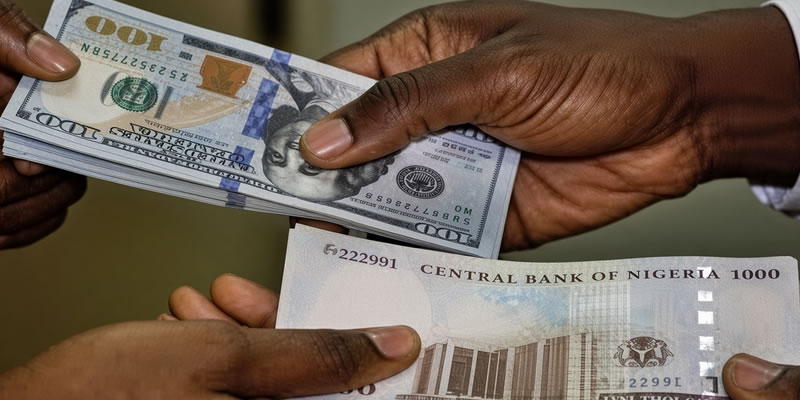
After months of calm and stability, the Nigerian naira is floundering and slipping. On Thursday, the currency weakened to N1,394.01 per dollar at the official Nigerian Foreign Exchange Market (NFEM).
Data from the market showed a drop of 0.31 per cent, or N4.28, from the N1,389.73 recorded on November 20. The last time the naira traded around the N1,390 mark was in March.
The parallel market paints a slightly different picture. The naira gained 0.69 per cent on Wednesday to close at N1,445 per dollar, up from N1,455 on November 20. Lagos bureau de change operators bought at N1,440 and sold at N1,445. Still, that minimal gain came just days after the currency hit N1,470 on November 18, its weakest street rate since January.
After months of steady progress, the sudden reversal has raised eyebrows and sparked an urgent question: what changed?
Foreign Investors and 2027 Election Uncertainty
Market analysts point first to foreign portfolio investors. For months, these investors brought dollars into Nigeria to chase high yields after the Central Bank of Nigeria (CBN) raised interest rates. Now, many of them are pulling back. About ₦31.55trn of CBN OMO bills mature this quarter. Instead of rolling them over, many foreign holders are converting to dollars and exiting. Net foreign outflows this quarter are about $1.02bn.
Analysts at Cordros Securities say heavy dollar demand from exiting foreign investors drove the recent fall. That demand was so strong that it gulped a massive Central Bank of Nigeria (CBN) intervention of $1.30 billion during the week ended November 20, but it was not enough to halt the dip as demand still outpaced supply.
The reason for their exit is largely political. With the 2027 general elections drawing closer, foreign investors are getting nervous.
Tajudeen Olayinka, Chief Executive Officer of Wyoming Capital Partners, explained that investors are reducing their exposure due to political uncertainty. They also fear that the government could return to populist economic policies as campaigns intensify.
Local politics is exacerbating the situation. Financial market reports show that Nigerian politicians have already started stockpiling dollars ahead of the 2027 race. Analysts warn that this early election spending is putting much heavier pressure on the naira than the market expected.
Yuletide Demands and Limited Supply
Politics is half of the problem. The calendar does not also favour the naira.
As December approaches, Nigerian businesses and importers are trying to mop up dollars. There are also cases of parents who need dollars to pay their children’s school tuition abroad. They need foreign currency to pay for Christmas goods and end-of-year stock. This seasonal surge happens almost every year, and it is hitting the market right when foreign inflows are slowing down, which has compounded this year’s pressure on the naira. FX coming into the market fell from $2.48bn to about $808m in one week.
Trading numbers reveal just how tight things have become. Weekly market turnover recently jumped by 36.59 per cent to $4.67 billion, the second-highest weekly figure in 2026. Spot trades made up 99.40 per cent of that volume.
On the surface, high turnover looks like good news. Analysts, however, say the spike is an indication of frantic dollar demand, not better supply. Forward market rates confirm this gloom. The one-year forward rate recently slid to N1,597.57 per dollar, showing that traders expect pressure to last through the rest of the year. For importers, this means higher costs in the weeks ahead.
Should Nigerians Worry?
Despite the sudden dip, many experts say there is no cause for alarm as things are expected to normalise in the coming weeks. They describe the slide as a temporary liquidity crunch rather than a brutal foreign exchange squeeze capable of triggering a collapse of the economy.
Nigeria’s external reserves offer strong backing for that view. According to CBN data, gross reserves stood at $54.58 billion as of November 20. That is a jump of $9.02 billion, or 19.8 per cent, from the $45.56 billion recorded on January 2. With that kind of buffer, the CBN still has enough firepower to defend the currency when needed.
The recent dip also echoes a warning from Anambra State Governor, Charles Soludo. Speaking on October 27, the former CBN governor cautioned Nigerians against celebrating a strong naira. Instead, he implored the country to maintain a competitive exchange rate over the next decade. According to him, a realistic rate helps local factories grow and makes Nigerian exports cheaper abroad. In his view, a currency that is too strong can actually hurt local producers.