


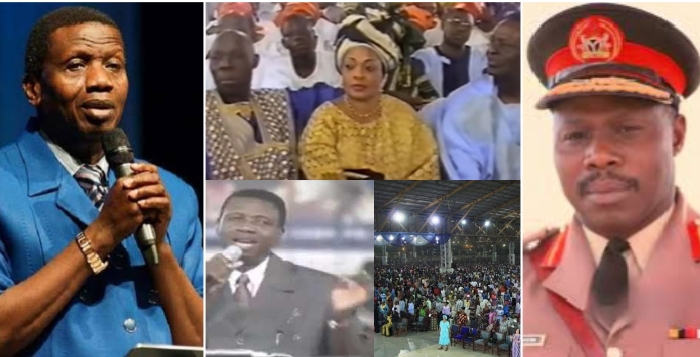
It began like every other Holy Ghost Congress night — millions gathered under the iron ribs of the Redemption Camp canopy, the sea of believers breathing in rhythm with the wind. The lights of Redemption City flickered like stars trapped between human longing and celestial memory. Vendors of pure water and faith literature lingered outside the vast arena, while ushers in white gloves gestured with silent authority.
That night, the wind carried a subtle weight. Nobody could name it. The worship flowed as usual — the hymns swelling, the prayers rising, the stage glowing with the soft certainty of divine choreography. Then, amid the murmuring multitude, an unannounced figure entered through the western flank of the crowd. Silent convoy lights. Silent trumpet of sirens. Only a man in his late sixties, wearing a cap that once symbolized command, now pulled low over a brow that had seen both gunfire and grace.
Olusegun Obasanjo — Nigeria’s former Head of State, president, farmer, warrior, and paradox — had come, quietly, to the camp.
He did not walk to the front. He did not take the seat reserved for dignitaries. He moved among the faithful, shaking heads, murmuring a muted “amen,” until he melted into anonymity somewhere in the middle rows.
And the congregation bowed their heads — not to him, not yet, but to the voice that soon ascended the podium.
The Soldier Who Feared God
Olusegun Obasanjo’s relationship with God has always been public and private in equal measure. To fathom why he came incognito to the camp, one must rewind history — to 1979, when he handed over power to Shehu Shagari, becoming the first Nigerian military ruler to do so voluntarily. To many Nigerians, that gesture was political maturity; to Obasanjo, it was a divine assignment completed.
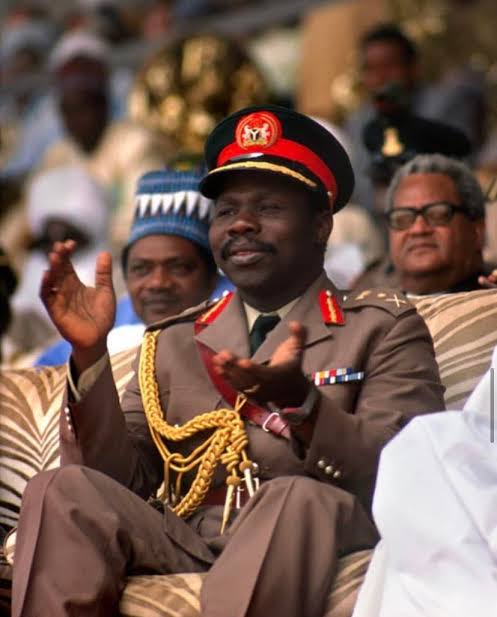
By the mid-1990s, when the Abacha regime imprisoned him for alleged treason, the once-mighty general had nothing left to defend but faith. In Yola Prison, he turned to the Bible, reading it line by line, writing reflections that would later form his book The Man and the God He Served. There, stripped of the military salutes and national broadcasts, Obasanjo learned silence — the kind that prepares a man for redemption.
So when he emerged from prison in 1998 and was elected president in 1999, his visits to places like the Redemption Camp were not political courtesy. They were pilgrimages.
To those who knew, the general no longer came to show power; he came to understand it.
Redemption Camp as Nigeria’s New Capital
By the early 2000s, the Redemption Camp had grown from a patch of swampy land on the Lagos–Ibadan Expressway into a city of its own. With over 12,000 hectares, it housed banks, schools, roads, and entire neighborhoods. In many ways, it mirrored the Nigerian dream — chaotic, expanding, and hopeful.
Presidents visited it, governors sought prayers there, and ordinary Nigerians found in its dust a sense of direction absent from state institutions.
For Obasanjo, who had lived the paradox of leading a fractured country, the Camp represented an ungoverned order — millions moving in obedience to an unseen authority, no soldiers required. Adeboye’s influence stretched quietly into the very spheres where the Constitution faltered.
And so, during one Holy Ghost Congress in the early 2000s, Obasanjo came without cameras. He wanted to see the nation’s spiritual pulse without the filter of protocol.
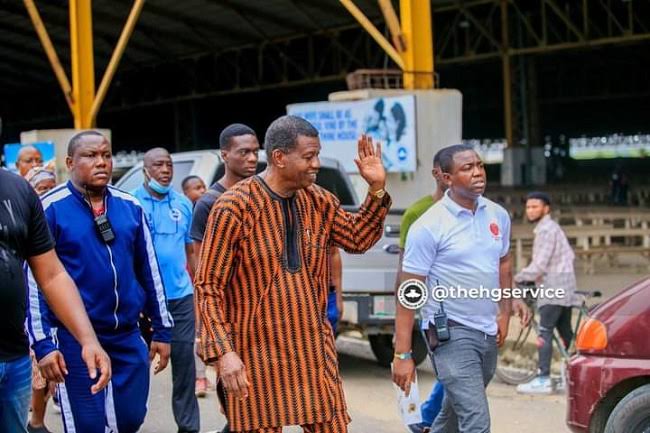
What he witnessed that night — a people whose reverence moved without instruction — would linger with him for years.
The Voice That Commands Two Kingdoms
When Pastor Enoch Adeboye mounts the pulpit on that night in December 2003, the atmosphere thickens. His presence does not shout; it hums. At his age, his frame is lean, his words measured, but his silences speak louder than thunder. To the millions who gather at Redemption Camp, he is not just the leader of a church — he is a moral axis, a soft-spoken oracle whose prayers have outlived governments.
That night, as he began to pray, Obasanjo — somewhere in the crowd — closed his eyes. No cameras caught him. No aides whispered. It was a convergence of two institutions that have defined post-colonial Nigeria: the State and the Sanctuary.
One wields the sword; the other, the spirit. And on rare nights like this, they kneel before the same invisible throne.
Adeboye’s prayer moved through the vast field — for the nation, for its leaders, for wisdom. Every head bowed. In the anonymity of millions, Obasanjo’s head too bent forward. No one around him knew that the man beside them had once commanded armies, signed decrees, and released nations from chains.
The congregation bowed in unison, an ocean of reverence before God and the man they call “Daddy G.O.”
Obasanjo bowed too, unseen in the crowd. Then, a few minutes later, when Adeboye announced, almost reluctantly, that the nation’s president was in attendance, the camera lights searched and found him. The crowd gasped, applauded, then instinctively the crowd of pastors and senior church members around the politician bowed again as they welcomed him— this time not out of worship, but recognition.
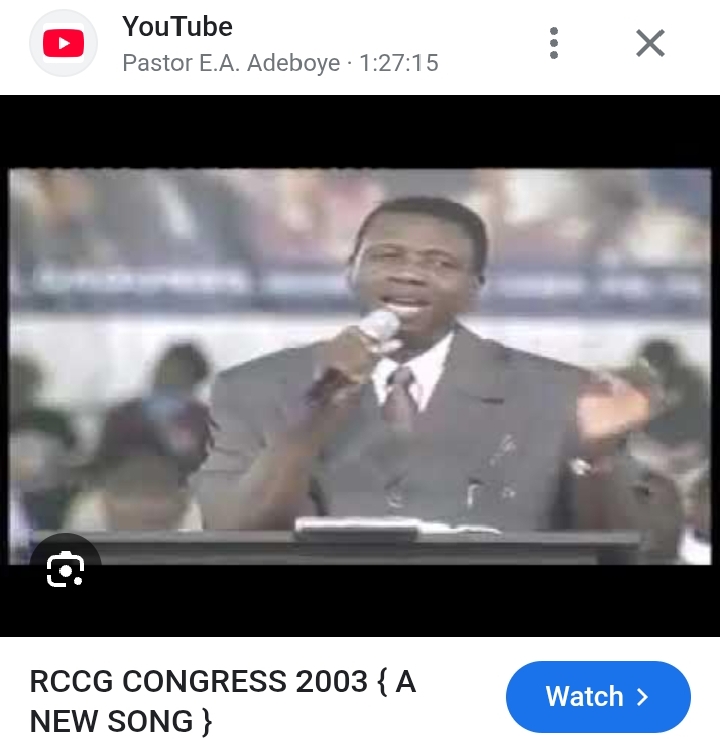
When Adeboye finished praying, the crowd rose. A wave of worship followed. And for a fleeting moment, millions had bowed twice — One for heaven, one for the state.
It was a moment heavy with metaphor — the ancient Nigerian reflex to honor power, sacred or secular. Yet it also symbolized something deeper: the coexistence of two altars in one nation — the pulpit and the presidency — forever locked in quiet negotiation.
Between the Altar and Aso Rock
For much of Obasanjo’s second presidency (1999–2007), the influence of religious leaders hovered over state policy. The Pentecostal surge was no longer peripheral; it was central to how Nigerians interpreted governance, hope, and identity.
Adeboye prayed with presidents. Oyedepo counseled industrialists. T. B. Joshua courted foreign leaders. The spiritual had become inseparable from the political.
Obasanjo, more than any of his peers, understood this fusion. He knew that faith, in a land of broken institutions, was the last functioning bureaucracy. Where parliament failed, prayer prevailed.
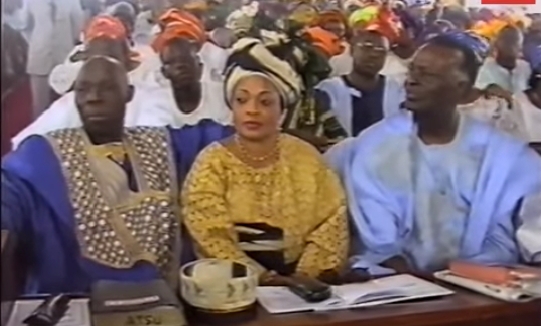
His relationship with Adeboye was not merely pastoral; it was philosophical. Both men were architects — one of the modern Nigerian state, the other of its moral psyche.
Behind closed doors, they discussed more than scripture. They discussed power, destiny, and the weight of leading millions in a land where faith is currency.
Legacy of the Unseen Visit
Years later, those who recall that night describe it not as a miracle, but as a mirror. Obasanjo’s decision to come quietly reflected a rare humility for a man once called “the last general.”
For Adeboye, it reinforced his belief that power must bow before God — even if power wears agbada instead of armor.
The double bow became folklore in RCCG circles, often retold as proof that no one, not even presidents, stands taller than God’s call. Yet beyond the pulpit, the image carried political resonance: a country that bows easily, that confuses reverence with reform, that finds redemption easier than accountability.
The Redemption Camp that night became a metaphor for Nigeria itself — a crowd united in faith, divided in understanding, seeking salvation while power sat quietly among them.
The Eternal Paradox
In the years since that humid night at Redemption Camp, Olusegun Obasanjo has walked the tightrope of contradiction that defines his life: soldier and supplicant, politician and pilgrim, skeptic and believer. He attends national prayer sessions not as a ceremonial act, but as a subtle acknowledgment that authority alone cannot govern the invisible currents of a nation’s conscience. At public lectures, he speaks of ethics, governance, and civic responsibility — but the margins of his speeches often hint at a deeper meditation: the unseen hand of providence, the quiet verdicts of history, and the lessons only humility can teach.
Across the same landscape, Enoch Adeboye continues to expand his reach. He is no longer merely a pastor of Lagos, nor simply a shepherd of the faithful. He has become a force-field of influence, touching commerce, politics, and culture without issuing a single command. Banks, industries, educational institutions, even corridors of government — all feel the gravity of the man who preaches with a voice gentle as a breeze yet dense as the granite of Mount Olodumare.
Their paths, though diverging in method, seem to converge in essence. Obasanjo, forged in the crucible of war and power, embodies the tangible weight of human authority. Adeboye, tempered by decades of spiritual discipline, represents the intangible architecture of influence — faith as scaffolding, prayer as mortar. Together, they mirror the duality of Nigeria itself: a nation built on soil rich with both blood and benediction, where the visible and invisible are perpetually intertwined.
And every December, as millions assemble under the same starlit canopy at Redemption Camp, the tale resurfaces — not as a headline, not as a sermon for the cameras, but as a quiet murmur in the collective consciousness of those present. The story is whispered, passed from shoulder to shoulder: that night when the head of a nation bent twice — once to heaven, once to the unspoken covenant between power and faith. It is more than memory; it is a symbol. A demonstration that in Nigeria, authority and devotion are not opposites, but intertwined threads in a tapestry that resists simple unraveling.
It was never a spectacle. It was a choreography of reverence, a silent symphony of posture and presence, a sermon written not in words, but in motion. And like all profound mysteries, it leaves its audience unsettled yet reverent, aware that some truths are best understood not through decree, but through gesture.
Final Thoughts: The Bow That Echoed
History is precise in its ink, recording wars, treaties, and elections. Yet history is often blind to gestures — fleeting, silent acts that carry the weight of worlds. The double bow at Redemption Camp was such a gesture. It was unplanned, unfilmed in official footage, yet it reverberated through the spiritual and civic consciousness of a nation.
The first bow — to heaven — symbolized Nigeria’s longing for moral compass, the acknowledgment that human governance is fragile, finite, and often flawed. The second bow — to the man who once wielded power over armies and economies — recognized that even in the presence of divinity, earthly authority cannot be ignored. Together, the two bows formed a dialogue between mortal ambition and divine oversight.
In that silent choreography, there is a lesson: every government maintains an altar, whether political or spiritual. Every altar, whether grand or hidden, exerts its politics. The faithful gather, the powerful maneuver, yet all are bound by the same invisible rhythm of consequence and conscience.
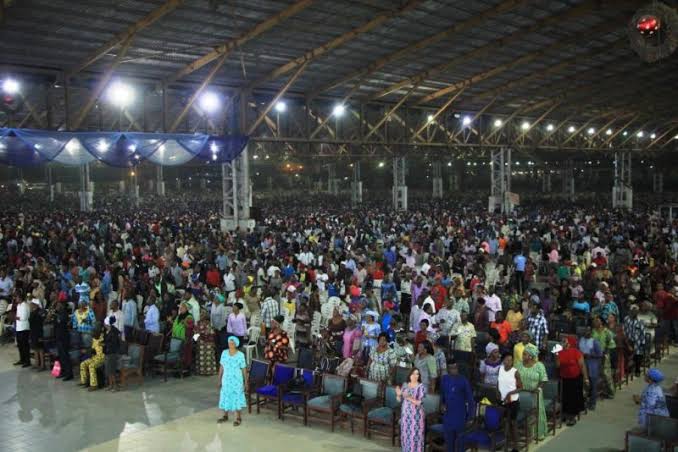
And perhaps, that night, when Obasanjo bent his head, he conveyed what no decree, no speech, no policy could ever capture: that the true measure of leadership is not how loudly one commands, but how quietly one bows. In kneeling, he acknowledged not weakness, but the enduring paradox of Nigeria — that power is always provisional, and reverence, whether for God or for the moral conscience of the people, is eternal.
In the end, the bow that echoed was not just Obasanjo’s. It was the nation’s — a subtle, unrecorded testament to the fragile, beautiful interplay of faith, authority, and history. It lingers in memory, in folklore, in the quiet understanding that even the mightiest must sometimes kneel, and that true power often waits humbly for recognition.
Discussion about this post