


Every culture has its unspoken grammar of respect — gestures that carry centuries of meaning in a single movement of the hand. On that humid evening in Lagos, when the lights of Eko Hotel glowed like miniature suns above the heads of Nigeria’s elite, a single handshake would momentarily test the limits of that grammar. Pete Edochie, the towering Igbo thespian whose voice once defined the moral backbone of Nollywood, extended his hand to greet the Ooni of Ife, Oba Adeyeye Enitan Ogunwusi. It was a greeting wrapped in heritage, but also in quiet defiance — the kind that turns a polite encounter into a national conversation.
The crowd didn’t flinch at first. Cameras clicked, lights blinked, conversations continued. Yet, within that second of cultural exchange, something ancient stirred beneath the velvet of the evening — a question about hierarchy, pride, and what happens when two civilizations meet halfway. The handshake wasn’t aggressive, nor was it casual. It was deliberate, measured, steeped in the rhythm of Igbo courtesy — the backhand clasp of elders that signals equality and age-earned dignity.
Later, when the clip surfaced online, social media erupted into chaos. Some saw a breach of Yoruba protocol. Others saw the poise of a legend who understood the power of mutual respect. But beneath the noise lay something far more profound — the friction and beauty of a country where cultural boundaries are porous yet fiercely defended.
Edochie’s gesture would be replayed, slowed down, analyzed, and debated until it became less about him and more about Nigeria itself — a mirror to how one nation wrestles with its multiple definitions of honor.
The Night Lagos Held Its Breath
That night wasn’t just another social event. It was the birthday celebration of Elizabeth Jack-Rich, the wife of philanthropist and businessman Tein Jack-Rich, attended by some of Nigeria’s most visible figures. The ballroom shimmered with chandeliers, lace, and laughter. Royal fathers mingled with actors, clergy, politicians, and CEOs — the very image of modern Nigeria in its layered finery.

Pete Edochie arrived with Kanayo O. Kanayo, another emblem of Nollywood’s golden generation. Together, they carried the aura of men who had played gods, kings, and philosophers on screen — actors who taught a nation how to interpret authority through performance. Their entrance drew murmurs of admiration. Phones lifted. Eyes followed.
Across the hall sat the Ooni of Ife, resplendent in white, the embodiment of Yoruba monarchy and ancestral continuity. Tradition dictates that visitors approach the throne with gestures that signify deference. But Edochie, a cultural custodian in his own right, extended his hand in the manner of Igbo elders — a dignified backhand grip.
The Ooni accepted the gesture with grace. He smiled, exchanged words, and motioned for them to sit. The event flowed on, but something about the moment lingered — not in tension, but in the electricity that hums when two worlds momentarily brush against each other.
By dawn, the moment had left the ballroom and entered the bloodstream of social media. Posts multiplied. Commentaries spiraled. The nation had found its newest theatre — one that didn’t need a script, only memory and meaning.
A Monarch, an Elder, and the Weight of Custom
Custom is the oldest kind of diplomacy. In Nigeria, it is both map and border, guiding how respect is shown, received, and reciprocated. For the Yoruba, the act of prostration before royalty is not subservience but a recognition of divine custodianship. The monarch is not merely a man; he is an institution, a vessel of ancestral authority.
The Igbo worldview reads differently. Within its republic of elders, no man is born into permanent subjugation; respect is mutual, horizontal, earned by age, wisdom, and accomplishment. A handshake between men of stature is not rebellion — it is a language of parity.
Pete Edochie, molded by this Igbo ethos, is not one to act without intention. His greeting was not arrogance but cultural literacy. The Ooni’s acceptance was equally significant — a monarch secure enough to embrace another tradition without offense. But their followers, separated by screens and sentiment, were less diplomatic.
Debates sprang up overnight. Was Edochie wrong to shake a monarch’s hand? Was the Ooni too lenient in accepting it? Or had both men demonstrated what Nigeria rarely achieves — cross-ethnic maturity? The conversation, though born of a simple gesture, became a national seminar on identity and modern coexistence.
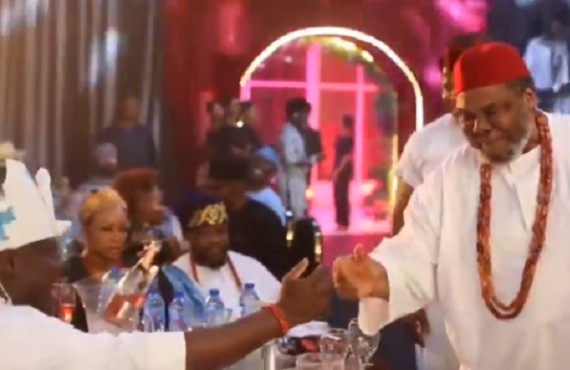
In that moment, the handshake became a living metaphor for Nigeria’s balancing act: the search for respect that honors tradition without trapping it.
The Igbo Handshake: History of a Gesture Older Than the Screen
The Igbo handshake is not casual. It is ceremony condensed. Among Igbo elders, the backhand clasp often follows a verbal exchange of honorifics. It is performed with quiet solemnity — a way of acknowledging shared humanity rather than institutional rank.
Historically, this gesture predates colonial boundaries. Oral histories from Nri and Arochukwu describe elders greeting each other with open palms, symbolizing transparency of heart. To clasp hands was to recognize another man’s spirit. To withhold it was to signal caution or distance. Over time, the handshake evolved into a mark of seniority — offered downward by elders, received upward by the younger.
For Edochie, born in 1947 in Enugu and raised in the disciplined mold of Igbo tradition, such a gesture carries personal theology. He has often described respect as something measured not by performance but by sincerity. To extend his hand to the Ooni, therefore, was to meet tradition with tradition — to say, without words, I see your crown, and I bring my own heritage to this table.
The symbolic weight of that moment drew its power from history itself — two great civilizations acknowledging each other through gestures older than film and more enduring than fame.
When Cultures Collide in Polite Company
Nigeria’s diversity has always been its mirror and its maze. Every gathering of power — from boardrooms to banquets — becomes a subtle negotiation of cultural codes. The Lagos event was no different. Beneath the laughter and camera flashes, invisible rules hummed like ancestral scripts.
For many Yoruba observers, a handshake offered to a king looked like irreverence. For Igbo witnesses, it was mutual dignity performed in public view. The friction was not hostility but translation — two languages of respect colliding gently on the same stage.
This wasn’t the first time Nigerian traditions had intersected under bright lights. At film premieres, coronations, and weddings, similar tensions have surfaced: Who bows first? Who speaks first? Who sits where? Yet, what made this moment distinct was the symbolism of the men involved — Pete Edochie, the cinematic oracle, and the Ooni, the living custodian of Yoruba spiritual geography.
Their exchange was neither confrontation nor confusion. It was an illustration of a nation still learning to harmonize its multiple courtesies — a reminder that respect is not uniform, yet its essence is universal.
Between the Camera and the Crown
The irony of the event was how quickly it turned from real life to spectacle. Cameras didn’t just record the handshake — they transformed it. Within hours, video clips spread across TikTok, Twitter, and Instagram, stripped of context and reloaded with commentary.
Pete Edochie, who built his career on solemn patriarchal characters, suddenly became the subject of memes and moral essays. The Ooni, accustomed to ceremonial interpretations of his every movement, became a symbol in an online debate he never joined. The line between performance and personhood blurred completely.
Observers forgot that both men are, in their own ways, actors — one by craft, the other by throne. Every gesture is watched, decoded, magnified. Yet, behind the spectacle lies human grace. The Ooni’s calm response prevented escalation. His acceptance was itself an act of maturity, one that acknowledged that Nigeria’s diversity cannot survive if every greeting becomes a cultural test.
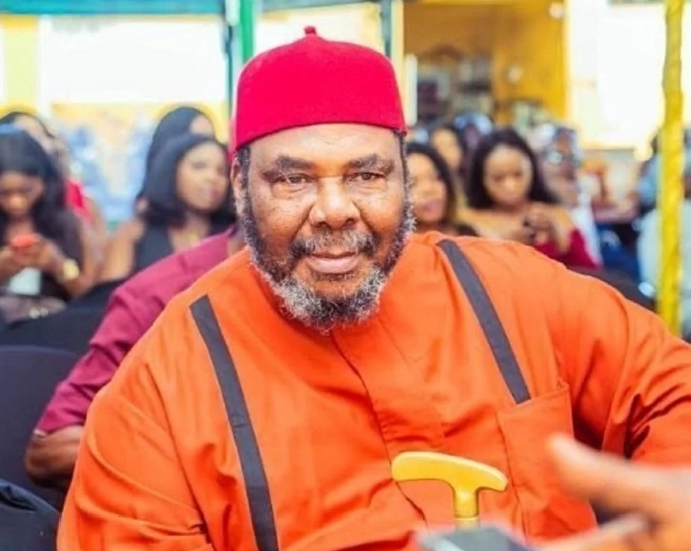
The handshake, frozen in digital replay, reminded the nation of how fragile its harmony can be — and how dignity sometimes requires silence, not defense.
Social Media, Modernity, and the Theatre of Respect
The Nigeria of 2023 is not the Nigeria of 1980 when Pete Edochie became Okonkwo in Things Fall Apart. The digital age has multiplied the audience but shrunk the patience for nuance. Where elders once debated under trees, the youth now argue in comment sections.
The online reaction to the handshake revealed this shift. Tweets declared wars of culture. Influencers turned heritage into hashtags. Opinion pages offered interpretations that said more about Nigeria’s anxieties than its anthropology. Respect, suddenly, became trending content.
Yet amid the noise, a subtler truth emerged: modern Nigeria is still searching for a language of coexistence. The handshake controversy was less about disrespect and more about discomfort — the unease of a society caught between protocol and progress.
Pete Edochie, long known for his refusal to conform to trends, unintentionally forced a generational conversation. Can tradition evolve without losing its soul? Can reverence coexist with equality? These questions linger long after the viral moment passed.
Edochie’s Legacy and the Language of Dignity
To understand Pete Edochie is to understand restraint. His public persona has always radiated gravity — a man who moves as if every gesture might one day be archived in memory. Over decades, he has embodied the archetype of the Nigerian patriarch: wise, fierce, and unbending.
His handshake that night was more than greeting; it was biography in motion. This was the same man who, decades earlier, had turned Achebe’s Okonkwo into living folklore. His understanding of masculinity, respect, and heritage was shaped by pre-colonial sensibilities — that dignity is not displayed; it is possessed.
In interviews, he has often emphasized that respect should not be performative. For him, cultural pride is an act of remembering one’s roots even in foreign spaces. That principle pulsed through his fingers when he met the Ooni. The gesture said: I acknowledge you, but I do not vanish before you.
Dignity, for Edochie, has always been the bridge between generations — an inheritance passed through quiet gestures rather than words.
A Nation Reading Itself Through a Handshake
The beauty of Nigeria’s diversity is also its burden. Every ethnic gesture carries both pride and potential misunderstanding. The handshake between Edochie and the Ooni became a national mirror — reflecting not what they did, but how the rest of us see one another.
For some, it exposed the persistence of ethnic defensiveness; for others, it demonstrated the possibility of grace in difference. The moment reminded the country that culture is not competition. It is dialogue — a conversation older than borders and newer than the next viral trend.

Historians will remember it not as scandal but symbolism: a moment when two giants of culture acknowledged each other with sincerity, and the public briefly mistook that sincerity for offense. The true story lies not in the handshake but in our reaction to it — a revelation of how unity feels fragile when we treat heritage as hierarchy.
Takeaway: What Tradition Teaches Us When We’re Not Listening
Long after the online debates faded, what remained was the image of two men — one crowned, one revered — meeting halfway. That still frame, stripped of captions, holds a lesson about maturity. Tradition, when properly understood, is not a wall but a language.
The handshake endures because it captures a question every generation must answer: how to honor difference without fear. The Ooni’s grace and Edochie’s poise turned a possible misunderstanding into a quiet teaching moment — one that scholars, filmmakers, and elders will continue to reference.
For Nigeria, it was more than gossip fodder; it was a parable of coexistence, a gentle reminder that culture need not compete to command respect. Each tradition has its throne. Each gesture, its own crown.
When Pete Edochie extended his hand and the Ooni received it, two histories met without bowing. Between them stood the invisible handshake of a nation still learning how to greet itself.
Discussion about this post