


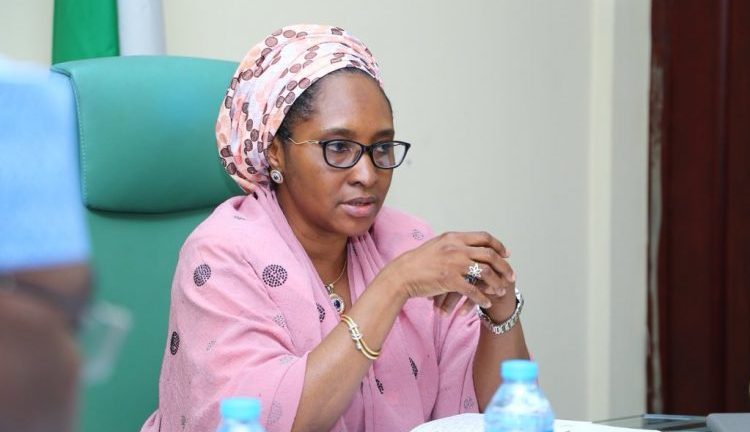

The Federal Government has made efforts to justify the overall deficit of N6.39 trillion appropriated in the 2022 budget, despite mounting criticisms, blaming it on lean revenue profile and the need to up infrastructural development in the country.
Minister of Finance, Budget, and National Planning, Mrs. Zainab Shamsuna Ahmed said the amount which represents 3.46 percent of the Gross Domestic Product (GDP) would be financed mainly by borrowings due to paucity of funds.
As documented in the budget, N2.57 trillion would be borrowed from domestic sources and another N2.57 trillion from foreign sources, while government hopes to draw down N1.16 trillion from Multi-lateral/bi-lateral loans and harvest N90.7 billion from privatisation proceeds.
This would invariably lead to an increase in the country’s debt stock, but Mrs. Ahmed said “the debt level of the Federal Government is still within sustainable limits. Borrowings are essentially for Capital Expenditure and Human Development, as specified in Section 41(1)a of the Fiscal Responsibility Act 2007”.
According to her, “having witnessed two economic recessions we have had to spend our way out of recession, which contributed significantly to the growth in the public debt; it is unlikely that our recovery from each of the two recessions would have been as fast without the sustained government expenditure funded partly by debt.
“To compound matters, the country has technically been at war, with the pervasive security challenges across the nation; this has necessitated massive expenditures on security equipment and operations, contributing to the fiscal deficit”.
Defence and Security sector is allocated N2.29 trillion in the 2022 budget representing 13.4 percent, but in the 2021 budget, it accounted for 22 percent. The amount is for the Military, Police, Intelligence, and Para-Military (Recurrent & Capital expenditure.
The Finance Minister pointed out that Nigeria’s Budget Deficit/GDP of -4.3 percent, as of November 2021, and Debt/GDP ratios of 30 percent as of September 2021 are the lowest among Africa’s leading economies.
She, however, admitted that Nigeria’s Debt Service/Revenue ratio of 76% percent as of November 2021 is the highest among the same African top economies, noting that “this is proof that what we have is not a classic debt sustainability problem, but a revenue challenge”.
Mrs. Ahmed added: “Tax rates and compliance ratios are significantly higher in these comparator countries. For instance, Nigeria’s VAT rate of 7.5 percent is the lowest in Africa, and less than 50 percent of the average rate.
The 2022 aggregate Federal Government of Nigeria (FGN) expenditure (inclusive of Government Owned Enterprises (GOEs) and project-tied Loans) is projected to be N17.13 trillion, which is 18 percent higher than the 2021 Budget.
Recurrent (non-debt) spending is estimated to amount to N6.91 trillion, which is 40 percent of total expenditure, and 20 percent higher than the 2021 Budget.
Aggregate Capital Expenditure of N5.96 trillion is 35 percent of total expenditure. This provision is inclusive of the capital component of Statutory Transfers, GOEs capital, and project-tied loans expenditures. At N3.61trillion, debt service is 21 percent of total expenditure, and 34 percent of total revenues.
Provision to retire maturing bonds to local contractors/suppliers of N270.71 billion is 1.6 percent of total expenditure, and Mrs. Ahmed said “this provision is in line with the FGN’s commitment to offset accumulated arrears of contractual obligations dating back over a decade”.
Discussion about this post