


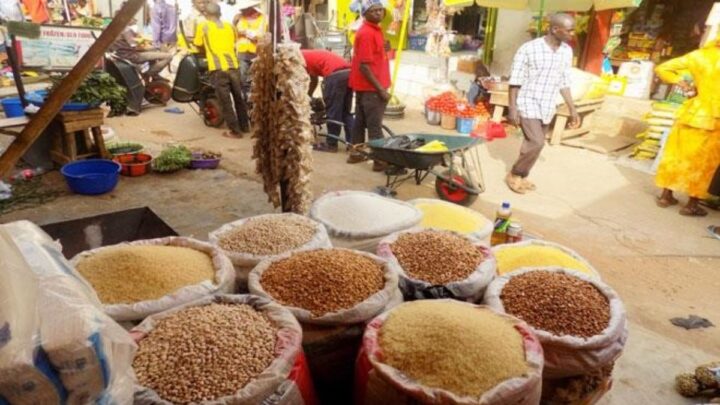

The Minister of Information, Alhaji Lai Mohammed has insisted that Nigeria has produced enough food to feed the citizens through the policies and programmes of the Buhari administration.
The minister however says the increasing prices of food currently being experienced in the country will come down as more food is produced.
The minister spoke in Abuja on Thursday at the presentation of the scorecard of the administration in the mining and solid mineral sector from 2015 to 2023.
Mohammed is unhappy that the achievement being made by the Buhari administration in the area of self sufficiency in most basic needs is not being drummed up but downplayed.
Mohammed said, “There is a part of this Administration’s scorecard that has been largely downplayed, and that is the area of self sufficiency in most basic needs. Yes, we are not fully there yet but this Administration has done well since assuming office. I am sure many of us have seen video clips of empty supermarket shelves in the Western World, especially in the wake of the COVID-19 pandemic, Russia-Ukraine war and the economic uncertainty which have all combined to disrupt global
supply chains.
“Long before these crises, however, President Muhammadu Buhari had, in a statement that has now turned out to be prescient, admonished Nigerians to grow what they eat and eat what they grow.
“Then, many neither understood the importance of that admonition nor appreciated its relevance. Well, it turned out that the consequence of that statement, which made Nigerians to look inward and relied less on imports, saved Nigerians from hunger, especially during the prolonged global lockdown, when exporting nations shut their ports and borders and nations that relied on imports were struggling to meet their needs.
“Imagine that Nigeria, during that period, had relied on imports to feed itself. In 2020, when the pandemic started, we were just 5 years into the Buhari administration’s food security programme. “But we had enough food to eat and enough fertilizer to farm, thanks also to the Presidential Fertilizer initiative.
Recall, distinguished ladies and gentlemen, that even before the pandemic, our borders were closed and food imports were largely banned.
“So if we can survive a pandemic with only 5 years of food security journey, just imagine what we can do in 10 years? This is just one of the many lasting legacies that Muhammadu Buhari, the President who saw tomorrow, will leave Nigeria with.
“Our farmers are now part of our economy. Companies and factories are coming up to manufacture, process and distribute food. If you visit our markets and supermarkets today, what you will see mostly are ‘made in Nigeria’ products. This is a huge progress in such a short time.
“May I remind you all that major contributors to our huge progress towards achieving food sufficiency include the increase in the number of fertilizer blending plants in the country from 10 in 2015 to 142 today, and the increase in the number of rice mills in the country from 10 in 2015 to 80 integrated rice mills today.
” To further highlight our progress in rice production, Nigeria was the number one export destination for rice in 2014, according to Thai authorities. However, by 2021, the same Thai authorities ranked Nigeria as number 79!
“I know that many cynics will say ‘yes, there is food but the prices are high’. My response will be that as we engage more in local food production and move closer to achieving food security, prices will begin to fall.
” For now, we must acknowledge the success we have achieved in the area of food production and in scaling up made in Nigeria products. This will be an indelible legacy of the PMB Administration!”.
Discussion about this post