


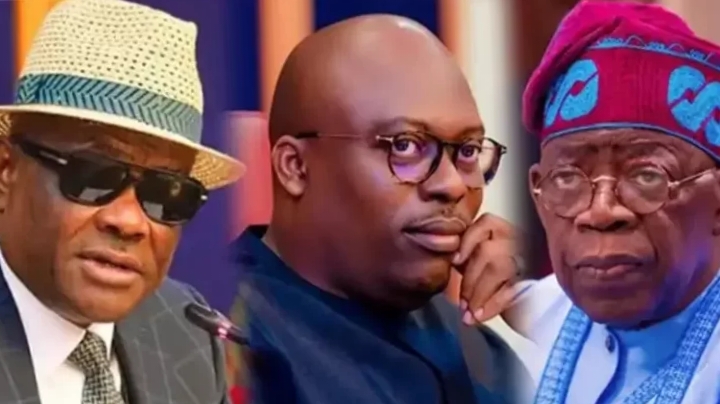

- This is a flagrant abuse of power dressed in the cloak of reconciliation and peace.
- The conditions of Fubara’s reinstatement not only amount to a subversion of the will of the Rivers people but also the gradual tearing down of our democracy, one brick at a time.
It is believed that the Greek philosopher Plato contrived the rule of law” paradigm. Whereas he, Plato, alluded to benevolent dictatorship as the best form of government, Aristotle triggered the debate, as to whether it was better for a king to rule by discretion or by the rule of Law. Both positions are debatable. The argument is that law is a system of rules independent of the ruler himself.
It therefore becomes a matter of deep thought or concern for a ruler who is not the author of the set rules to become discretionary or dictatorial when applying a rule or law. It needs to be reiterated here and now that ours is not a dictatorship, a monarchy or an absolute environment. Ours is a democracy, which does not in any way mean a bludgeoning of the people by a people, for a people. The elementary meaning of the word democracy has not been lost on Nigerians who still believe in it.
The system is anchored on absolute respect for what the law says, and never on the whims and impulses of the leadership, or rulership as the case may be. Above all else, the three arms of government – Executive, Legislative and judiciary are independent of one and the other. Their roles are clearly defined as well. The extant laws, or provisions of the Constitution, as amended, are not in any way cryptic or vague. Where there is confusion or ambiguity, the courts bear the burden of interpretation.
But just as the roles of the three arms of government are clearly spelt, the roles and responsibilities of the three tiers of government — the federal government, state government and the local government — are also defined so that one tier of government does not become all too powerful and start dominating others. However, the events of the past four months in Rivers state have raised concerns and questions around the true extent of a president’s power and how he should wield the power.
Recall that the president, in March, unilaterally suspended the state governor, Siminalayi Fubara, and the members of the state House of Assembly declared a state of emergency in the oil-rich state after months of political crisis occasioned by the power struggle between Fubara and his predecessor, Nyesom Wike. The president had claimed the declaration became imperative because the crisis had become a threat to the security and economic interests of the nation. Nigerians who were following the unfolding events in the state at the time knew nothing was happening in the state that warranted a state of emergency proclamation. The state of emergency declaration and the removal of the governor were all part of the Federal government’s plan to take over the state and control its political structure and resources ahead of the 2027 general elections.
After his removal as governor, Fubara went on a self-imposed political oblivion and was not seen in public for a while. But last week, a picture of him at the presidential Villa alongside the FCT minister and the president surfaced signalling a reconciliation and mending of broken fences. A report subsequently emerged that the president had brokered a peace accord between Fubara and Wike, and the bitter mutual animosity of the past has given way to a cordial and mutually beneficial relationship. But many cynics worry that there is more to the peace accord than the parties involved in it are willing to let the public know. And it did not take long before their doubts were confirmed.
Days after the purported rapprochement of the former adversaries, details of the peace deal emerged and they are as astounding as they are deeply troubling. According to TheCable, the peace deal was reached after Fubara agreed to Tinubu’s conditions for his reinstatement. The newspaper reports that Tinubu agreed to reinstate Fubara as the governor of Rivers State, but on the strict condition that he will not seek re-election at the end of his current tenure in 2027 and he will surrender the leader the control of the local government to Wike. Fubara will serve the remainder of his tenure but at a very steep cost. This is not a peace deal. This is a power grab and brazen desecration of democracy.
This is a flagrant abuse of power dressed in the cloak of reconciliation and peace. The conditions of Fubara’s reinstatement do not only amount to a subversion of the will of the Rivers people but the gradual tearing down of our democracy one brick at a time. The truth is that the crisis that led us to this point, where laws are brazenly violated and democratic ideals are trampled upon with glee, is avoidable and could have been extinguished in its early days before it became a conflagration if the president really wanted peace. But it is obvious from the very moment he stepped in that he was not interested in being an unbiased mediator but an umpire who wanted to exploit the crisis for his political gains.
Make no mistake about it, Tinubu’s intervention in the crisis and the eventual backroom “peace accord” between Wike and Fubara were not about restoring peace to Rivers State. It was about reasserting control, ensuring that Abuja maintains its grip on the state. Ensuring Wike’s shadow looms large over the state governance. The whole affair has further raised questions over Tinubu’s democratic credentials and whether his unchecked and inordinate ambition for power is not putting our nascent democracy on the precipice. For someone who constantly regales the nation with his involvement in the struggle for democratic rule, his actions when it comes to upholding the intrinsic elements of democracy and adhering to the constitution have left much to be desired. He can’t arrogate to himself the power to determine who can and cannot contest for a public office in a democracy without any tenable or plausible evidence for his action other than a troubling power play and political scheming that serves only his interest. A president can’t become a law unto himself in a democracy, and if he does, the consequences for everyone are dire.
Discussion about this post