


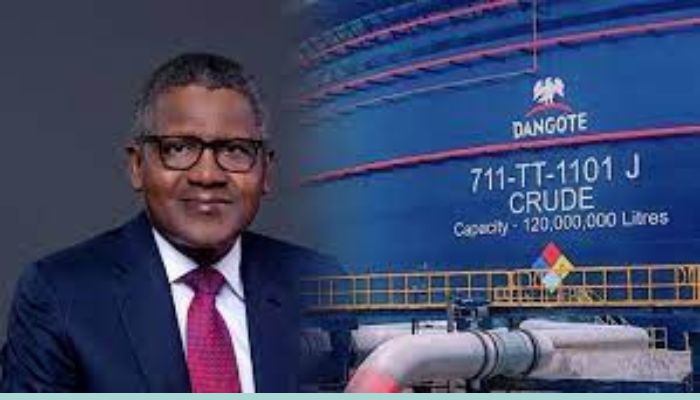

The Dangote refinery has again had to make an uncomfortable compromise to navigate another systemic and institutional hurdle to its economic viability and success. But what is certain is that this is not the end and we’re not going to hear the last of these mounting orchestrated impediments anytime soon
Our Nigeria is like an Indian rubber. A little causes it to swell, while a lot will not make it snap. This makeup makes Nigeria fascinating, and keeps the outside world on tenterhooks. Our palpable proclivity for absurdity leaves people in sober climes gasping for air.
A friend, who is non-Nigerian, has a cheeky and derisive catchphrase in capturing the abnormality, surreality and disconcerting peculiarity of our nation and its people — “only in Nigeria”. We chorus it almost in unison during animated rendezvous. It can only be heard in Nigeria that the largest oil producer does not have a working state-owned refinery to refine petroleum products for its people and local consumption. One will be hard pressed to think of any nation with enormous crude oil that exports its unrefined crude oil to other countries to be refined and then imports the refined crude oil into its country.
For years, many have wondered why Nigeria ditched its own refineries after letting them fall into disrepair, and why successive governments have not done much to revive these moribund refineries. The answer to this confounding reality is not far-fetched. The answer can be found in the midst of the motley crowd of carpetbaggers and rentseekers prowling Nigeria’s corridors of power and who place personal interests over public good. The answer is in the grand edifice of the petroleum ministry in Abuja. The answer is located in the monumental and imposing headquarters in Abuja. The answer is in the many fuel depots scattered across the country used by fuel importers. The answer is vested interests. It’s also worth mentioning that the heavy reliance on imported crude places a huge strain on our foreign exchange.
Seeing how troubling and somewhat hopeless the nation’s energy situation has become and the damaged the sharp practices of unscrupulous men in the nation’s upstream and downstream sector are doing to the Nigeria, Nigeria’s richest man, Aliko Dangote, embarked on an ambitious and historical project with the construction of a Refinery and Petrochemicals is a 650,000 barrels per day (BPD) integrated refinery located in the Lekki Free Zone in Lagos. The $20 billion Refinery, which is the biggest in Africa, was completed and commenced operation in 2023. It will meet 100% of the Nigerian requirement of all refined products and also have a surplus of each of these products for export.
However, since the refinery commenced operation in 2023, it has been plagued by a plethora of challenges, many of which are designed to frustrate its operations and make the multi-billion-dollar project unsustainable. Some of these challenges are posed by officials of government regulatory agencies. It will be recalled that Dangote filed a suit (registered as FHC/ABJ/CS/1324/2024) late last year. In the suit, he asked a court to declare the Nigerian Midstream and Downstream Petroleum Regulatory Authority’s continued issuance of petrol import permits to the NNPC and other marketers as unlawful and should be set aside. The company argued that the permits undermine the goal of domestic refining — in effect weakening the refinery’s viability and going against the government’s stated policy to end petrol imports once local refining capacity was attained.
In July, Dangote Petroleum Refinery and Petrochemicals suspended its sale of fuel at a discounted price after it found out that some of its affiliate marketers and strategic partners were involved in racketeering. The refinery stated that the marketers and partners who bought refined petroleum products from it at discounted and subsidised rates were diverting the fuel to unregistered third-party marketers. It said the discovery of the fraud necessitated the suspension of the fuel price reduction and discounted product scheme aimed at ensuring affordability and a steady supply of clean fuel across retail outlets.
Dangote is also spending more than half a billion dollars monthly to import crude oil from the United States because Nigeria does not have enough feedstock to supply its refinery. In recent days, the media has been awash with reports of the standoff between the Dangote refinery and some stakeholders in the oil & gas sector, marking the latest hurdles encountered in its drive to address the major challenges in the nation’s oil and gas sector.
To ensure the safety, feasibility and success of his refinery, Dangote decided to grab the bull by the horns and go for broke, as it was increasingly becoming clear that he was up against people who see his refinery as a threat to their interests. In June, the refinery announced its plan to start direct delivery of petroleum products to buyers. To achieve this, it disclosed that it had procured 4,000 compressed natural gas-powered trucks. Expectedly, this news drew the ire of bodies like The Nigeria Union of Petroleum and Natural Gas Workers (NUPENG), the Independent Petroleum Marketers Association of Nigeria (IPMAN), Western Zone, also suspended its strike action and the Nigerian Association of Road Transport Owners (NARTO).
These bodies had claimed that allowing Dangote refinery unfettered and unrestricted access into the downstream sector will have a devastating impact on the oil and gas sector, as businesses in the petroleum distribution value chain will be destroyed and thousands of people will lose their jobs. Last week, NUPENG announced that its members would embark on a nationwide strike from Monday, 8 September in protest against what it labelled “anti-union labour practices” connected to the deployment of newly imported Compressed Natural Gas (CNG) trucks by the Dangote Refinery, for direct distribution of petroleum products.
However, NUPENG shelved its proposed industrial action on Tuesday after it reached a compromise with the management of Dangote Refinery to recognise workers’ rights to unionise. The agreement was reached at a closed-door meeting convened by the State Security Service (SSS or DSS) and attended by the Minister of Finance, Wale Edun, and representatives of the Nigeria Labour Congress.
The Dangote refinery has again had to make an uncomfortable compromise to navigate another systemic and institutional hurdle to its economic viability and success. But what is certain is that this is not the end and we’re not going to hear the last of these mounting orchestrated impediments anytime soon. The refinery has what it takes to fend off these vested interests but doing so may hamper it somewhere else and delay whatever benefits Nigerians are supposed to derive from it. The refinery is too big to fail and one can only hope the people in government know this and act accordingly.
Discussion about this post