


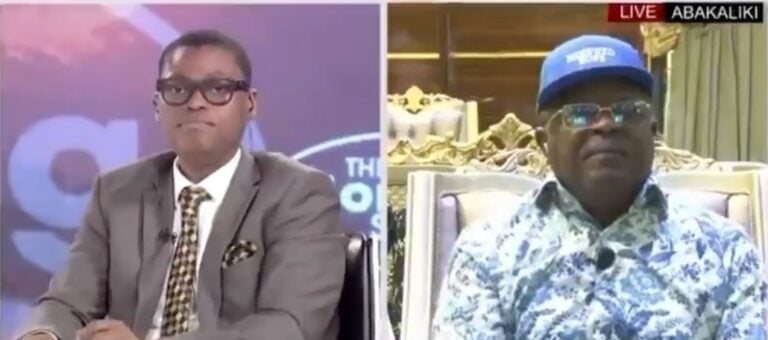

We can argue about the manner of questioning adopted by the journalist, but it will, however, be disingenuous and unfair to chastise or tongue-lash him for demanding that a public officer who serves at the pleasure of the people answer questions on the amount spent executing a public project.
The primary role of journalists is to probe, investigate and inquire. To ask pertinent, hard and tough questions that certain interests will prefer not to be asked. To investigate and expose corrupt and perverse elements in society. To shed light on the ills of their environment. These are the duties of a journalist. As simple and easy as the job seems on the surface it carries a lot of weight and impact. It shapes discourse and gives members of the public a sense of awareness. But what happens when a journalist’s sense of duty and service clashes with the ego of overbearing public officers?
On Tuesday, the Minister of Works, David Umahi, had a heated exchange with popular TV host Rufai Oseni during Arise TV’s flagship programme, the morning show. Matters came to a head after the minister took offence at the question Oseni asked him, leading to an altercation between the duo.
The anchor had demanded that the minister disclose the cost of the Lagos-Calabar road project per kilometre. The minister, however, refused to answer the question, saying the exact cost of the 750-kilometre highway cannot be given due to differences in topography and terrain of the locations that the road will pass through. Oseni also questioned the rationale behind the Umahi decision to comment on a particular case in court involving the demolition of properties to pave the way for the road project.
The minister was also livid after he (Oseni) accused him (Umahi) of reporting him (Oseni) to President Bola Tinubu over his views on the Lagos-Calabar Coastal Road. The minister had replied by saying, “You are too small for me to report to the President. Stop saying I reported you to the President, you’re too small,”
The on-air clash has got tongues wagging on social and divided opinions. While some, mainly the supporters of the current government, pitched their tent with the Umahi, berating him for the deemed insolence and imprudence towards the minister, others believe the Oseni did his job as a journalist, which is to ask questions that the minister finds uncomfortable.
From the onset, the Lagos-Calabar road project has been beset by controversy and scandal. The awarding of the project did not go through a proper bidding process. It was unilaterally awarded to Hitech construction company, a company owned by a friend of the president. This controversy created a fertile ground for doubts and misgivings about many aspects of the projects.
Additionally, when the first phase of the project was inaugurated in May this year with glitz and pomp, the government claimed that the commissioned phase was thirty kilometres; however, it was later discovered that the completed section of the commissioned section of the road was less than 15 kilometres.
We can argue about the manner of questioning adopted by the journalist, but it will, however, be disingenuous and unfair to chastise or tongue-lash him for demanding that a public officer who serves at the pleasure of the people answer questions on the amount spent executing a public project. The minister also did not say how much it costs on average to build a kilometre of the road.
The journalist is the eyes and ears of the people. They ask questions that the people would not ordinarily get the chance to ask those in power. They should be supported not vilified or aligned. The government also needs to be forthright and honest on matters of public interest, lest it betrays the trust of the people.
Discussion about this post