


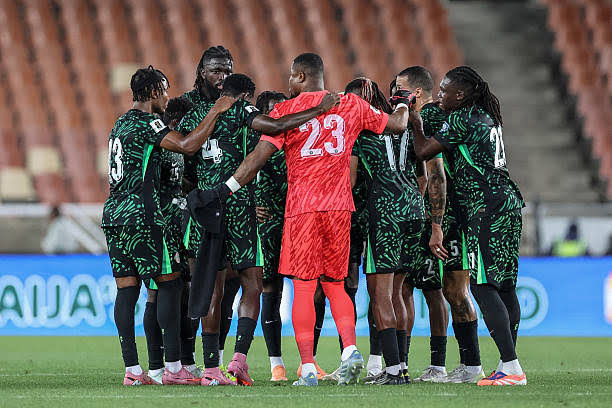

Last month, Nigeria booked a spot in the 2026 World Cup play-offs after what appeared to be an impossible task and a lost cause with all hope dashed. The Super Eagles put up a dominant and impressive performance to revive their dream of playing at next summer’s World Cup finals
A fourth goal in stoppage time from Brentford midfielder Frank Onyeka after Victor Osimhen’s brilliant hat-trick proved pivotal during the last match of the group stage played at as it helped Eric Chelle seal a spot as one of the four best runners-up in the African qualifying series, edging out Burkina Faso from Group A on goal difference after the two sides finished with the same points.
Those four best runners-up will now enter a play-off to determine who will be CAF’s only representative at the expanded inter-confederation World Cup play-offs in March 2026 in Mexico.
Alongside Nigeria, which was absent at the 2022 World Cup in Qatar, Gabon reached the play-offs as the best of the rest after finishing second behind the Ivory Coast in Group F, beating Burundi 2-0 at home in their final qualifier but seeing their rivals brush aside Kenya to take top spot. Nigeria’s playoff match against Gabon has been slated for November 13.
Ahead of a crucial match, which will take place in Morocco, the Confederation of African Football (CAF) has released key match regulations detailing procedural guidelines that will determine how the high-stakes encounter will be officiated.
As the two countries ramp up preparations for the winner-takes-all fixture, here are the major rules to note:
1. Extra Time if Scores Are Level After 90 Minutes
CAF disclosed that if the match ends in a draw after 90 minutes, it will proceed to extra time. The additional period will offer both sides another chance to secure a result before penalties come into play.
2. Penalty Shootout to Decide Final Outcome
If both teams are level after extra time, the winner of the tie will be determined via a penalty shootout. The shootout will ultimately decide which nation progresses.
3. Five Substitutions in Regulation Time
Teams will be allowed to make up to five substitutions during regular time. The provision gives coaches enough latitude and room to manage fatigue and shape the game.
4. Sixth Substitution in Extra Time
CAF added that teams will be allowed a sixth substitution during extra time. The rule is intended to help cope with the intensity of extended play.
5. VAR to Be Used
Video Assistant Referee (VAR) technology will be deployed for the playoff, assisting match officials in major decision-making involving goals, penalties, red cards, and cases of mistaken identity. The use of VAR is expected to foster fairness and accuracy
Discussion about this post