


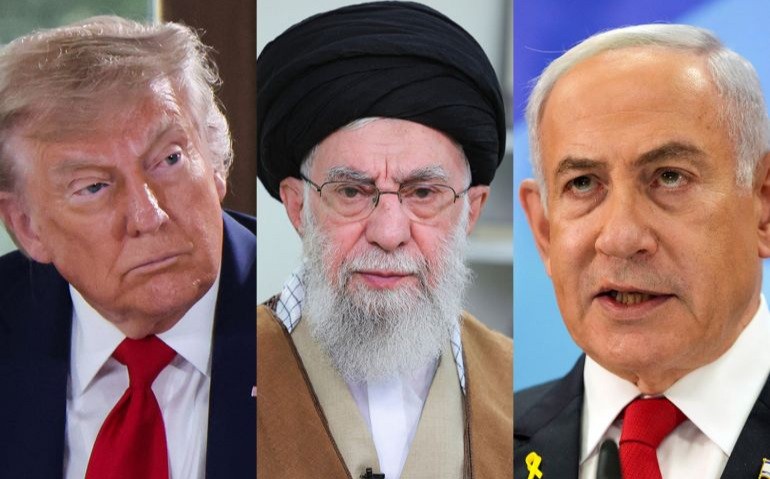

On Saturday, the United States and Israel launched attacks on the Islamic Republic of Iran. The attack on Iran, which Israel called ‘preemptive strikes’ came amid ongoing negotiations between Iran and the United States over the enrichment of uranium for nuclear weapon purposes.
The Supreme Leader of Iran, Ayatollah Ali Khamenei, was killed in the missile strikes which targeted his residence in Tehran. Reports of his death began circulating on social media on Saturday afternoon after the multiple airstrikes across Iran targeting top political and security officials as well as key military facilities and installations, especially those housing Iranian missile programmes. After initial uncertainty, doubts and confusion regarding the existential status of Khamenei, the news of his death was confirmed by Iranian state media in the early hours of Sunday.
The death of Khamenei brings to an end his 36-year rule over the ancient nation. Other top military officials and generals were reportedly killed in the missile strikes on Khamenei’s residence while they were reportedly gathered for a meeting with the martyred supreme leader. The Ayatollah’s daughter, son-in-law and grandson are also among those killed.
In a swift retaliation, which marked a dangerous escalation that could plunge the Middle East into a protracted war, the Iranians, after the unprovoked deadly attack by the US and Israel on Saturday, responded with missile attacks targeting US bases in the region and nations believed to be aiding the onslaught against Tehran. Missile and drone attacks have also been carried out against Israel hitting cities like Tel Aviv, Haifa and Ashkelon.
The troubling turn of events in the Middle East will no doubt have far-reaching impacts on the world economy. The Middle East is the world’s most important net exporter of oil and holds over half of the world’s proven reserves. The Middle East acts as the primary source of supply for a global market. While the global oil trade is diversified, the region is central to oil production and export and with the outbreak of hostilities between Iran and Israel which could morph into a full-blown regional conflict, oil prices are expected to rise in ways that will unsettle trade and shake economies of countries across the globe, including Nigeria.
Just like how previous geopolitical conflicts in the Middle East — the 1973 Arab-Israeli War, the 1979 Iranian Revolution and the Gulf War in early 90s — have brought bountiful harvest and joyous windfall to Nigeria, the latest hostility, if it continues for the foreseeable future, is expected to inject much-needed improved liquidity occasioned by imminent high earnings from oil sales due to prolonged conflict into the nation’s coffers. But soaring oil prices could be a double-edged sword for Nigeria and its much-tried populace.
Oil Prices: A windfall for the government
Crude Oil is the mainstay of Nigeria’s economy so much so that the performance of a government is to a great extent determined by how high or low oil prices are during its administration. The renewal of hostility in the Middle East conflict has already sent prices on an upward trajectory. Before the strikes, Brent crude, the global oil benchmark, closed at $72.87 per barrel on Friday. By Saturday, after the attacks, the oil price spiked by more than 3.66%, trading at $73 per barrel. With the Iranian announcing the closure of the Strait of Hormuz, through which roughly a fifth of the world’s oil passes, analysts say prices could soar in the coming days.
For the federal government, this is a heartwarming and splendid development. Nigeria’s 2026 budget was passed using a conservative oil price benchmark of $64.85 per barrel. With Brent now tracking above $73, every additional dollar translates into billions of extra naira in monthly revenue in Nigeria. The 2026 budget already carries a deficit of N23.85 trillion. A sustained oil price surge could help reduce the deficit significantly, fund abandoned and new capital projects, and ease pressure on the naira.
However, an increase in oil prices globally is one piece of the puzzle. To fully reap the benefits of imminent high oil prices other pieces of the jigsaw puzzle must align perfectly. First of all, Nigeria must ramp up oil production. The country has been unable to meet the oil production quota it sets. In 2025, the government set a targeted 2.06 million barrels per day but averaged closer to 1.6 million. The government’s inability to meet its oil production objectives is not unconnected to pipeline vandalism caused by oil theft, lack of adequate investment in the sector and the government’s own lack of political will to tackle head-on the existential problems mitigating against energy security. Higher oil prices help, but only to the extent that Nigeria can actually get the oil out of the ground and into the market.
Higher fuel prices may worsen economic hardship for ordinary Nigerians
While high oil prices may offer the government some fiscal reprieve, it may become a source of pain and distress for many Nigerians. Nigerians may find themselves paying for excess dollar inflow into the country’s treasury occasioned by high oil prices with a hike in pump prices of fuel which will worsen the harsh economic reality of a people who are already battling with inflation and high cost of living. Since President Bola Tinubu removed the petrol subsidy in May 2023 and deregulated the downstream sector, retail fuel in Nigeria is now priced in line with global crude prices which makes Nigerians vulnerable to the vagaries of market forces as the petrol subsidy which largely absorbs the shock and cushions the effect of disruption in oil prices has been removed.
Days before the conflict began, Nigerians had been enjoying some relief. Competition between the Dangote Petroleum Refinery and independent importers had forced petrol prices to as low as ₦815 per litre in some areas. That respite is now being threatened. If crude prices spike to $85, $90 or higher — an inevitable development should the conflict intensify— refining and import costs will rise, and those costs will be passed directly to the consumer.
Another hike in fuel prices will have a brutal and devastating effect on struggling Nigerians as inflation will skyrocket. It will have a ripple effect on the economy. Transport fares, food prices, and the cost of nearly every manufactured good are delicately but precariously tied to the price of fuel. Nigeria’s inflation had been declining steadily through 2025, though many have argued that this reduction does not reflect in the lives of ordinary Nigerians. A fresh fuel price shock could potentially erode those hard-won gains.
Aviation and Trade: Disruption hits travellers
The impact of the conflict is not limited to oil price fluctuations only. The aviation sector is already reeling from the eruption of hostility. Iran’s missile strikes targeting some Middle East countries have forced the UAE to close its airspace, Qatar Airways to suspend all flights, and Dubai’s and Bahrain airports to shut indefinitely. Nigerian passengers scheduled to travel with Emirates and Qatar Airways flights from Abuja and Lagos have been stranded following widespread cancellations and delays on Middle East routes. Prolonged disruptions would impede trade flows and hamper diaspora remittances.
The war puts Nigeria in a catch22 situation that must be navigated with economic deftness and social ingenuity. Higher oil prices offer fiscal respite to a government that desperately needs it. But in a completely deregulated fuel market, those same price dynamics could become a poisoned chalice for beleaguered Nigerians as they may be forced to now pay more for transport, food and other essential needs following an increase in oil prices.
Discussion about this post