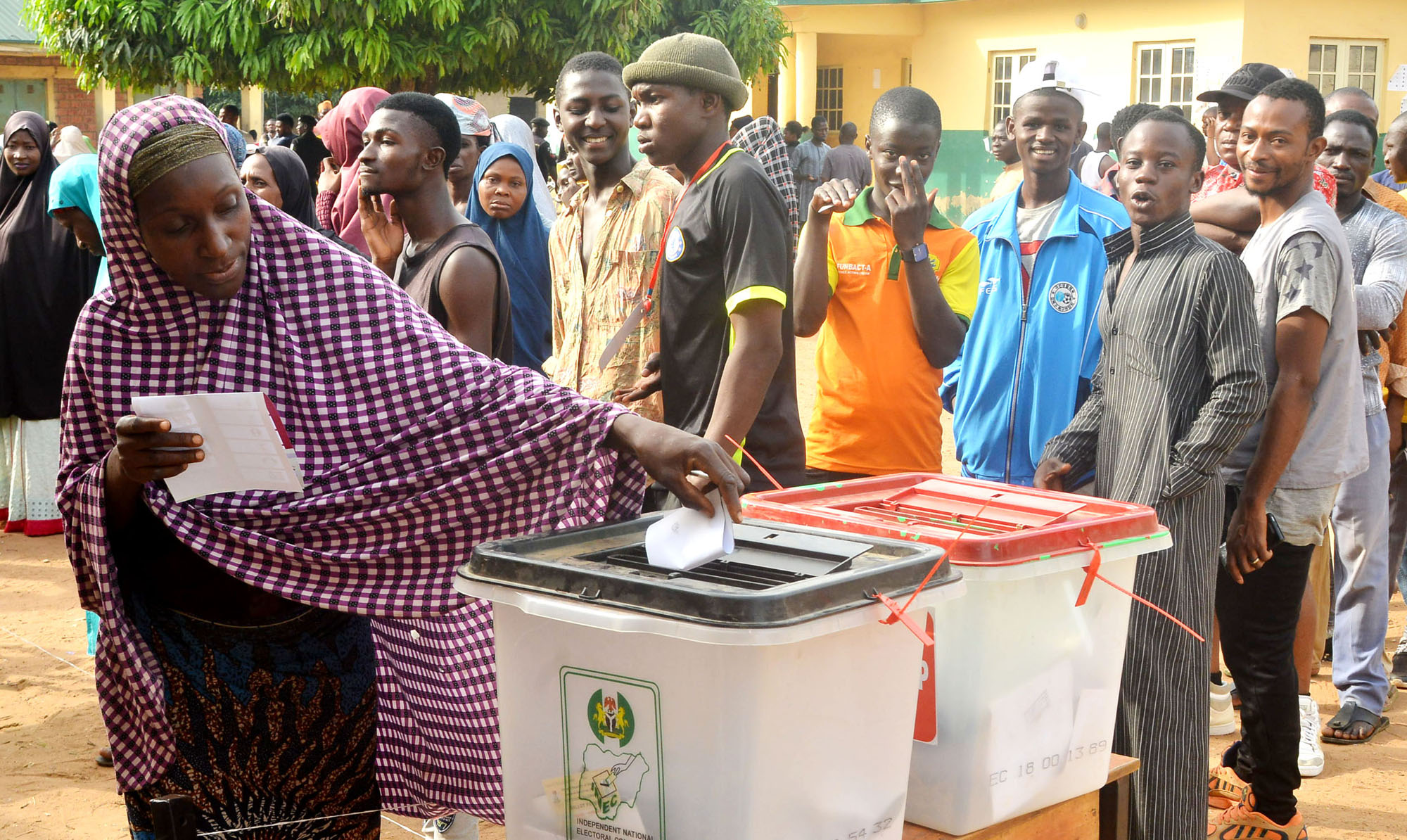
As one of the most decisive elections in Nigeria’s history approaches, a lot of states and non-state actors have taken center stage, showing their abilities to affect the Feb 25 election. The election is likely to be a major determiner and change a lot of templates on how the nation’s political structure has been built over time.
The Independent National Election Commission INEC has declared over 93.5 million Nigerians as eligible to participate in the exercise as voters.
INEC Chairman, Prof. Mahmood Yakubu noted that 12.29 million Nigerians completed their registrations as new voters in the just concluded Continuous Voter Registration CVR, Yakubu added that after a rigorous cleanup of the data using the Automated Biometric Identification System ABIS, over 2.78 million were identified and removed as ineligible registrants. According to the figures he provided, the total number of eligible voters rose by 9,464,924 or 11.3 percent from the 84,004,084 recorded in the 2019 general elections to 93,469,008 eligible voters in 2023.
Youths, a major factor
The INEC chairman, Prof. Mahmood Yakubu, disclosed that 37,060,399 or 39.65 percent of voters are between the ages of 18 and 34; while 33,413,591 or 35.75 percent are middle-aged persons between the ages of 35 and 49. The INEC chairman also said 17,700,270 or 18.94 percent of the total registered voters are elderly voters between the ages of 50 and 69.
Yakubu further revealed that students make up the largest category at 26,027,481 or 27.8 percent of all registered voters, in terms of occupational distribution.
With this, there is no gainsaying that the youths will play a major role in the outcome of the election. Although recent outcomes have revealed that the youths are divided on the choice of candidates, a collective decision to back up any candidate will increase the poll results. Their collective will and support will serve as a strong push with the capability of pushing such candidates to victory.
Insecurity
Non-state actors have taken the center stage as insecurity continues in some parts of the country. Just recently, the Independent National Electoral Commission (INEC) lamented the growing wave of election-related insecurity across the country, expressing fears that the trend if not checkmated, could lead to the cancellation or postponement of the forthcoming polls.
With kidnapping becoming a lucrative business for bandits, electorates in affected areas might not come out to exercise their civic rights. The spike in insecurity could hinder the declaration of election results and lead to a constitutional crisis. This is a major challenge and can affect the outcome of the coming election.
Money can change plans
Money is a major factor in every election in Nigeria, aside from the money spent during campaigns, vote buying and selling have been included in political party structure and action plans. We’ve seen how electorates dance to the tune of political parties as a result of a few amounts of Naira. Votes have been sold and elections marred because of this. The influence of money knows no bounds, especially as poverty is being weaponized against the citizens. Vote-buying will occur as there are no concrete steps taken to curb the menace. People will buy and sell their votes, and the election will serve as a marketplace where votes will be traded and the highest bidder wins.