Some names arrive in the public eye like fireworks, exploding across headlines and conversations, impossible to ignore. Obi Cubana’s name has always carried that weight, a presence that bends attention toward him whether in a nightclub, a gala, or a philanthropic gesture. Yet in the early days of 2026, a different kind of light was cast on the man who once commanded applause for energy, for showmanship, for the pulse of nightlife itself.
The world know him as a party impresario, a king of celebration, but now the traditions of centuries, the quiet authority of ancestral councils, had chosen to recognize him. It was a recognition that demanded more than spectacle. It demanded history, culture, and an understanding of a community’s soul.
The ceremony was held in Enugwu-Ukwu na Umunri, a town cradled by hills and stories older than any headline. Here, ancestral songs echo in the wind and the soil carries the footsteps of generations. To witness Obi Cubana step into this space was to see the collision of two worlds: the neon-lit glamour of modern fame and the muted, sacred authority of Igbo tradition. It was a moment that required pause, reflection, and reverence. It was the beginning of a chapter few could have predicted, yet one that seemed inevitable in retrospect. This was not a celebration of wealth alone, nor the applause of fans, but the affirmation of a people, their culture, and a life that had intersected with theirs in ways both visible and invisible.
The Ceremony in Enugwu-Ukwu
On January 3, 2026, the town of Enugwu-Ukwu na Umunri was alive with movement, draped in colors that spoke to history and identity. The streets buzzed with anticipation, not the artificial buzz of city lights, but the slow hum of communities gathering for something larger than themselves. Families arranged themselves in careful order, elders adjusted their robes, and children followed with curiosity, wondering why the man they had seen on screens would now kneel in a hall that smelled of incense and tradition.
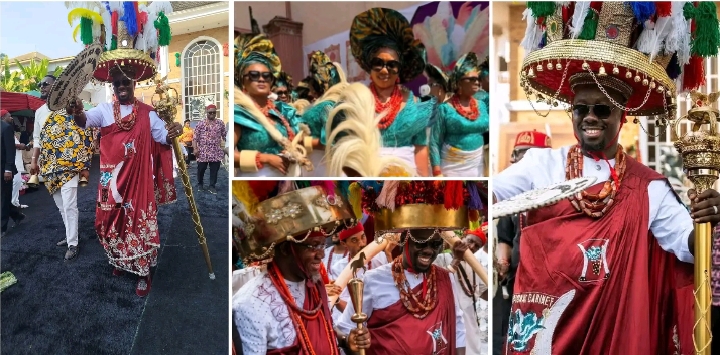
Obi Cubana arrived in attire unlike any he had ever worn publicly. Layers of fabric, embroidery, and beadwork transformed him into a figure both regal and approachable. Every step he took toward the Council of Chiefs was weighted with the expectation of ceremony, and yet there was ease in his movement, a familiarity with attention, a subtle confidence born from decades in the public eye. Cameras captured the event for social media, but the most important witnesses were the living memory of the community: the elders whose authority had spanned decades, the chiefs who carried ceremonial staffs like extensions of history, and the citizens whose lives were intertwined with the traditions being enacted.
The title itself, Ife-Igbo-Ji-Ka-Mba, was pronounced slowly and deliberately by His Royal Majesty Igwe Ralph Obumneme Ekpe. Each syllable echoed against the walls and over the courtyard, carrying the weight of meaning. It was more than a label. It was a responsibility, a covenant between the honoree and the people, between modern achievement and ancestral expectation. In that moment, applause mixed with ritual chants, photographs captured smiles, and Obi Cubana accepted the honour with a bow that seemed to carry both humility and acknowledgment of his journey.
A Community in Celebration
Enugwu-Ukwu na Umunri did not treat the conferral as a simple ceremony. Streets were alive with preparation, families gathering to witness a historic moment in the town’s timeline. Traditional drums, long symbols of announcement and rhythm, punctuated the air. Voices rose in song, telling stories of lineage, prosperity, and collective pride. In this environment, Obi Cubana’s presence became a lens through which the community reaffirmed its own values, traditions, and aspirations. The celebration was as much about him as it was about the people declaring the continuity of their heritage.
The ceremonial hall itself became a stage where generational memory and modern recognition met. Elders in traditional attire carried staffs of office, symbols of authority and wisdom. Their gestures, their chants, their careful attention to the protocol revealed centuries of accumulated knowledge. Every act, from the recitation of titles to the presentation of ceremonial beads, signaled a continuity that linked Obi Cubana’s accomplishments with a lineage of cultural leadership. The honour was tangible, visible in the very architecture, color, and movement of the event.
Outside the hall, community members watched and participated with fervor. Children peered from corners, elders nodded in approval, and young adults took photographs that would later circulate across the country. Social media captured fragments, but the lived experience was richer, filled with smells of traditional foods, the sound of coordinated chants, and the weight of history pressing softly against the modern world. In these moments, Obi Cubana became part of the collective memory, a figure whose story was now inseparable from the town’s.
The ceremony also carried broader implications. In a country where modern celebrity often eclipses local traditions, this event reaffirmed the importance of cultural authority and communal recognition. It demonstrated that true influence extends beyond media attention. For Obi Cubana, the day marked not only a personal milestone but a shared celebration, a bridging of worlds, and a testament to how heritage and modern achievement can coexist and amplify one another.
The Weight of Tradition
In Igbo culture, chieftaincy titles are not mere ornamental awards. They are markers of trust, of responsibility, and of contribution. The title Ife-Igbo-Ji-Ka-Mba carries with it centuries of expectation, demanding that the bearer serve as an exemplar, as someone whose actions reflect the community’s values. For Obi Cubana, whose life has been lived largely in the spotlight, this recognition signified a bridge between fame and cultural stewardship. To receive this title is to be entrusted with a symbolic authority, the kind that shapes narratives, inspires younger generations, and preserves the essence of heritage.
Understanding the title requires understanding the context of Enugwu-Ukwu na Umunri, a town steeped in history. The Council of Chiefs, the custodians of tradition, do not confer honours lightly. They consider the entirety of a life, the patterns of generosity, the influence on community development, and the embodiment of cultural ideals. In bestowing this honour on Obi Cubana, the council recognized not just a successful entrepreneur, but a man who has, in his own ways, amplified the Igbo narrative globally. It is a recognition that transcends material wealth, speaking to the essence of legacy, influence, and cultural respect.
The responsibility is palpable. Each appearance, each decision, each public gesture from this point forward carries with it the shadow of this title. Community members, peers, and even critics will watch, not merely as observers of celebrity, but as guardians of tradition. The honour transforms an individual’s public persona into a cultural emblem, and Obi Cubana’s journey is now inseparable from the collective narrative of the people who conferred it.
Public Reaction Across Nigeria
The news of Obi Cubana’s chieftaincy title spread rapidly across social media platforms, sparking conversations that blended admiration, curiosity, and analysis. Users shared videos of the ceremony, highlighting his colorful regalia, the grand cap, and the meticulous choreography of the event. Memes, commentary, and celebratory posts proliferated, signaling that while the title is rooted in Igbo culture, its resonance extended to a broader national audience. Fans and cultural commentators alike engaged in discussions about the symbolism, importance, and implications of the honour.
Many Nigerians saw the conferment as emblematic of a larger societal shift. Where fame and wealth often eclipse cultural recognition, Obi Cubana’s recognition reminded the public that traditional systems still wield authority and influence. People debated the meaning of Ife-Igbo-Ji-Ka-Mba, explored its historical context, and considered how such titles serve to legitimize achievements beyond financial success. In these conversations, social media acted as a bridge, translating local traditions into a form accessible to audiences who may never attend a ceremonial hall.
Critics, too, contributed to the discourse, questioning the intersection of celebrity and cultural honour. Was the recognition a reflection of true community impact, or a convergence of media visibility and influence? The responses varied, but the discussion itself reaffirmed the relevance of chieftaincy titles in contemporary Nigeria. It highlighted the tensions between public perception and traditional authority, forcing observers to reconcile the two in meaningful ways. Obi Cubana’s role became a case study in navigating these dualities, serving as a focal point for debates on modern fame and cultural legitimacy.
Historical Context of Anambra Chieftaincy Titles
To fully appreciate the significance of Ife-Igbo-Ji-Ka-Mba, one must trace the roots of chieftaincy in Anambra. These titles have existed for centuries, carrying weight that transcends the ceremonial. They serve as mechanisms to recognize leadership, wisdom, valor, and service to the community. The process of conferring a title is deliberate, often requiring extensive consultation among elders, assessment of personal and communal contributions, and alignment with values that have guided societies long before colonial or modern interventions.
Anambra titles are particularly notable for their attention to both social impact and cultural integrity. Chiefs and titled individuals act as custodians of history, memory, and social order. Their authority does not derive from wealth alone but from demonstrated commitment to the betterment of the people, as well as adherence to cultural norms and values. The conferment process is rigorous, involving formal announcements, rituals, and symbolic gestures that convey both recognition and responsibility.
Over time, the meaning of chieftaincy titles has evolved, integrating contemporary achievements without losing the essence of tradition. Figures such as Obi Cubana exemplify this evolution. While his wealth and celebrity are unmistakable, his recognition also emphasizes character, philanthropic engagement, and representation of the Igbo ethos on a national and global scale. The conferment thus becomes a testament to the capacity of Anambra communities to honor modern accomplishments while maintaining the integrity of ancestral frameworks.
This historical lens situates Obi Cubana’s honour as more than a singular event. It is part of a continuum that stretches across generations, connecting the modern entrepreneurial spirit with the age-old mechanisms of governance, social cohesion, and cultural affirmation. It illustrates the adaptability of tradition and its ability to integrate individuals whose influence is global yet whose roots remain profoundly local.
Concluding Meditation on Obi Cubana’s Evolving Identity and Societal Impact
Obi Cubana’s journey from nightlife entrepreneur to chieftaincy honoree highlights the balance between personal success and community responsibility. The title Ife-Igbo-Ji-Ka-Mba recognizes not just his achievements in business and entertainment but also the ways he has contributed to society and upheld cultural values. It marks a shift in his public identity, from visibility and spectacle to honor and stewardship.
The impact of this recognition reaches beyond Obi Cubana himself. It offers a model for young entrepreneurs and public figures, showing that success can be meaningful when paired with social contribution. For the community, it reaffirms the relevance of traditional institutions in contemporary life, demonstrating how heritage and modern achievement can coexist and complement each other.
The honour emphasizes that influence is measured not only by wealth or fame but by positive societal impact and respect for cultural values. Obi Cubana’s evolving identity reflects a broader lesson about leadership, responsibility, and legacy, showing that recognition is both a reward for past actions and an invitation to continue contributing meaningfully to the community.