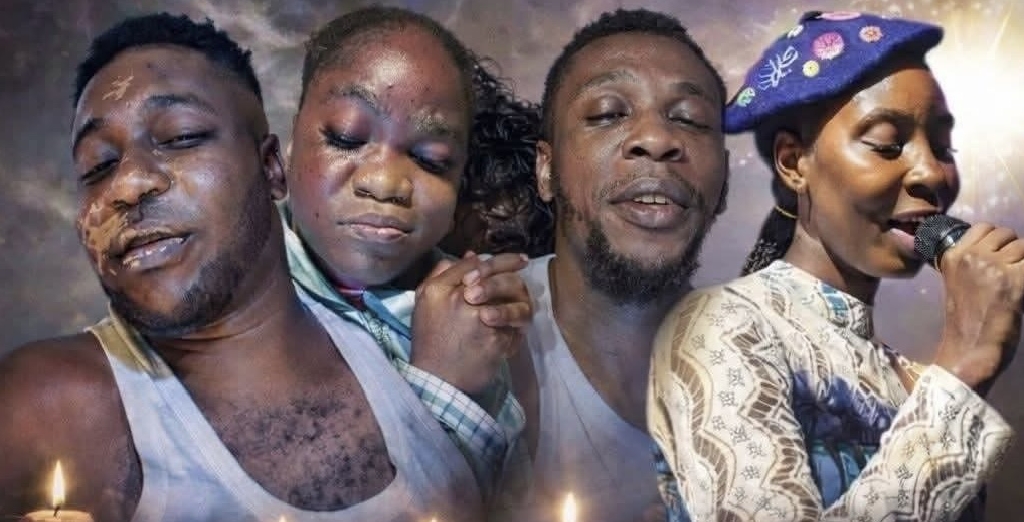


There are funerals that close stories and there are funerals that tear them open. On a humid Lagos afternoon at Atan Cemetery, a burial meant to lower a gospel singer into the earth instead lifted years of buried questions into public view. Mourners came prepared for hymns and tears, not for a moment that would ripple far beyond the graveside.
What unfolded lasted only minutes, yet it carried the weight of years, silence, absence, and unresolved ties between a son and a father who was not there. Before anyone could frame it as drama, it had already become something deeper, a collision between grief and memory, between who was present and who had been missing for far too long.
A Burial Ground Heavy With Expectation
On Thursday, 29th Of January 2026, Omije Ojumi was laid to rest began like many others at Atan Cemetery, orderly, solemn, restrained. The singer’s life had been defined by voice and faith, and those gathered expected a farewell shaped by worship and quiet dignity. Family members stood close, friends hovered in respectful circles, and colleagues from the gospel music community whispered prayers and condolences.
There was already an unspoken awareness that this funeral carried more emotional weight than most. Those closest to the family knew that the home the singer left behind had been shaped by strain. Her children had walked through illness with her, shared hospital rooms, financial uncertainty, and long nights without reassurance from a father figure. Even so, no one expected the burial itself to become the place where those tensions surfaced.
Funerals are supposed to compress time, drawing the past, the present, and the future into one narrow corridor of ritual. At Atan Cemetery, that compression became unbearable. What should have been a moment of final closure turned instead into a pause where unresolved history demanded attention.
By the time the coffin was lowered, emotions were already stretched thin. Grief had sharpened everything, every word carried extra weight, every gesture felt loaded with meaning.
The Absence That Spoke Loudest
Omije Ojumi’s estranged husband was not physically present at the burial. Reports indicated he lived abroad and had been largely absent from the family’s daily life for years. His absence was not new, but funerals have a way of magnifying what is missing.
Rather than appearing in person, the father attempted to reach his children through a video call during the burial proceedings. In many settings, this might have been received as a gesture of concern or regret, but at this graveside, it landed differently. To the son standing meters away from his mother’s coffin, the call did not feel like connection, it felt like intrusion.
A relative of the estranged husband acted as an intermediary, trying to speak on the father’s behalf, offering reassurance and framing the absent man as still part of the family. The intention may have been reconciliation, but the timing was catastrophic.
Grief does not negotiate politely. When loss is fresh, the mind does not accept symbolic gestures as substitutes for years of physical presence. What might have been tolerable in a living room or private conversation became unbearable beside an open grave.
The Moment Words Replaced Silence
When the relative spoke, urging the son to accept the father’s place in the family, the atmosphere changed instantly. The son’s response was not measured or diplomatic, it was raw, loud, and unmistakably emotional.
His rejection was not framed as argument but as refusal. He denied the framing of family being offered to him. In that moment, he was not speaking as a child performing grief, he was speaking as someone who felt that history was being rewritten too late.
Other mourners froze. Some looked away, others stepped closer, unsure whether to intervene or give space. The burial paused, not formally but emotionally, and the ritual could not proceed as if nothing had happened.
Family members moved in quickly to calm the situation. Hands were placed on shoulders, quiet words replaced raised voices. The exchange did not escalate into physical confrontation, but the damage had already been done, the grief had changed shape.
Why the Son’s Reaction Shocked and Resonated
To outside observers, especially those encountering the scene through short online videos, the son’s reaction appeared abrupt. But to those aware of the family history, it was a release long delayed.
Reports suggested that the father had been largely absent during the children’s upbringing. During Omije Ojumi’s illness, when care demands were highest, the absence reportedly deepened. The children were raised primarily by their mother, who balanced her health struggles with parenting and career demands.
At the service of songs held earlier in the funeral sequence, the singer’s daughter reportedly spoke openly about this reality. Her words framed their mother not just as a performer but as a single pillar holding the family together, and that context matters. The burial did not create the conflict, it merely exposed it.
For many watching online, the son’s reaction resonated because it mirrored unspoken experiences in other families. Absent parents are a common story, funerals rarely give room to discuss them honestly, this one did.
Sequence of Events at the Graveside
The confrontation did not erupt without warning. It followed a clear sequence that unfolded rapidly:
- First came the attempt at digital contact from the absent father, introducing a presence without physical accountability.
- Next came the intermediary, a relative who framed the father’s intentions positively and encouraged acceptance.
- Then came the son’s response, immediate and emotional, rejecting both the message and the messenger.
- Finally came intervention from other family members, who prioritized restoring calm so the burial could continue.
Each step built upon the previous one. None existed in isolation, the tension escalated because each action touched a nerve already exposed by grief.
Why the Funeral Became the Flashpoint
Funerals are uniquely volatile spaces. They demand emotional honesty while enforcing social restraint, and when those demands clash, something gives.
For the son, the funeral represented the final chapter of a story in which he felt the father had not participated. To introduce the father symbolically at that moment felt, to him, like an attempt to claim presence without responsibility.
For the father’s side, the funeral may have felt like the last opportunity to reconnect, to assert familial bonds before it was too late. These motivations collided at the worst possible moment.
Neither side chose the burial as a battlefield, yet grief made compromise impossible. The cemetery became the place where private resentment met public ritual.
How Social Media Changed the Meaning of the Moment
Within hours, videos from the graveside circulated online. Clips were short, context was limited, and reactions multiplied quickly. What was a deeply personal family confrontation became a national talking point.
Social media flattened nuance. Some viewers framed the moment as disrespectful, others saw it as justified anger, many projected their own family histories onto the scene.
The family, for their part, attempted to control the narrative. Some figures urged the public to respect the singer’s memory and avoid sensationalism, others clarified that the burial issues were not connected to financial disputes or fundraising controversies.
Once shared, however, the moment could not be contained. It had become a mirror for broader conversations about fatherhood, absence, and accountability.
The Language of Grief and Refusal
One reason the moment lingered in public consciousness was the clarity of the son’s refusal. He did not hedge his words or soften his stance for the sake of appearances.
Grief stripped away diplomacy. What remained was a direct expression of how absence had been experienced, not explained away.
In many cultures, funerals discourage confrontation. Respect for the dead often extends into silence about the living. This son broke that pattern, not to provoke but to reject a narrative that felt false to him.
The discomfort this caused was part of its power. It challenged the assumption that reconciliation must always be performed publicly, even when it has not been lived privately.
Why This Moment Felt Unavoidable
Looking back, the conditions for confrontation were present long before the burial day. Years of absence, illness navigated without visible spousal support, children growing into adults with unanswered questions.
The funeral simply removed the buffers. Grief lowered defenses, ritual heightened emotion, and an attempt at reconciliation arrived without preparation.
In that sense, the moment did not disrupt the funeral, it revealed what the funeral could not contain.
Cultural Expectations and Emotional Reality
In many Nigerian families, respect for parents is treated as absolute, regardless of circumstance. Public rejection of a father figure challenges deeply held norms.
This tension explains part of the public reaction. Some viewers were less concerned with the son’s pain than with the perceived violation of cultural hierarchy.
Others argued that respect cannot be detached from responsibility, that presence matters more than titles.
The graveside confrontation forced these debates into the open, without offering easy answers.
The Role of the Relative as Messenger
The relative who spoke on the father’s behalf occupied a difficult position. Acting as intermediary often carries risk, the messenger absorbs the anger meant for the absent party.
In this case, the relative’s words were likely intended to soothe, instead they intensified the son’s sense of being misunderstood.
This highlights a key lesson. Reconciliation cannot be delegated, especially at moments of extreme vulnerability, proxy communication often fails where direct accountability is required.
How Grief Distorts Time
At funerals, years collapse into seconds. A sentence spoken carries the weight of decades. The son’s reaction was not just to what was said at the graveside, it was to everything that had not been said across years.
This distortion explains why emotions escalated quickly. There was no gradual build, grief accelerates expression.
Observers who judged the moment without this understanding missed its deeper logic.
Why the Moment Will Linger
Even after the burial concluded, the confrontation continued to echo. Online discussions persisted. Commentators revisited the clip repeatedly.
The reason is simple. The moment touched something unresolved in many households. It asked uncomfortable questions.
What does reconciliation require? Can it be claimed without participation? Is presence optional in parenthood?
These questions outlived the funeral. They continue to circulate because they remain unanswered.
Leaving With This
The son and father moment at Omije Ojumi’s funeral was not an interruption of mourning. It was mourning taking an unexpected form, a public expression of private history, a refusal to compress years of absence into a symbolic gesture.
The burial went on, the singer was laid to rest, hymns resumed, yet something else had been laid bare.
In the end, the moment mattered not because it was dramatic, but because it was honest. It reminded everyone watching that grief does not erase history, it illuminates it.