
Football rivalries often grow slowly through years of competition, pride, and community identity. In the Brazilian city of Belo Horizonte, the rivalry between Cruzeiro Esporte Clube and Clube Atlético Mineiro developed into one of the fiercest derbies in South American sport. Their encounters are known as the Clássico Mineiro, a name that represents far more than 90 minutes of football because it captures a century of emotion, social identity, and relentless competition for supremacy in the state of Minas Gerais. For generations of supporters, this fixture has been a battle for pride in the streets, workplaces, and homes of Belo Horizonte where families themselves are sometimes divided between the 2 sides.
The rivalry exploded back into global headlines on 9 March 2026 during the final of the Campeonato Mineiro when chaos broke out in stoppage time and the referee issued an astonishing 23 red cards. The match instantly spread across international media because disciplinary scenes of that magnitude are rare in professional football. Yet for anyone familiar with the long and volatile history between Cruzeiro and Atlético Mineiro, the explosion of tempers felt like the latest chapter in a story that has been unfolding for more than 100 years. To understand why emotions reached such an extraordinary boiling point in 2026, it is necessary to trace the origins of the derby and the many dramatic moments that have shaped it since the early 20th century.
The story of this rivalry is deeply connected to the growth of Belo Horizonte itself. Founded in the late 19th century as a planned city intended to replace the historic capital of Ouro Preto, Belo Horizonte developed rapidly as a modern urban center. As the population expanded during the early decades of the 20th century, football emerged as one of the most powerful cultural forces uniting and dividing communities. It was within this environment that Atlético Mineiro and Cruzeiro grew into symbols of identity, pride, and rivalry whose clashes would eventually become among the most passionate in Brazilian football.
The Founding of Atlético Mineiro and the Birth of Local Football Culture
The first of the 2 clubs, Clube Atlético Mineiro, was founded on 25 March 1908 by a group of students and young professionals in Belo Horizonte who were inspired by the rapidly spreading sport of football across Brazil. During those early years, the game was still associated with social elites and educated circles, particularly in urban centers. Atlético Mineiro quickly established itself as one of the city’s earliest football institutions and became known for its ambitious players and organized administration.
In the first decade of its existence the club dominated local competitions and helped establish football culture throughout Minas Gerais. The team’s black and white colors soon became widely recognized and its supporters developed a strong sense of identity that connected football success with civic pride. Atlético’s early dominance meant that by the time another major club emerged in the city, the foundations for a rivalry were already waiting to be ignited.
During this formative era, football matches were often social events that brought large crowds together in open fields and early stadiums. Newspapers of the time reported on Atlético’s victories with enthusiasm, and the club gradually built a reputation as a powerhouse of the regional game. This early advantage would shape how Atlético supporters viewed themselves in relation to their future rivals because they saw their club as the original giant of Belo Horizonte football.
The Arrival of Cruzeiro and the Spark of Rivalry
The club that would become Atlético’s eternal adversary was founded on 2 January 1921 under a different name. Italian immigrants living in Belo Horizonte created a football team called Palestra Itália, a club that reflected the identity and aspirations of the city’s growing immigrant community. This organization would later evolve into Cruzeiro Esporte Clube, but in its early years the connection with Italian culture was central to its identity.
From the beginning the emergence of Palestra Itália altered the balance of football power in Belo Horizonte. Unlike Atlético Mineiro, which had roots among established Brazilian elites, the new club represented immigrant families who had arrived seeking opportunity and belonging. Football became a platform through which those communities could express pride and unity while competing with established local institutions.
The first encounters between the clubs during the early 1920s quickly grew intense because both teams attracted large and passionate followings. Matches were not simply athletic contests but social events charged with emotion. Supporters filled the stands carrying the colors and symbols of their communities while newspapers eagerly reported every controversial moment. What began as competition soon transformed into a rivalry defined by identity, pride, and the constant pursuit of superiority.
The Humiliation of 1927 and the Birth of Derby Mythology
Among the earliest matches that cemented the ferocity of the Clássico Mineiro, one stands above all others in the collective memory of supporters. On 27 November 1927, Atlético Mineiro defeated Palestra Itália by the astonishing score of 9 goals to 2. The result remains the largest margin of victory in the history of the derby and continues to be referenced nearly a century later whenever the rivalry is discussed.
For Atlético supporters the match became a symbol of early dominance and proof of the club’s historic superiority. Newspapers from the era described the match as an overwhelming display of attacking football in which Atlético’s players controlled every aspect of the contest. The victory was celebrated across Belo Horizonte and strengthened the club’s growing reputation within Brazilian football.
For the supporters of Palestra Itália the defeat carried a different meaning. It became a painful memory that fueled determination to challenge Atlético’s dominance in future years. Rivalries often grow through shared moments of humiliation and redemption, and the 9 to 2 defeat became one of the earliest chapters in a narrative that would drive Cruzeiro supporters to demand greater success from their club.
Transformation During the Mid Twentieth Century
During the 1940s a major transformation reshaped the identity of Palestra Itália. As Brazil entered the period surrounding the Second World War, political tensions led the government to restrict the use of foreign names by local institutions. In response, the club changed its name to Cruzeiro Esporte Clube in October 1942, adopting the constellation of the Southern Cross as its emblem and creating a new identity rooted in Brazilian symbolism.
The change of name did not weaken the rivalry with Atlético Mineiro. Instead it marked the beginning of a new phase in which Cruzeiro began to establish itself as a serious competitor within Minas Gerais football. Throughout the 1940s and 1950s the club invested in youth development and infrastructure while gradually closing the gap that had once separated it from Atlético.
Matches between the 2 sides during this era were fiercely contested and frequently drew large crowds eager to witness the struggle for local dominance. The Clássico Mineiro was no longer simply a contest between an established power and an ambitious newcomer. It had evolved into a true rivalry in which either side could claim victory on any given day.
The Arrival of the Mineirão and the Explosion of Football Culture
One of the most transformative moments in the history of the rivalry arrived with the construction of the great stadium that would host countless unforgettable clashes between the 2 clubs. On 5 September 1965 the city inaugurated the Estádio Mineirão, a massive arena capable of hosting more than 100000 spectators during its early years.
The creation of the Mineirão changed the scale of football in Belo Horizonte. Matches that once attracted modest crowds now became enormous spectacles filled with noise, color, and emotion. When Cruzeiro and Atlético Mineiro met inside the new stadium, the atmosphere could feel overwhelming even for experienced players. Supporters from both sides filled the stands waving flags and singing songs that echoed throughout the structure.
The new arena also coincided with a period of rising success for Cruzeiro. The club assembled one of the most talented squads in its history during the 1960s, featuring legendary Brazilian forward Tostão. With skillful players and ambitious leadership, Cruzeiro began winning major titles and challenging Atlético’s long established reputation.
The Golden Era of Cruzeiro in the 1960s
The 1960s marked a turning point in the balance of power within the Clássico Mineiro. Cruzeiro’s talented squad captivated supporters with dynamic attacking football that brought the club national recognition. Their success reached a historic peak in 1966 when Cruzeiro defeated the powerful Santos FC team led by Pelé to win the Brazilian national championship.
Victories of that magnitude transformed Cruzeiro from a regional contender into one of the leading clubs in Brazil. Each triumph strengthened the confidence of its supporters and intensified the rivalry with Atlético Mineiro. Matches between the 2 teams during this era frequently filled the Mineirão with crowds exceeding 100000 spectators, turning the stadium into a cauldron of passion and tension.
Atlético supporters watched with frustration as their rivals gained momentum and recognition on the national stage. For them the rise of Cruzeiro represented a challenge to their historic dominance. The rivalry was no longer defined by past victories but by the immediate struggle to determine which club would represent the pride of Minas Gerais.
Cycles of Power in the Late Twentieth Century
The decades that followed were marked by shifting fortunes between the 2 clubs. During the 1980s Atlético Mineiro experienced a resurgence that restored its confidence and competitiveness. The team assembled strong squads capable of challenging for regional and national titles, reminding supporters that the club remained a formidable force in Brazilian football.
Cruzeiro responded during the 1990s and early 2000s with another powerful period of success. The club captured multiple major trophies including the Copa do Brasil and international competitions that expanded its reputation beyond Brazil. Each victory deepened the rivalry because supporters viewed success not only as personal triumph but also as proof that their club stood above its eternal adversary.
Throughout these decades the Clássico Mineiro maintained its reputation as one of the most unpredictable fixtures in Brazilian sport. Players understood that the derby carried emotional weight far beyond the standings of any particular season. Even when one club appeared stronger on paper, the intensity of the rivalry often produced surprising results that kept supporters enthralled.
The Historic National Final of 2014
A new milestone in the rivalry arrived during the 2014 edition of the Copa do Brasil when Cruzeiro and Atlético Mineiro faced each other in the final of a national tournament for the first time. The 2 legs of the final were played in Belo Horizonte, turning the city into the epicenter of Brazilian football during those dramatic weeks.
Atlético Mineiro emerged victorious over the 2 matches and lifted the trophy in front of jubilant supporters. For Atlético fans the triumph represented one of the most satisfying moments in the history of the rivalry because it occurred on a national stage where the entire country could witness their success. For Cruzeiro supporters the defeat was painful but it reinforced the emotional stakes that define the Clássico Mineiro.
The final demonstrated how deeply the rivalry had penetrated Brazilian sporting culture. Television audiences across the country watched as 2 clubs from the same city fought for national glory, a reminder that football in Brazil often thrives on the intensity of regional identities.
The Turbulent Years Leading to the 2026 Final
The decade leading to the 2026 championship produced contrasting fortunes for the 2 clubs. Atlético Mineiro experienced renewed success and captured several state titles during the early 2020s. Their squad included internationally recognized players such as Hulk whose powerful performances energized supporters.
Cruzeiro, meanwhile, endured financial and sporting challenges that led to relegation from the top tier of Brazilian football in 2019. The period tested the loyalty and patience of its supporters who continued to fill the stands despite uncertain results. By the time Cruzeiro returned to competitive strength, the hunger for redemption had become a powerful motivation within the club.
When the 2 teams advanced to the final of the 2026 Campeonato Mineiro, anticipation across Belo Horizonte was enormous. Supporters from both sides understood that the match carried enormous symbolic meaning because it represented not only a championship but also the continuation of a century long struggle for supremacy.
The Match of 9 March 2026 and the Explosion of Chaos
The final on 9 March 2026 unfolded as a tense and fiercely contested battle inside the Mineirão. Cruzeiro held a narrow 1 goal lead late in the match after striker Kaio Jorge scored the decisive goal. As the clock moved into stoppage time, frustration among Atlético players began to rise because their hopes of extending a run of state titles were slipping away.
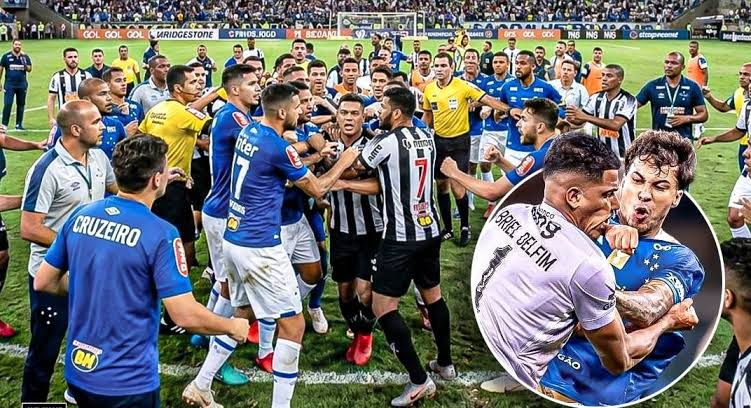
In the dying moments of the match a confrontation erupted between Atlético goalkeeper Everson and Cruzeiro midfielder Christian. Words were exchanged and tempers ignited as players from both teams rushed toward the scene. What began as a heated argument quickly escalated into a mass confrontation involving players, substitutes, and members of the coaching staff.
Security officials and police officers moved onto the field in an effort to restore order while referees struggled to identify those responsible for the altercation. The atmosphere inside the stadium shifted from tense anticipation to stunned disbelief as supporters watched chaos unfold on the pitch.
23 Red Cards and a Record of Infamy
After reviewing the events and consulting with his assistants, the referee delivered one of the most extraordinary disciplinary decisions in modern football. A total of 23 red cards were issued following the confrontation. 12 players associated with Cruzeiro and 11 connected to Atlético Mineiro were dismissed for their involvement in the melee.
Among the players sent off was Hulk whose reputation as one of Brazil’s most recognizable footballers ensured that news of the incident would spread rapidly across international media. The extraordinary number of expulsions immediately placed the match among the most chaotic disciplinary episodes ever recorded in professional football.
Although records indicate that a lower division match in Argentina in 2011 produced 36 red cards, the scale of the incident in the Cruzeiro and Atlético Mineiro final still shocked observers. For many supporters the event felt like the inevitable result of a rivalry that had been simmering for more than a century.
Why the Clássico Mineiro Continues to Ignite Passion
The extraordinary scenes of March 2026 illustrate why the Clássico Mineiro remains one of the most emotionally charged rivalries in world football. The 2 clubs share the same city, meaning supporters encounter each other daily in workplaces, schools, and neighborhoods. Every victory or defeat therefore resonates far beyond the stadium because it shapes the pride and identity of entire communities.
The rivalry also reflects deeper historical roots connected to class, culture, and migration. Atlético Mineiro’s early association with established elites and Cruzeiro’s origins within immigrant communities created narratives that supporters continue to celebrate and debate even today. Each match represents not only a contest for points but also a symbolic struggle over identity and heritage.
As Brazilian football continues to evolve, the Clássico Mineiro remains a reminder that sport often carries stories far greater than the game itself. The 23 red cards of March 2026 will be remembered as one of the most chaotic moments in football history, yet it also serves as a vivid chapter in a rivalry defined by passion, pride, and the relentless pursuit of victory.