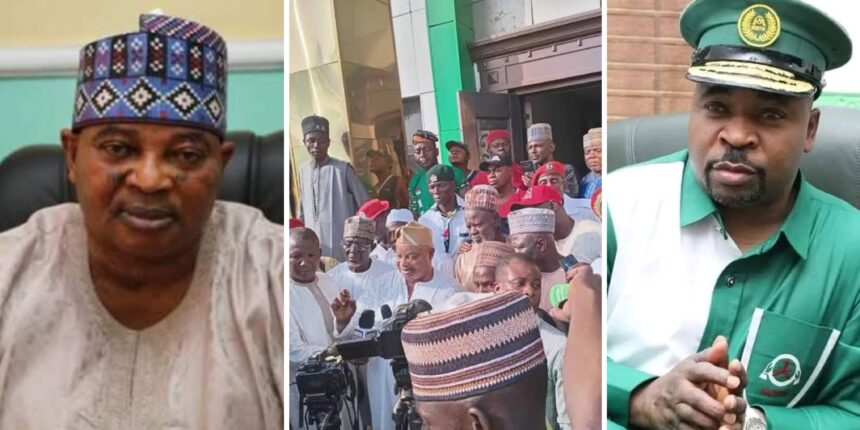
The National Union of Road Transport Workers in Nigeria has long been at the center of public attention not merely because of its crucial role in the transport sector but also due to its complex internal politics and leadership struggles. In March 2026, the NURTW Abuja secretariat became a focal point for national headlines when Tajudeen Baruwa, asserting his authority as the court-recognized president of the union, took control of the national secretariat in the federal capital.
This event marked a significant escalation in the prolonged conflict between Baruwa and Musiliu Akinsanya, popularly known as MC Oluomo, a figure whose influence in Lagos and national transport politics is formidable. The takeover was not an isolated occurrence but the culmination of years of legal battles, factional disputes, and power struggles within one of Nigeria’s most influential labor unions.
To understand the Abuja takeover, it is essential to examine the sequence of events that led to this point.
The Prelude to Conflict
The conflict that erupted in Abuja in March 2026 was far from sudden. Tajudeen Baruwa’s assertion of authority was built on a foundation of court victories dating back to 2023, when disputes over the legitimate presidency of the NURTW began to gain public attention. These legal interventions arose from complaints and suits that challenged the leadership legitimacy of Musiliu Akinsanya, popularly known as MC Oluomo, who had carved a powerful niche as the Lagos State chairman of the union. His rise to prominence was marked by strong control over the transport sector in Lagos and influence that often extended into the political sphere. Despite his popularity among certain factions of the union, MC Oluomo’s leadership had faced suspensions, accusations of insubordination, and alleged misconduct from the national body of the NURTW, particularly in 2022, when tensions with the union’s central authority became public and threatened to split the organization.
At the heart of this prelude was a legal battle in which Baruwa challenged the legitimacy of MC Oluomo’s control, arguing that the processes through which leadership had been maintained violated the statutes of the union and disenfranchised certain members who had supported his faction. The courts, including the National Industrial Court of Nigeria, delivered judgments in 2023 affirming Baruwa’s claim and ordering compliance. These decisions were later reinforced by the Court of Appeal in Abuja in late 2024, which confirmed Baruwa as the duly elected and recognized president of the NURTW. Despite these rulings, enforcement remained sluggish, as MC Oluomo’s faction resisted compliance, citing ongoing appeals and claiming that the orders were improperly directed against them. The prolonged stalemate set the stage for the events that would unfold in 2026.
The Day of the Takeover
On March 23, 2026, Tajudeen Baruwa, accompanied by a contingent of loyal supporters, entered the NURTW national secretariat in Abuja, asserting his authority over the premises. This operation was public and deliberate, designed to enforce court rulings that had been ignored for nearly two years. According to Baruwa, the operation was lawful and aimed at peacefully executing judicial orders rather than imposing power through violence. The presence of his supporters ensured that the takeover could occur without immediate chaos, although tensions inevitably escalated as MC Oluomo’s faction resisted. Clashes were reported, resulting in injuries and heightened security involvement. The police were summoned, arrests were made, and security forces ultimately sealed the secretariat to prevent further confrontations.
Baruwa’s supporters emphasized that the move was not an attempt to undermine the union’s operations but rather to restore legal order. The narrative from Baruwa’s side was one of lawful enforcement: he had been recognized by both the National Industrial Court and the Court of Appeal as the legitimate NURTW president, and his actions on that day were meant to implement these rulings. The operation involved careful coordination to avoid unnecessary violence and to minimize damage to the premises, yet it was clear that the deep-seated loyalty of MC Oluomo’s faction would make the enforcement of these rulings a complex and politically charged task.
Legal Foundation
The legitimacy of Baruwa’s actions was anchored in two critical court decisions. The first, delivered by Honorable O.O. Oyewumi at the National Industrial Court of Nigeria under Suit No. NICN/ABJ/263/2023, recognized Baruwa as the duly elected president of the NURTW and prohibited interference from opposing factions. This ruling was comprehensive, outlining the responsibilities of all union members to comply with the court’s directives and acknowledging the longstanding electoral process through which Baruwa’s leadership had been confirmed.
The second, Appeal CA/ABJ/CV/293/2024 from the Court of Appeal, delivered on November 8, 2024, reinforced the lower court’s judgment. It dismissed appeals by MC Oluomo loyalists, including Najeem Usman, Tajudeen Agbede, Aliyu Ore, Kayode Agbeyangi, Alhassan Haruna, Aliyu Tanimu, and Hakeem Adeosun, describing them as lacking merit. The appellate court also awarded costs of one hundred thousand naira against these appellants, further underscoring the validity of Baruwa’s claim. Respondents on the side of Baruwa included Bello Adamu, Eugene Job, Danjuma Saidu, Prince Isah Usman, Suleiman Adamu, and Odion Olaye JP, all of whom played active roles in the operation to reclaim the secretariat. These legal foundations were critical because they transformed the takeover from a mere factional confrontation into the lawful execution of court directives, even as resistance persisted on the ground.
The Role of MC Oluomo
MC Oluomo’s response to the takeover highlighted the tension between legal rulings and practical authority within unions. He refused to recognize the takeover, arguing that some of the court decisions cited by Baruwa were under appeal and subject to stay of execution, which, in his view, maintained his legitimacy as the president of the union. From his perspective, the issue was less about legality and more about political influence, local loyalty, and the reality of control over union structures, particularly in Lagos. His faction argued that the enforcement of national court rulings did not adequately consider the complexities of local leadership, where MC Oluomo had maintained significant influence over transport operations and political networks. This stance contributed to the prolonged conflict and ensured that the dispute would not be resolved immediately, even after the physical takeover of the secretariat.
MC Oluomo’s historical rise to power is a crucial context for understanding the dispute. He initially rose through the ranks as chairman of the Lagos State chapter, where he became known for a combination of assertive leadership and controversial tactics. His dominance in Lagos gave him leverage that extended beyond the city, influencing the union at a national level. Previous suspensions, including the 2022 actions by the national leadership, had temporarily weakened his position, but his ability to mobilize supporters and resist enforcement of court judgments made him a formidable figure. The ongoing standoff reflected the broader challenges of balancing legal authority with entrenched political and social power within Nigeria’s unions.
Factionalism and Internal Union Dynamics
The NURTW has long been characterized by factionalism, with loyalty often determined by personal allegiance rather than adherence to formal rules. The division between Baruwa and MC Oluomo’s factions exemplifies this dynamic. Over the years, the union has experienced violent clashes and political maneuvering, with local chapters exerting significant influence over national decisions. The Abuja secretariat takeover is one manifestation of these underlying tensions, revealing how factions can resist judicial authority and how power is often negotiated through a combination of legal, political, and personal influence.
These internal dynamics are deeply human. Members of both factions are not mere actors in a legal drama; they are individuals whose livelihoods, social networks, and sense of belonging are tied to their leaders. The conflict is therefore not just a matter of law but also of loyalty, identity, and trust within the union community. The injuries reported during the takeover and the subsequent police involvement underscore the personal stakes involved, illustrating that legal resolutions cannot automatically translate into compliance when social and political relationships are at play.
Security Challenges
Security played a critical role in the March 2026 takeover. Despite Baruwa’s emphasis on a peaceful operation, clashes were unavoidable due to the resistance of MC Oluomo’s faction. Police intervention became necessary to prevent escalation, with arrests made during the operation to maintain order. The sealing of the NURTW headquarters by security forces was a preventative measure to avoid further confrontation, highlighting the delicate balance between enforcing law and maintaining public safety.
The involvement of security forces also reflects the broader implications of union leadership in Nigeria. Leaders such as MC Oluomo wield considerable influence in urban transport and political networks, making enforcement operations highly sensitive. The presence of armed security personnel underscores the potential for conflict when legal authority confronts entrenched local power structures. The day’s events illustrate that even lawful operations require careful negotiation, planning, and the presence of authority to prevent escalation.
Broader Implications
The Baruwa takeover has significant implications beyond the immediate control of the NURTW secretariat. It highlights the challenges of enforcing court rulings against powerful figures who maintain local influence, illustrating the limits of legal authority when confronted with practical power on the ground. This conflict also sheds light on the intersection of union politics and broader political systems, as union leaders often have direct and indirect influence over municipal governance, transportation, and urban policy.
Moreover, the takeover underscores the importance of national cohesion within unions. Long-standing tensions between national leadership and state chapters can lead to fragmentation, which affects not only the operations of the union but also the stability of transport systems and local governance structures. The events in Abuja demonstrate that the enforcement of legal judgments must be paired with strategic negotiation, political sensitivity, and recognition of the social realities faced by union members.
Takeaway
The March 23, 2026, takeover of the NURTW national secretariat by Tajudeen Baruwa represents a pivotal moment in the history of the union. It was the lawful execution of court orders that affirmed Baruwa’s presidency after years of dispute with MC Oluomo’s faction. Yet the conflict also reveals the enduring influence of local power, loyalty, and factionalism within Nigeria’s unions. MC Oluomo’s refusal to recognize the takeover, citing ongoing appeals and political considerations, ensures that tensions remain. The events underscore the complex interplay between legal authority, political influence, and human loyalty, reminding observers that leadership disputes are not merely legal questions but deeply human dramas that reflect the broader societal dynamics of Nigeria.
The Baruwa takeover stands as both a legal and social lesson. It demonstrates the necessity of enforcing judicial decisions to maintain organizational order while highlighting the challenges of translating legal victories into practical control when confronted with entrenched power and loyalty. For the NURTW, the events of March 23, 2026, will be remembered not only for the assertion of Baruwa’s authority but also for the ongoing struggle to reconcile law, loyalty, and leadership in one of Nigeria’s most influential unions.