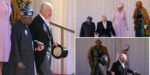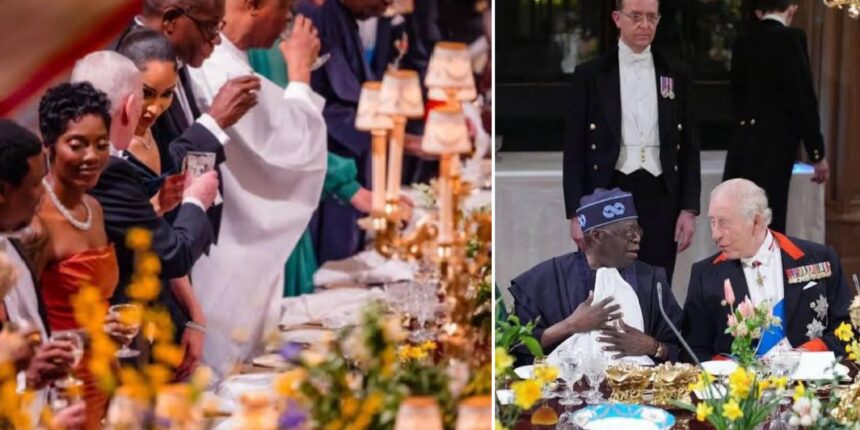
On March 18 2026, Windsor Castle became the scene of a historic state banquet hosted by King Charles III in honour of President Bola Ahmed Tinubu. This event marked Nigeria’s first full state visit to the United Kingdom in thirty seven years, making it an occasion of both ceremonial and diplomatic significance. The dinner took place in St George’s Hall, a space long associated with British royal protocol and formal receptions, where centuries of ceremonial tradition meet contemporary diplomatic practice.
About one hundred and sixty guests attended, including senior British royals, top UK political leaders, members of the Nigerian delegation, diplomats, business executives, and cultural representatives. Seating arrangements were carefully orchestrated according to rank and protocol, highlighting the meticulous planning required to host a successful state event of this magnitude.
For Nigerian citizens both at home and abroad, the banquet represented more than a formal dinner. It was a symbolic display of the country’s international stature and its historic ties with the United Kingdom. In particular, the presence of high-profile cultural figures like Tiwa Savage emphasized that Nigeria was showcasing not only its political leadership but also its global cultural influence. The ceremonial toast, formal speeches, and photography sessions were moments designed to be recorded and remembered, capturing the intersection of politics, culture, and international visibility. The inclusion of a globally recognized artist within a formal setting is a modern diplomatic strategy that aligns with the growing importance of cultural influence in shaping national reputation.
Confirming Tiwa Savage’s Attendance
Visuals online confirmed that Tiwa Savage was present at the state banquet. She was photographed participating in the ceremonial toast alongside other dignitaries, a moment that attracted significant attention once images circulated online. This placement indicates that she was not attending a peripheral reception or side event, but was seated among the official Nigerian delegation inside St George’s Hall, under the supervision of both the Nigerian and British protocol offices. Her inclusion in such a formal capacity demonstrates that her role went beyond social presence; it carried symbolic weight as part of Nigeria’s official representation during a historic state visit.
The photographic evidence and media reports were crucial in dispelling early confusion about her participation. Initially, the absence of her name in UK coverage of the banquet led to speculation that she might not have been present, since British media tends to focus primarily on the royals, heads of state, and high-profile fashion. However, the Nigerian confirmation illustrates that her attendance was real and formally recognized by the delegation. Her role in the ceremonial toast further emphasizes that she was engaged in one of the most symbolic moments of the banquet, an act traditionally reserved for officials and select representatives of the visiting nation.
This confirmation also reflects the increasingly recognized function of cultural figures in diplomacy. By being present at a state dinner, Tiwa Savage was acting as a cultural ambassador, representing Nigeria’s music, entertainment industry, and global influence. Her participation aligns with the broader strategy of integrating high-profile artists into formal diplomatic settings, allowing nations to project soft power in ways that complement political and economic negotiations. In this context, her presence was deliberate, meaningful, and strategically significant for Nigeria’s image on the international stage.
Why She Was Invited
Tiwa Savage’s invitation to the banquet was rooted in both protocol and strategic considerations. State banquets permit visiting countries to nominate part of their delegation, which typically includes government officials, business leaders, influential diaspora members, and cultural ambassadors. As one of the most globally recognized Nigerian musicians and a British-Nigerian citizen with strong ties to both countries, Tiwa Savage represented an ideal figure to project Nigeria’s cultural power during a formal diplomatic occasion. She had previously participated in high-profile royal events, including the 2023 coronation concert, giving her established credibility in cultural diplomacy contexts and positioning her as a trusted representative for the Nigerian delegation.
Her presence served multiple diplomatic purposes. Culturally, she allowed Nigeria to showcase its music, fashion, and entertainment influence on an international platform, signaling that the country’s global significance extended beyond politics or economics. From a diaspora perspective, she represented the millions of Nigerians living in the United Kingdom, a community whose contributions and presence were acknowledged during the state visit by King Charles III. In terms of soft power, having a widely recognized figure at the banquet reinforced Nigeria’s prominence on the world stage, emphasizing that the country’s culture carries weight alongside its political and economic influence.
The process of nomination also considered decorum and adherence to royal protocol. Attendees like Tiwa Savage were expected to follow strict guidelines, participate in ceremonial aspects such as toasts and photography, and maintain diplomatic composure throughout the evening. Unlike performers in concerts or entertainment shows, she was not there to perform but to serve as a living symbol of Nigeria’s cultural identity and global relevance. Her inclusion underscores the evolving understanding of influence, where artists and cultural icons contribute to a nation’s visibility and diplomatic strategy in ways that complement formal political representation.
The Moment That Triggered Public Attention
The moment Tiwa Savage drew widespread public attention came when images of her at the banquet began circulating online. Social media users immediately noticed her seating among high-profile dignitaries and interpreted this as a potential political alignment with the Tinubu administration. Her participation in the ceremonial toast was widely highlighted, and the public discussion quickly expanded to questions about the appropriateness of a celebrity appearing at such a formal political and diplomatic event.
Critics argued that her presence suggested endorsement, questioning whether celebrities should maintain neutrality in politically sensitive contexts. Because the state banquet was a high-profile event covered globally, the optics of Tiwa Savage seated beside political leaders and the British monarch amplified perceptions of political association. These interpretations were compounded by the visual symbolism inherent in the event, where every participant’s placement conveys a message of legitimacy, respect, or influence. Consequently, a space intended for cultural diplomacy became a subject of intense debate, reflecting the complex intersection of celebrity, politics, and public perception in contemporary society.
This moment also illustrated how digital media shapes public understanding of formal diplomatic events. Images shared on social platforms often bypass traditional narrative control, creating interpretations that may diverge from protocol intentions. For Tiwa Savage, this meant that her symbolic role as a cultural ambassador was viewed through the lens of politics, highlighting the challenges faced by celebrities participating in formal state settings where visibility is inseparable from meaning. The incident underscores the delicate balance between representation, symbolism, and perception in international engagements that involve both political and cultural actors.
Political and Diplomatic Symbolism of Attendance
Tiwa Savage’s presence at the banquet carried multiple layers of political and diplomatic symbolism. First, it represented cultural diplomacy, where Nigeria was able to showcase its global influence beyond conventional political and economic avenues. Her status as one of the most internationally recognized Nigerian musicians allowed the country to signal that its soft power—through music, fashion, and entertainment—is an integral part of its national identity and international presence. Second, she served as a diaspora bridge, representing the large Nigerian community in the United Kingdom, whose contributions and cultural significance were acknowledged by King Charles III during the visit. Her presence provided a tangible link between the monarchy and the global Nigerian population, reinforcing shared cultural connections.
Additionally, her inclusion in the official delegation was a demonstration of soft power optics. Bringing a globally influential artist to a state dinner emphasized Nigeria’s relevance in global culture while also complementing its political authority. Unlike strictly political figures, cultural ambassadors communicate influence in subtler ways, shaping perceptions, forging connections, and enhancing prestige. In this context, Tiwa Savage’s presence at Windsor Castle reflected an intentional strategy to blend formal diplomacy with cultural representation, a practice increasingly common in modern state visits where optics, symbolism, and perception play roles as critical as formal agreements or economic treaties.
Her attendance also underscored the importance of multidisciplinary representation in diplomatic events. Politics alone does not define a nation’s global image; music, fashion, and arts all contribute to the narrative of a country’s identity and capabilities. By including Tiwa Savage, the Nigerian delegation was signaling a nuanced understanding of international relations, one where soft power is considered alongside economic and political leverage, demonstrating that culture can be a tool for strengthening bilateral relations and reinforcing global stature.
Closing Thoughts
Tiwa Savage’s presence at the Windsor banquet highlights the evolving nature of influence, where cultural icons increasingly move alongside political figures and shape international narratives without uttering a single policy word. Her attendance illustrates how soft power works quietly, using visibility, symbolism, and reputation to communicate national pride and global relevance. The discourse that followed in Nigeria also reflects a deeper societal conversation about the roles of celebrities in civic life and the tensions between personal achievement and perceived political alignment.
From a diplomatic lens, her inclusion signals that state visits are no longer purely about governance or bilateral deals, but about projecting a holistic image of a nation that blends heritage, contemporary culture, and global connectivity. Ultimately, this episode reminds us that in a world dominated by optics, subtle gestures and appearances often resonate as loudly as speeches and formal statements, and navigating this space requires a delicate understanding of both domestic expectations and international perception.