As you read or hear Yoruba tales of our warriors or forebearers, you will be amazed and start to question how these tales could be true. You might increasingly get disengaged from reality the harder you attempt to understand how intricate these stories are. Sitting at the feet of elders and hearing their old folktales makes you wonder if they are telling the truth or not.
These stories, despite their seeming horror, impossible nature, or frightening content, are real. It is true that there are many different kinds of customs. Additionally, Yorubaland has different taboos for different families and communities.
In some places, ladies are required to carry out specific activities on the eve of their wedding, and pounded yam must not be eaten within a certain time frame. It was also revealed to us that masquerades are not allowed to practice magic in Iwoye-Ijesha. It was also learned that if horses entered the town with force, their legs would break.
Are these taboos true stories or just stories spoken by moonlight? Exaggeration or stories meant to frighten locals? As the reporter goes out to find out more about these “taboos,” these kinds of inquiries keep coming up. Iwoye-Ijesha is not strange to commuters in Ijesaland.
At WITHIN NIGERIA, we usually let people who are concerned share their own tale on their own. To verify the truth of these taboos, we traveled to Iwoye-Ijesha to speak with his Royal Majesty, Oba Ogidiolu Adewumi Amos Otokobo II.
This reporter left Osogbo at around 10:00 a.m. and made her way to Oriade Local Government’s administrative center, Ijebu-Ijesa. The borders of Iwoye-Ijesha and Ijebu-Ijesa are shared. The boundary may be reached by foot from His Royal Majesty, Oba Ogidiolu Adewumi Amos Otokobo II’s under construction palace, which is next to Iwoye Microfinance Bank. The reporter entered the palace and was greeted with great affection by the venerable monarch who had been informed by phone beforehand.
Masquerades or magicians dare not transform to Erè (Phyton)
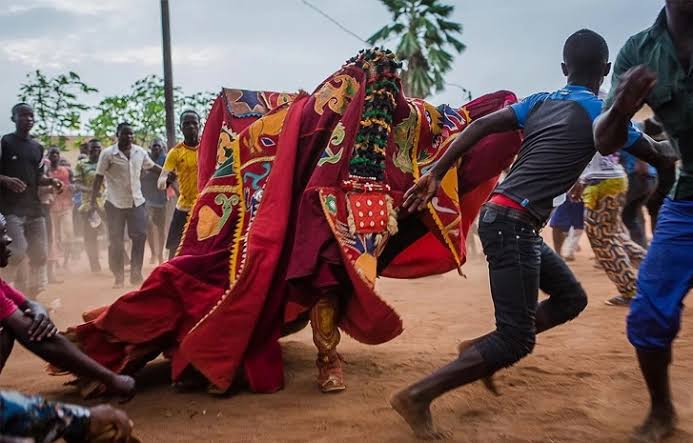
The reporter asked Oba Ogidiolu Adewumi Amos Otokobo II, the Oniwoye of Iwoye-Ijesha, if it is indeed forbidden for masquerades to enter or use magic in the town. The king replied that while masqueraders and magicians are allowed to show off or amuse the public, it is forbidden for them to change into Erè (Phyton).
The monarch claims that these taboos have their roots in a specific incident that happened a very long time ago.
When discussing the origins of the taboo, Oba Otokobo II told WITHIN NIGERIA that masquerades were once allowed to enter the town and amuse people with any type of magic and feats they desired—that is, until this peculiar and startling episode occurred many years ago.
The monarch told the story of how, at the request of the previous king, certain strong forces transported a deity known as Okun—who possesses the divine and spiritual ability to change into a body of water whenever it is placed in any space—into the town from Efon-Alaaye, a town in Ekiti State.
The king claims that the town’s residents still honor and revere the aforementioned divinity.
The monarch went on, ‘Erè is an animal (snake) that is affiliated with Okun deity – which primarily originates from Irun Akoko’.
Oba Ogidiolu told this reporter that a masquerade and a group of people entered the town and began entertaining bystanders with stunts and magic while recounting the incident that resulted in the taboo.
The masquerade could change into any animal he wanted. He could change into any object or animal, and then he would return to being a person. As a visitor, the masquerade is unaware of the latest events concerning the Okun deity and its connection to Erè (Phyton), who was changed into Erè (Phyton) for the amusement of the public. Sadly, the disguise was unable to transform back into a human, according to the monarch.
All spiritual endeavors, including consultations among his disciples and the disguise to change from Erè (Phyton) to human, were useless, according to the monarch.
He did not change back into a human being despite their best efforts till dusk. After transforming into Erè (Phyton), the masquerade disappeared by crawling into the Okun River. The traditional ruler went on to say that since this terrible and horrifying tragedy occurred a few years ago, masquerades are not allowed in Iwoye-Ijesha.
Would horses’ legs break if they enter the town with force?
Horses are not permitted to approach the town of Iwoye-Ijesa since they will be encountering Erè (Phyton) within the Okun River, according to Oba Ogidiolu Adewumi Amos Otokobo II.
On a major road heading into the town, the Okun River is situated on the left side of a small bridge. The border between Ijebu-Ijesa and Iwoye-Ijesha is only a few meters away from the small bridge.
Referencing the Fulanis’ early 1800 invasion of Yorubaland, Oba Otokobo revealed that the Fulani Warriors were unable to cross the Okun River and reach Iwoye-Ijesha because the legs of the horses they rode broke.
The sacred Okun River cannot be crossed by horses, and Fulani warriors of the early 1800s rode their horses to battle. The Okun River functions as a safeguard. The monarch described how the Okun River defends the town against mounted warriors who arrive in huge numbers. The river does this by putting the Erè in the path, so that if the warriors try to force their way inside, the horses would not be able to walk with their legs.
The king answered the reporter’s question about whether the warriors in the town utilized horses in the past by saying that those who did not tie their horses a short distance from the boundary before entering the town.
The days of the Social Democratic Party (SDP) campaigning in Iwoye-Ijesha were also mentioned by the monarch.
The leaders of the SDP entered the town with horses. Since the horses could not walk again, they had to be removed from the town using a lorry. The monarch went on to say that you could just question any SDP member or chieftain who went with politicians to Iwoye-Ijesa if they were still living.