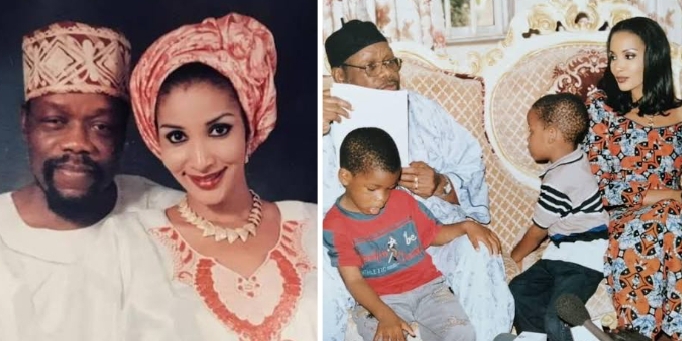
You know some places in Nigeria have this way of feeling things before they happen, whispers in traffic, taxi drivers murmuring while honking, market women nodding like they know something you don’t. When Chief Chukwuemeka Odumegwu Ojukwu passed away in 2011, the country felt it even if most people didn’t understand exactly what it meant. He was not just a general, not just a politician, not just the face of Biafra, he was a symbol, a storm, a legacy wrapped up in sharp suits and sharper words. And when a man like that dies, he does not go quietly. His family, his legacy, his property, they all start talking back in ways the law struggles to control.
Bianca Odumegwu Ojukwu, his widow, had to carry not only the memory of a legend but the weight of the estate left behind, the houses, the businesses, the companies tied to the Odumegwu name, and the expectations of a family spread across continents, across generations. And then there was Ojukwu Transport Limited, one of the crown jewels, a company tied to his father, whose control suddenly became more than business, it became a statement, a claim of rightful inheritance, a question of tradition versus what the Lagos courts would say.
The streets, the offices, the lawyers offices, they were buzzing. People said Bianca is smart, she will fight, she knows the rules. Others whispered, the first sons have the tradition, they have the right. And nobody said it straight out, but the battle was on, it was deep, it was messy, and it was about to stretch into a saga that would last over a decade.
The Legal Storm That Started in 2012
By 2012, what was once whispers on Lagos streets became papers, signatures, suits filed in court, and lawyers moving like chess pieces. Bianca and her two sons were suddenly at the center of a long running legal storm. The first suit claimed rights to certain houses, the family company, and properties that had been under Ojukwu’s control before he died. It was not just about property, it was about respect, about tradition, about power in the family, about who could carry the Odumegwu name forward in a way that mattered.
The filings read like a map of Nigerian inheritance law tangled with Igbo tradition. On one side, you had the widow and her children citing statutory law, citing wills, citing legal documents signed and registered. On the other side, some family members cited customary rights, the expectation that first sons and male heirs had priority, the idea that some things in Igbo families were not written down but lived and enforced in memory and ritual. Lawyers debated endlessly. Magistrates and judges had to listen to a mixture of documented evidence and cultural memory, sometimes trying to separate fact from belief, what was legally binding from what was socially enforced.
In Lagos High Court, the courtroom became a theatre of tension. You had witnesses who spoke about Ojukwu as if he were still alive in the room, recounting his instructions, his intentions, his words about fairness and family. You had accountants, valuers, corporate records, land certificates, all moving across tables like instruments in a symphony nobody wanted to end. And outside the court, gossip travelled faster than emails, faster than newspapers could report. The city was following it, the market people, the drivers, even young lawyers in training. Everyone knew something big was happening, something that would decide not just who got what, but what precedent it would set for wealthy families in Nigeria balancing law and tradition.
The years stretched on, filings became countersuits, appeals came, and the story became more than a family dispute. It became a public lesson about inheritance, legacy, and the sometimes invisible rules that govern Nigerian family life. And in the midst of it all, Bianca and her sons stayed in the fight, their lawyers pushing boundaries, navigating every clause in law books, every loophole in custom, every historical expectation.
The Judgment That Shook the Family
By 2023, the courtroom drama had stretched over a decade. Ten years of filings, countersuits, affidavits, evidence, and endless arguments about who had the right to houses, lands, and control of Ojukwu Transport Limited. And then the Lagos High Court finally spoke. Bianca and her sons were recognized as the lawful heirs, their rights affirmed, and the family members who had challenged them could no longer dispossess them of the properties.
It was more than a legal ruling. It was a statement that tradition alone could not override statutory law in Nigeria, that written wills mattered, that modern courts could enforce fairness even when it clashed with long standing cultural expectations. But for the family, the ruling was a mix of relief and lingering tension. Some relatives accepted it quietly, others murmured resentment in private gatherings, the kind of murmurs that travel from one Lagos neighborhood to another without ever being printed in newspapers.
For Bianca, it was validation, but also a new responsibility. The estate was hers and her sons, but carrying the legacy of a man like Ojukwu meant navigating the delicate balance between honoring the past and living in the present. Every property, every company, every asset became a symbol, a reminder of battles fought in courtrooms and living rooms, in boardrooms and family compounds.
The judgment also exposed a larger lesson. In Nigeria, even the most prominent families are not immune to conflict over inheritance. And when those conflicts involve cultural norms, the law has to walk carefully, respecting tradition while enforcing written rights. The Ojukwu case became a reference, cited by lawyers, discussed in law schools, debated in cafes and offices. Everyone wanted to understand how a widow and her children could stand against family tradition and win.
Tradition Versus Modern Law
In many Igbo families, inheritance is not just about property, it is about identity, respect, and the invisible rules passed from one generation to the next. The first son often carries the expectation of leadership, control of family assets, and even moral authority over siblings. It is taught at the dining table, in village meetings, in subtle gestures that signal who should speak, who should decide, who should inherit.
But the Ojukwu estate showed what happens when those expectations meet modern legal frameworks. Bianca and her children had a will, clear documentation, legal registration, and statutory rights. The Lagos High Court did not ignore custom, but it made clear that in Nigeria, courts can and will enforce written law. For some family members, it felt like tradition had been sidelined. For others, it was a necessary evolution, proof that fairness and equity could exist alongside culture, that the law could protect widows and children even when tradition expected something else.
This tension between family, culture, and law is what made the Ojukwu case resonate far beyond Lagos. Lawyers studied it, sociologists discussed it, cultural historians nodded at it, because it illustrated a universal lesson: wealth and legacy are fragile when they sit at the crossroads of expectation and legality.
At the same time, the dispute forced a conversation about morality and duty. Should inheritance honor the wishes of the deceased, or the claims of the living, rooted in centuries of culture? Should the law bend to social norms, or should norms bend to law? In every meeting, every court session, every family argument, those questions hung heavy. And through it all, the city watched quietly, the whispers never fading, the lessons slowly sinking in among ordinary people who saw themselves reflected in the struggle.
The Cultural Ripples Across Nigeria
The fight over Ojukwus estate was not just a family affair. Across Nigeria, people watched, discussed, debated, and sometimes argued in markets, offices, and living rooms. The story became a cultural touchpoint, a cautionary tale about how wealth, legacy, and law collide with tradition.
In Igbo communities, elders debated quietly about the changing meaning of inheritance. Some saw Bianca and her children as disruptors of long held norms, a sign that modern law was bending the rules of family honor. Others celebrated them as trailblazers, proof that fairness and equity could exist alongside culture, that the law could protect widows and children even when tradition expected something else.
The legal scholars used the case as a study in classrooms, explaining how statutory law, customary law, and family expectations interact in Nigeria. Lawyers referenced it in arguments about other estates, judges cited it when decisions required balancing custom and law. The saga became a blueprint for how wealthy families might avoid the pitfalls of generational conflict by documenting intentions, registering wills, and planning succession.
Even the media played a role in shaping public perception. Articles, columns, and documentaries explored the subtle tensions, the legal arguments, the human drama, and the lessons embedded in the story. The whispers in Lagos streets found their way into national conversation, reminding everyone that what happens in one family compound can teach a whole nation about negotiation, fairness, and responsibility.
And yet, beneath the headlines and commentary, the human reality persisted. Families in every Nigerian city and village, wealthy or modest, could see themselves reflected in the struggle. Inheritance is rarely clean, tradition is rarely silent, and the law is rarely simple. The Ojukwu estate showed that these tensions are not abstract concepts, but lived experiences, full of emotion, missteps, and lessons that do not fit neatly into textbooks.
The ripple effect extended further. Discussions about gender and inheritance gained new weight. Widows and daughters in many parts of the country began questioning long standing norms, seeing in Bianca’s story a possibility of legal protection and fairness. The intersection of law and culture became not just a debate for elites, but a topic that touched ordinary lives, changing expectations about what inheritance could and should mean in modern Nigeria.
The Human Story Behind the Estate
Beyond the court filings, the affidavits, the signatures, and the rulings, there was a deeply human story in the Ojukwu estate. Bianca and her children were not just litigants, they were people carrying grief, memory, and responsibility. Losing a husband and father is never simple, but to step into a public fight over his legacy adds a weight few can imagine.
Every time Bianca entered a courtroom, she carried more than the right to property. She carried the memory of a husband whose life was extraordinary and complicated, a man who had shaped history and expectations alike. She carried the responsibility to protect her children, to uphold dignity, to navigate family tensions that could have easily crushed anyone. Her sons grew up in the shadow of legend, learning lessons about courage, strategy, and resilience not in playgrounds but in legal documents, whispered family arguments, and careful observations of adult negotiations.
Family members on the other side were human too, navigating pride, grief, and expectation. They tried to honor memory as they understood it, defend cultural norms, and maintain personal positions within the family hierarchy. Misunderstandings, resentment, loyalty, and love collided in ways that only families of legacy understand.
And then there were the small moments nobody saw. Quiet conversations late at night, hesitation before signing papers, the careful balance between confrontation and respect, unspoken acknowledgment of history and legacy. These were the invisible pulses of the saga, the human beats behind the legal battles.
This human layer is what made the Ojukwu estate story resonate. People across Nigeria saw not just law or property disputes but the tension of grief and responsibility, pride and humility, history and modernity. It reminded everyone that inheritance is never only about wealth, it is about relationships, memory, and the choices we make when navigating family, culture, and law. Legacy, in this case, was alive, not just in papers and buildings but in hearts, conversations, and the slow unfolding of justice and fairness over more than a decade.
Closing Thoughts
The story of the Ojukwu estate is a mirror of Nigeria itself, a country where history, culture, law, and human emotion collide in ways that are beautiful, messy, and unpredictable. It is a story about legacy, about the weight of a name, about the invisible rules that guide families long before courts ever get involved.
Bianca and her children showed that courage, persistence, and preparation matter. They navigated the intersections of tradition and modern law, proving that fairness can exist even when expectations are stacked against you. But the saga also showed the cost of legacy. Family relationships strain, pride can hurt more than any court ruling, and the emotional scars last far longer than the legal victory.
For Nigeria, the saga offers lessons in law, culture, and human nature. Courts can enforce rights and protect those who might otherwise be marginalized. Families must plan carefully, communicate clearly, and respect both tradition and the legal framework. And ordinary citizens can see themselves in the story, learning how to balance respect for the past with the reality of the present.
The whispers in Lagos streets, the quiet conversations in village compounds, the debates in offices across the country, all reflect the lasting power of this story. The Ojukwu estate is more than a legal battle. It is a human drama, a lesson in resilience, a story of love, loss, pride, and responsibility that continues to ripple through Nigeria.
In the end, legacy is never just about what you leave behind. It is about how it is handled, how it teaches, and how it shapes the lives of those who carry it forward. The Ojukwu estate reminds us that law, culture, family, and human emotion are inseparable, that each carries weight, and that navigating them requires courage, patience, and understanding.
The story is complete, yet it continues in the lives of those who inherit not just property, but history, memory, and responsibility. And for everyone watching, listening, learning, it is a story that will never truly end.