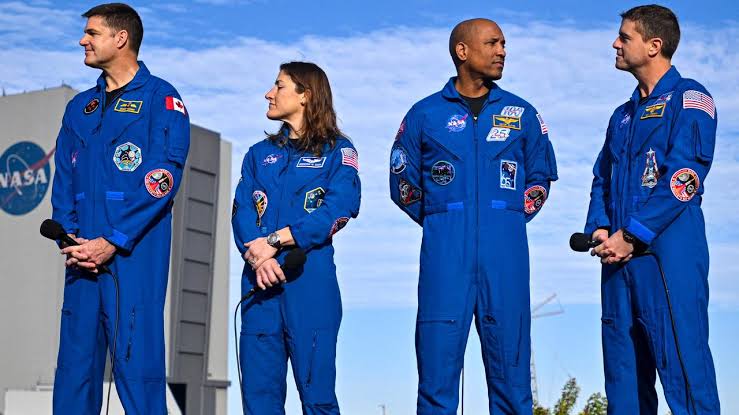
Four astronauts returned safely from a journey to the Moon for the first time in nearly 50 years. WITHIN NIGERIA learned that the project, dubbed Artemis II, is the second in NASA’s Artemis program, with the first being an uncrewed trip.
On Wednesday, April 1, the National Aeronautics and Space Administration (NASA) launched another mission known as Artemis II.
During the 10-day Artemis II mission, the team traveled around the Moon as a flight test for NASA’s Exploration Ground Systems (the systems that launch and retrieve rockets and spacecraft), the SLS rocket, and the Orion spacecraft.
It was also revealed that the Artemis II mission was a follow-up to the uncrewed Artemis I mission in 2022; this crewed trip will allow NASA to flight test Orion’s life-support systems while astronauts are on board. According to experts, it must be completed before NASA launches astronauts on longer-duration trips as part of the Artemis program.
Here are 18 facts you probably didn’t know about Artemis II:
- Artemis is the first crewed mission of NASA’s Artemis program, with the goal of returning humans to the moon.
- Reid Wiseman, Victor Glover, Christina Koch, and Jeremy Hansen made up the crew.
- Reid Wiseman is a mission commander at NASA. He was a test pilot and captain in the United States Navy before joining NASA in 2009. As commander, he conducted the mission to test the Orion spacecraft system in deep space.
- Victor Glover is a pilot with NASA. He is a United States Navy Captain, test pilot, and engineer chosen by NASA in 2013. He piloted the first operational SpaceX Crew Dragon voyage to the ISS, spending 168 days in orbit and executing four spacewalks.
- Christina Koch is a Mission Specialist at NASA. She is an engineer and scientist chosen by NASA in 2013. She holds the record for the longest single mission by a woman (328 days on the ISS in 2019-2020) and took part in the first all-female spacewalk. She is the first woman to go to the moon.
- Jeremy Hansen is a mission specialist (CSA). She is a fighter pilot with the Royal Canadian Air Force and the first Canadian to lead a NASA astronaut class. She was selected as an astronaut in 2009. He is the first Canadian and non-American to travel to the vicinity of the Moon.
- The expedition was launched on April 1, 2026, and spent ten days in space, performing a lunar flyby.
- Artemis II was the first time humans had gone beyond low Earth orbit since 1972.
- The crew established a new record for the farthest distance from Earth, reaching 252,756 miles.
- The spacecraft swung around the moon’s far side, with the crew watching meteorites crashing onto the lunar surface
- The Orion capsule safely returns to Earth on April 10, 2026, splashing down in the Pacific Ocean
- The mission’s completion clears the path for future deep space exploration, including crewed missions to Mars.
- Artemis II lays the groundwork for creating a lunar Gateway, a space station in orbit around the moon that will act as a hub for further exploration.
- The mission ignites enthusiasm in STEM subjects, encouraging young Nigerians and people around the world to seek careers in space exploration.
- Artemis II demonstrates global collaboration, with contributions from space agencies and partners worldwide.
- The mission stimulates the space sector, generating prospects for innovation, employment, and expansion.
- Artemis II’s mission allowed the testing of the Space Launch System (SLS) rocket and Orion spacecraft in deep space.
- It paved the way for future lunar missions and prospective moon base building.