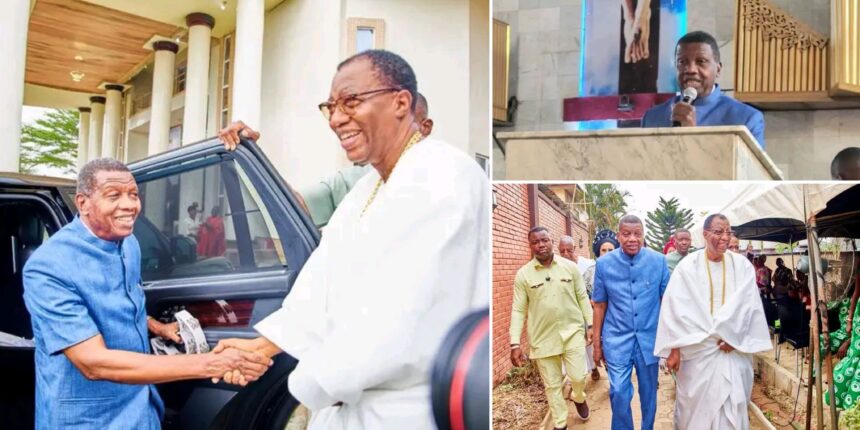
The thanksgiving service held on 6 April 2026 at Abraham’s Tabernacle in Sagamu, Ogun State, emerged as one of the most widely discussed high society religious gatherings of the year due to its rare combination of political weight, spiritual leadership, and elite attendance. The occasion marked the 70th birthday thanksgiving of Otunba Gbenga Daniel, former Governor of Ogun State and serving senator, drawing attention not only because of the celebrant’s political history but also because of the calibre of personalities who gathered under one roof for a joint expression of gratitude. The atmosphere reflected a blend of reverence and public ceremony where faith and governance intersected in a single space, creating a setting that naturally attracted both physical attendance and digital attention.
The venue itself, Abraham’s Tabernacle, has long been associated with large scale Christian gatherings in Ogun State, and on this specific Sunday it became a convergence point for political leaders, traditional rulers, business figures, and religious authorities. The service was structured as a thanksgiving programme rather than a conventional birthday party, placing emphasis on worship, prayers, and sermons. This framing is important because it positioned the event primarily as a spiritual gathering even though its guest list reflected deep political and social influence. The combination of those elements set the stage for later online interpretation, where short video clips would eventually detach moments from their full context.
Arrival of Pastor Enoch Adeboye and significance of his presence
The presence of Pastor Enoch Adeboye represented one of the defining spiritual highlights of the entire gathering. As the General Overseer of the Redeemed Christian Church of God, his participation carried symbolic weight that extended beyond the immediate celebration. His arrival was not as a ceremonial guest alone but as a central minister invited to lead parts of the thanksgiving service. His role reflected a tradition where prominent national figures often invite him to minister during milestone celebrations, especially when such events carry both public and private significance.
His presence immediately elevated the spiritual dimension of the event, shifting attention from a purely political birthday celebration to a structured worship gathering. Observers noted that his entry into the service was marked by the formal protocols typical of large church conventions, where order, reverence, and structure guide movement within the auditorium. That structure later became one of the points that social media users interpreted differently when isolated clips circulated online. Within the full context of the service, however, his presence aligned with established practice in large Christian assemblies where senior ministers are accorded structured respect during entry and seating arrangements.
The sermon delivery and spiritual message at the thanksgiving service
During the service, Pastor Adeboye delivered a sermon that focused heavily on spiritual accountability, divine wisdom, and the reality of human life requiring eventual accountability before God. His message centered on the importance of living with consciousness of eternity, encouraging reflection on decisions, leadership responsibility, and moral conduct. The tone of the sermon remained consistent with his long standing preaching style, which emphasizes simplicity, spiritual clarity, and moral instruction rather than political commentary.
Within the sermon, he referenced values that are commonly associated with leadership responsibility, including integrity, commitment, and faithfulness in stewardship. These themes aligned naturally with the occasion since the celebrant is a public office holder with decades of involvement in governance. The sermon, however, remained within spiritual boundaries, avoiding any direct political endorsement or campaign language. It was framed as a thanksgiving reflection rather than a public declaration of political alignment, a distinction that becomes important when analyzing later public reaction.
The delivery maintained a calm and reflective tone, consistent with sermons typically delivered during milestone thanksgiving services. Rather than focusing on celebration alone, the message guided attendees into reflection about life purpose, service to humanity, and accountability before God, which is a common emphasis in such gatherings involving senior national figures.
Public remarks about Gbenga Daniel and recognition of character
A notable part of the service came when Pastor Adeboye offered remarks concerning Gbenga Daniel’s character and conduct over the years. He described him as an exceptional political figure and referenced attributes of reliability, consistency, and commitment to promises. He also referred to him as an Omoluabi, a Yoruba expression that conveys a person of integrity, honour, and commendable moral upbringing. This description carried cultural and ethical significance within the Yoruba sociopolitical context, where character recognition is deeply valued.
The remarks further highlighted Daniel’s relationship with the church and his perceived support for religious institutions, particularly in relation to commitments made in the past. These comments were delivered in a tone consistent with acknowledgment rather than endorsement, reflecting appreciation of personal conduct within a spiritual gathering. The recognition of character was framed within thanksgiving context, which typically includes testimonies and acknowledgments of relationships and experiences.
Such statements are not unusual in Nigerian thanksgiving services where leaders and celebrants are often acknowledged publicly for their contributions to society and their relationships with faith communities. However, given the visibility of the personalities present, these remarks later became part of the broader online interpretation of the event.
Presence of political and traditional elite and expansion of event significance
The event was attended by several high profile figures including former President Olusegun Obasanjo, represented government officials, senators, traditional rulers, and business leaders. Among them was Olusegun Obasanjo, whose presence added historical and political depth due to his long standing relationship with Ogun State politics and national leadership history. The attendance of such figures transformed the gathering into a major convergence of Nigeria’s political and social elite.
This mix of guests contributed to the perception of the event as more than a private birthday thanksgiving. It became a symbolic intersection of religion, governance, and traditional authority. The presence of governors, lawmakers, and royal fathers created a layered environment where public service history and cultural leadership met within a spiritual space. This dynamic is common in Nigeria where major life events of political figures often attract broad elite participation, especially when hosted in religious settings.
The combination of these elements is central to understanding why the event gained attention beyond Ogun State. It was not simply the birthday of a former governor but a gathering that reflected networks of influence across multiple sectors of Nigerian society.
Viral circulation of video clips and emergence of public interpretation
Following the service, short video clips began circulating widely across social media platforms. These clips focused particularly on moments involving movement within the pulpit area, including the entrance and positioning of Pastor Adeboye during the service. Because social media consumption often relies on short visual segments without full context, interpretations quickly developed that were not always aligned with the complete structure of the service.
One of the most discussed aspects was the perception of movement interpreted by some viewers as a gesture of deep respect toward the celebrant. While within church protocol such movements are often part of orderly worship arrangements, online audiences interpreted them differently due to the absence of full service footage. This created a divide in public reaction where some users defended the actions as standard ecclesiastical procedure while others questioned the optics of a religious leader appearing closely aligned in posture with a political figure.
The viral nature of the clips demonstrates how modern media consumption can reshape perception of structured events. The absence of context often transforms ordinary ceremonial movements into symbolic interpretations that spread rapidly across digital platforms.
Discourse on religion and politics interaction
Public reaction to the event was divided into two broad interpretations. One group viewed the service as a standard thanksgiving gathering where religious protocol was properly observed and where spiritual leadership played its expected role. This group emphasized that large church services often include structured movements, seating arrangements, and acknowledgments that can be misinterpreted when viewed in isolation.
Another group expressed concern about the perceived closeness between religious authority and political figures during such events. Their argument focused on optics and symbolism, suggesting that religious platforms should maintain clear distance from political celebrations to avoid misinterpretation. This perspective was amplified by the presence of multiple political elites at the event, which further intensified scrutiny.
The discourse reflected a broader ongoing conversation in Nigeria about the relationship between religious institutions and political leadership. Such debates are not new, but they become more visible when high profile personalities are involved in public ceremonies that blend both spheres.
Societal context of thanksgiving services in Nigeria
Thanksgiving services for political figures are a well established tradition in Nigeria, often serving as moments of reflection, celebration, and public acknowledgment of personal milestones. These services frequently include sermons, prayers, and public testimonies, and they typically attract a cross section of society including political allies, religious leaders, and traditional authorities.
Within this cultural framework, the event in Sagamu fits into a recognized pattern where life milestones are marked through religious gatherings rather than private ceremonies alone. Such events often serve dual purposes, functioning both as spiritual observances and as social gatherings where relationships are reaffirmed. The presence of senior clergy at such events is also common, especially when celebrants have long standing relationships with religious institutions.
Understanding this cultural backdrop is essential to interpreting the event beyond surface level viral clips. It reflects a social structure where religion and public life often intersect in ways that are normalized within local tradition.
Final interpretation of the event and its lasting public meaning
The thanksgiving service held on 6 April 2026 ultimately stands as an example of how structured religious gatherings involving public figures can evolve into national talking points when interpreted through digital media. At its core, the event remained a church thanksgiving service led by senior clergy including Pastor Enoch Adeboye, focused on spiritual reflection and gratitude.
The viral attention that followed was driven less by the content of the sermon and more by visual interpretation of select moments. These interpretations were shaped by the presence of political elites, the stature of the religious leader involved, and the speed of social media circulation. When viewed holistically, the event reflects a longstanding Nigerian tradition of combining faith and public celebration, while also highlighting the modern challenge of context loss in digital communication.
The significance of the gathering therefore lies not only in the celebration of a milestone birthday but also in the way it illustrates the intersection of faith, leadership, culture, and public perception in contemporary Nigerian society.