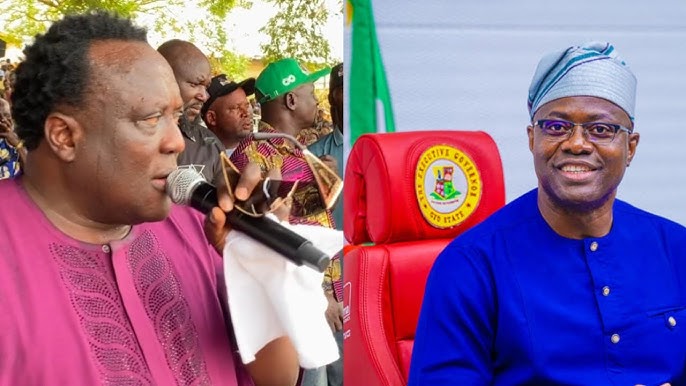
Political gatherings in Oyo State often carry layers that go far beyond the surface of speeches, music, and public celebration, especially when influential entertainers step onto such platforms. On April 17, 2026, Ibadan witnessed one of those moments where performance and politics blurred into a single charged atmosphere that quickly escaped the boundaries of entertainment. Saheed Osupa, a prominent Fuji musician, appeared on stage during a political declaration gathering tied to Senator Sharafadeen Alli governorship ambition, a setting already saturated with political expectation and strategic messaging. What followed from his microphone was not treated as ordinary stage talk, instead, it became a subject of interpretation, debate, and political reading across Oyo State and beyond.
The remarks attributed to him did not directly mention Governor Seyi Makinde in clear terms, yet the timing, the audience composition, and the political environment created a strong association in public perception. That association immediately turned a musical appearance into a political signal, whether intended or not, and the reaction spread rapidly through recordings circulating across social platforms. The event now sits at the intersection of entertainment influence and political sensitivity in a state where public figures often carry significant emotional weight among supporters.
Background Of Ibadan Political Event
The gathering held on April 17, 2026, in Ibadan was structured around a political declaration linked to Senator Sharafadeen Alli governorship ambition within Oyo State. The atmosphere of the venue was not designed as a neutral cultural show, instead, it functioned as a mobilization ground where supporters, party loyalists, and political associates converged with expectations of direction and endorsement signals. Music performances were part of the event design, yet even those performances were naturally absorbed into the broader political messaging of the day.
Saheed Osupa presence at the event added a cultural layer that amplified attention, since Fuji music holds deep influence within Yoruba speaking political spaces. His stage entry was received with enthusiasm, typical of political rallies where entertainers are often seen as emotional bridges between candidates and the public. However, the setting also meant that any statement made from the stage would not remain within artistic boundaries alone, especially given the political undertone already present in speeches delivered before his performance.
The crowd dynamics reflected a mixture of celebration and expectation, with supporters listening closely not only for music but also for perceived alignment cues. That environment created conditions where even subtle commentary could be interpreted as direct political messaging. It is within this context that the later controversy began to form, long before any online circulation of video clips began shaping public debate.
Sequence Of Stage Performance
Saheed Osupa performance reportedly began in familiar fashion with musical engagement designed to energize the audience and sustain the celebratory rhythm of the event. As is common in Fuji culture, performances often include spoken interjections where artists comment on social behavior, leadership, or community issues. It was during one of these transitions that his tone shifted from pure entertainment into commentary that listeners later interpreted through a political lens.
The shift was not presented as a formal speech but emerged naturally within his stage delivery, blending music with reflective statements directed at the audience. His words emphasized caution about leadership decisions and warned against repeating what he described as disappointing governance experiences. The audience response varied, with some cheering in agreement, while others appeared more reserved as the message unfolded in real time.
At that moment, the event was still ongoing, and no immediate official interpretation existed. However, the recording of the performance later became the primary reference point for public analysis. Once circulated, the segment detached from its live context and became a standalone piece of political evidence in online discussions, shaping how people interpreted intent, meaning, and target of the message.
Core Message From Stage
The central message attributed to Saheed Osupa during the Ibadan appearance revolved around caution directed at political leadership choices and the consequences of public trust. His statements in Yoruba carried emotional weight that translated into English interpretations suggesting warnings against supporting leaders perceived as untrustworthy or inconsistent. One widely circulated translation framed his message as a caution not to rely on deceitful leadership, a phrase that quickly became the focal point of discussion.
Although no explicit naming of Governor Seyi Makinde appeared in verified clips, the timing and setting led audiences to draw conclusions about the intended direction of the remarks. The political sensitivity of the gathering meant that neutrality was difficult to assume, especially since the event itself was tied to a governorship ambition launch. This combination of message and environment created a perception stronger than the literal words spoken.
The delivery style also contributed to interpretation challenges, since Fuji stage commentary often relies on indirect phrasing, metaphor, and cultural expression rather than direct political naming. That cultural communication style left space for multiple readings, which later expanded into competing narratives depending on political alignment and personal interpretation of the audience.
Political Context In Oyo State
Oyo State political environment around 2026 was already shaped by early positioning ahead of the 2027 electoral cycle. Political actors, supporters, and allied public figures were gradually aligning themselves through public appearances, endorsements, and symbolic gatherings. Within this atmosphere, entertainment figures often become influential participants because of their ability to mobilize attention and emotional engagement from large audiences.
Governor Seyi Makinde administration had maintained both strong supporters and vocal critics within the state political space. Infrastructure development, governance decisions, and political alliances had created a divided perception landscape where public commentary is frequently interpreted through partisan lenses. This made any public statement from influential figures particularly sensitive when delivered in politically connected environments.
The Ibadan event therefore became more than a cultural performance moment. It was absorbed into the broader political tension already developing within Oyo State. Any message referencing leadership, trust, governance disappointment, or electoral choice naturally became part of the ongoing conversation about direction and future leadership decisions in the state.
Historical Relationship: Osupa and Makinde
The relationship between Saheed Osupa and Governor Seyi Makinde has not been static over time. Earlier years around 2020 to 2022 included moments where Osupa publicly expressed support during political campaigns and aligned himself with the governor’s political journey. Those moments contributed to a perception of mutual recognition between entertainment influence and political leadership within the state.
However, reports from later periods indicated strains that emerged over expectations, recognition, and perceived distance between cultural supporters and political office holders. These tensions were publicly discussed within media spaces and eventually led to moments of reconciliation where endorsements and apologies were also reported. The relationship therefore moved through cycles of alignment and distance rather than remaining fixed.
By 2024 to 2026, occasional resurfacing of tension narratives reappeared depending on political climate and public interpretation of statements or appearances. This historical background plays a significant role in why the Ibadan 2026 remarks were not viewed in isolation. Instead, they were interpreted as part of a longer evolving pattern between both figures.
Public Reaction Patterns
Public reaction to the Ibadan performance commentary quickly split into contrasting perspectives. Supporters of Osupa interpretation argued that entertainers have the right to reflect societal realities and express opinions about leadership direction, especially in a democratic environment. They viewed his remarks as emotional reflection rather than targeted political attack, and emphasized the importance of free expression within cultural spaces.
On the opposing side, critics argued that the stage used was connected to a political declaration event, and therefore any commentary delivered there carried political weight that could influence public perception. From this viewpoint, the timing of the remarks was seen as interference in political messaging at a sensitive moment. Some also expressed concern that such statements could deepen political division within the state.
Across social media platforms, discussions expanded rapidly as short video clips circulated without full context. This contributed to selective interpretation where audiences responded to fragments rather than the full sequence of performance and audience interaction. The result was a widening gap between intent perception and public conclusion.
Media Circulation Of Event
Once recordings of the Ibadan performance began circulating online, the narrative shifted from localized event interpretation to statewide and national discussion. The clip was repeatedly shared with captions emphasizing political meaning, often removing surrounding context of music performance and audience interaction. This pattern amplified emotional reaction rather than balanced analysis.
Different media platforms framed the moment in varying ways depending on audience orientation. Some emphasized controversy and political implication, while others focused on entertainment expression and cultural performance style. This divergence contributed to a fragmented understanding of what exactly transpired on stage.
The speed of circulation also meant that official clarifications or contextual explanations struggled to match the pace of public interpretation. By the time detailed breakdowns began emerging, the initial impression had already taken strong root within public consciousness.
Implications For 2027 Race
The incident has now become part of broader political conversation ahead of the 2027 electoral cycle in Oyo State. Whether intentional or not, the remarks attributed to Saheed Osupa have entered the political narrative space where influence, perception, and alignment signals are closely monitored. Political actors are aware that cultural figures can shape emotional direction among large sections of the electorate.
For Governor Seyi Makinde, the incident introduces additional interpretive layers within public discourse, even though no direct statement from him has been attached to the controversy. For opposition aligned groups, the moment has been used to reinforce arguments about dissatisfaction or alternative leadership direction depending on their positioning.
The key implication lies not in the literal content of the remarks alone, but in how they are being used within political conversation cycles. As 2027 approaches, similar moments involving public figures are likely to attract heightened scrutiny and faster amplification across communication channels.
Concluding Lens
The Ibadan stage incident involving Saheed Osupa on April 17, 2026, demonstrates how quickly entertainment spaces can transform into political interpretation arenas within Nigerian political culture. A performance that began within a musical framework became a subject of governance discussion, public debate, and political analysis within hours due to timing, setting, and historical context.
Governor Seyi Makinde was not directly named in verified statements, yet public perception naturally linked the commentary to his administration due to existing political context within Oyo State. The reaction that followed highlights the sensitivity of political environments where cultural voices hold influence beyond entertainment boundaries.
As political attention gradually shifts toward 2027, the event remains a reminder that words spoken on public stages, especially within politically charged gatherings, rarely remain confined to their immediate moment. They travel, expand, and evolve into narratives that shape perception long after the music has ended.