It started with a fever in the open South Atlantic. Within weeks, it had turned into the first hantavirus cluster ever recorded on a cruise ship, with three people dead and health officials across a dozen countries scrambling to track down passengers who had already flown home.
The MV Hondius, a Dutch-flagged expedition vessel operated by Oceanwide Expeditions, left Ushuaia, Argentina, on April 1, 2026, carrying 114 passengers and crew on a birdwatching voyage. By the time the World Health Organization was formally notified on May 2, three people were dead, five cases had been laboratory confirmed, and three more were suspected. The ship was anchored off Cape Verde, its passengers stuck aboard while health authorities in Europe argued over where to send it.
This is what we know, how the WHO has responded, and what the outbreak means for anyone travelling in regions where hantavirus circulates.
What Is Hantavirus?
Hantavirus is not new. It has been circulating in rodent populations for centuries and jumping to humans who get too close to infected animals, their urine, droppings, saliva, or nesting material. What makes it dangerous is the speed at which it can turn serious, and the fact that there is no approved antiviral treatment and no vaccine.
There are two main disease patterns. In the Americas, infection typically causes Hantavirus Pulmonary Syndrome (HPS), a respiratory illness that can progress to lung failure within days. In Asia and Europe, the dominant strains cause Haemorrhagic Fever with Renal Syndrome (HFRS), which attacks the kidneys.
Case fatality rates differ sharply by region. In Asia and Europe, death rates sit below 15%. In the Americas, they can reach 50% with certain strains.
The strain at the centre of the cruise ship outbreak is the Andes virus, found primarily in South America. It is the only known hantavirus strain capable of human-to-human transmission, though this is rare and typically requires very close, prolonged contact. That detail has driven much of the concern around the MV Hondius, not because a mass outbreak is likely, but because it changes the containment calculus considerably.
How the MV Hondius Outbreak Unfolded
The first casualty was a 70-year-old Dutch man. He fell ill on board the ship on April 11 with fever, headache, abdominal pain and diarrhoea, symptoms that can easily be mistaken for gastroenteritis or a travel bug. He died the same day. His body was not removed from the vessel until April 24, when the ship docked at Saint Helena, a British Overseas Territory in the remote South Atlantic.
That stop at Saint Helena is now the source of serious concern. Around 30 passengers, some accounts say closer to 40, disembarked there, including the dead man’s wife. She later boarded a KLM flight from Johannesburg to Amsterdam on April 26, but was removed from the plane before takeoff when her condition worsened. She died in a Johannesburg hospital two days later. Her husband’s birdwatching route before the cruise is now being reconstructed by Argentine authorities. The couple had spent months travelling through Chile, Uruguay, and Argentina before boarding in Ushuaia, passing through Neuquén and Misiones, two provinces where hantavirus is endemic.
A third passenger, a German national, died on board on May 2.
On May 6, Switzerland confirmed that a man who had disembarked from the ship and returned home was being treated at University Hospital Zurich for the Andes strain. His wife had not shown symptoms but was self-isolating. That brought the confirmed case count to eight.
Meanwhile, a KLM flight attendant who had come into contact with the Dutch woman was admitted to a hospital in Amsterdam for testing. The Dutch Health Ministry confirmed the hospitalisation without identifying her by name.
The ship attempted to dock in Tenerife, Canary Islands, but the regional president Fernando Clavijo refused entry, citing safety concerns for residents, an echo, he said, of the early COVID-19 pandemic experience. The WHO called Spain’s refusal a failure of its legal obligations under international health law, noting that Spanish citizens were among those on board.
WHO Response: What Has Been Done
The WHO received formal notification of the outbreak on May 2, 2026 from the UK’s International Health Regulations focal point. By May 7, WHO Director-General Tedros Adhanom Ghebreyesus had addressed the media directly, laying out a timeline and calling for coordinated international action.
The organisation’s current risk assessment for the general public is low. That word has been repeated carefully and deliberately. “This is not the next COVID, but it is a serious infectious disease,” said Maria Van Kerkhove, WHO’s director of epidemic and pandemic preparedness. “Most people will never be exposed to this.”
The WHO’s specific guidance has included:
- All remaining passengers and crew should monitor for symptoms for 45 days after potential exposure
- Anyone showing symptoms should self-isolate and inform medical staff immediately
- Respiratory etiquette and mask-wearing are required for anyone with respiratory symptoms
- Onboard cleaning must avoid dry sweeping, which can aerosolise infected particles
- Ventilation in the ship’s common areas must be maintained
- Medical evacuation of serious cases to appropriate ICU-level facilities
Health authorities in at least 12 countries are actively tracing and monitoring former passengers. In the United States, the CDC confirmed it was coordinating with state health departments in Arizona, California, Georgia, Texas and Virginia, where returning passengers were located. As of early May, none had shown symptoms.
Argentina has launched a rodent-trapping programme in Ushuaia and plans to conduct around 2,500 diagnostic tests to trace the origin of the outbreak. The Argentine health ministry has noted that no hantavirus cases have been recorded in Ushuaia in recent decades, though the virus is endemic in other parts of the country.
Why Argentina Is a Key Piece of the Puzzle
Argentina has seen a sharp rise in hantavirus cases since mid-2025. The health ministry reported 101 infections between June 2025 and early May 2026, roughly double the caseload over the same period the previous year. Experts have pointed to climate variability, land-use changes, and more people moving into or through rodent habitats as likely contributors.
The leading hypothesis, according to two Argentine investigators cited by the Associated Press, is that the Dutch couple contracted the virus during a birdwatching outing in Ushuaia that brought them near a landfill, precisely the kind of environment where rodents concentrate. If confirmed, this would mean the virus was brought aboard the ship by passengers already incubating the infection, rather than being transmitted on the vessel itself.
That matters because the incubation period for hantavirus runs from one to six weeks, sometimes longer. Someone infected in late March could easily fall ill in mid-April, which matches the timeline.
Hantavirus Symptoms: What to Watch For
Hantavirus does not announce itself dramatically at first. Early symptoms are easy to dismiss: fever, fatigue, muscle aches, headache, chills, nausea, and sometimes diarrhoea. This flu-like prodrome phase can last anywhere from a few days to two weeks.
The dangerous shift happens fast. In HPS cases, the lungs start filling with fluid. Patients develop a dry cough, shortness of breath, and within hours can deteriorate into acute respiratory distress syndrome. Without intensive care, and sometimes even with it, this phase can be fatal.
Seek immediate medical attention if you develop:
- Sudden fever combined with severe muscle pain
- Rapid breathing or shortness of breath after potential rodent exposure
- Gastrointestinal symptoms alongside respiratory deterioration
- Any of the above within six weeks of visiting a hantavirus-endemic area
Prevention: What You Can Actually Do
There is no vaccine for hantavirus. There is no specific antiviral drug. Prevention is entirely about avoiding exposure to infected rodents and their waste.
If you are travelling to endemic areas (particularly rural South America, Argentina, Chile, Paraguay, Uruguay):
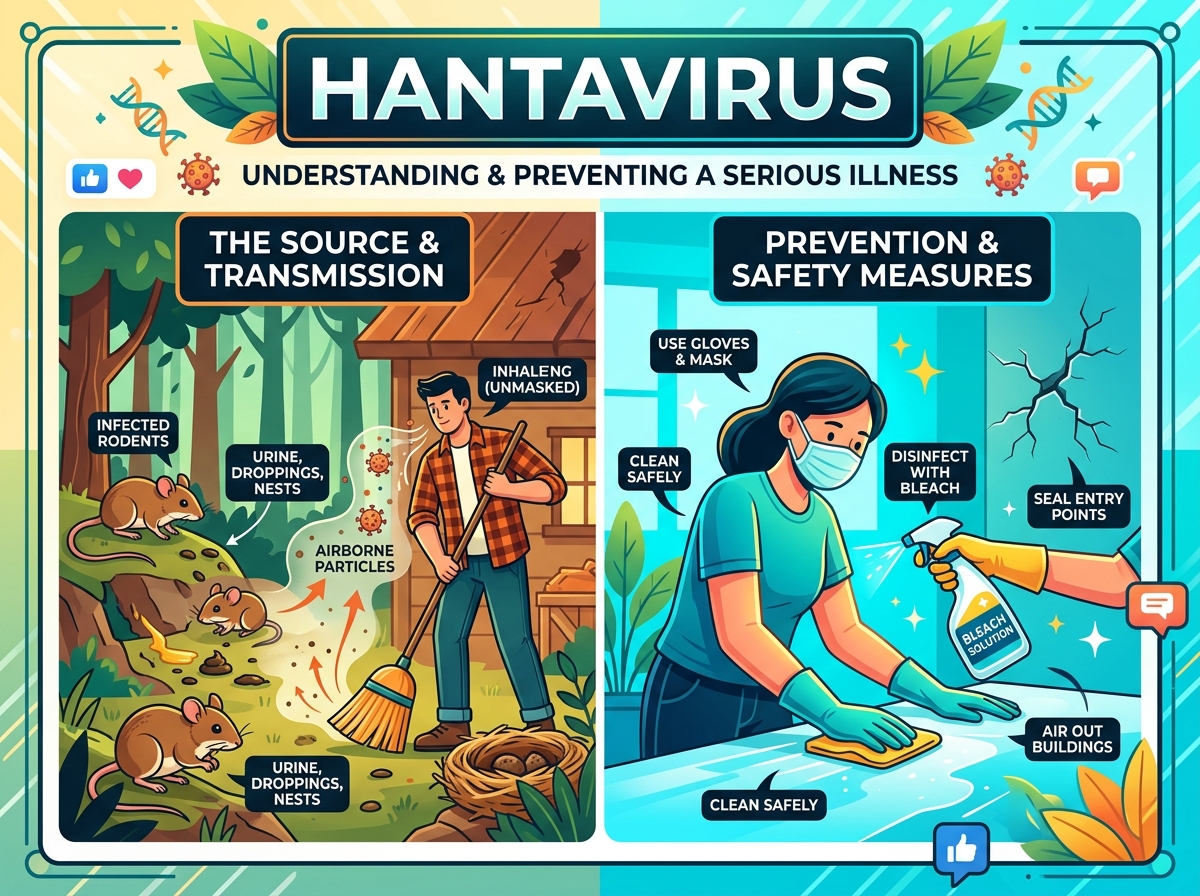
- Avoid sleeping in or near areas with signs of rodent activity, droppings, gnaw marks, or nesting material
- If cleaning an area where rodents have been present, wet the surface with a disinfectant solution first. Never dry sweep or vacuum without wetting surfaces, this aerosolises the virus
- Wear gloves and, ideally, an N95 mask when handling anything that may be rodent-contaminated
- Store food in sealed containers; do not leave food waste accessible to rodents
- When camping, use tent floors and avoid sleeping directly on the ground in areas with dense rodent populations
For cruise ship passengers and crew:
- Report any symptoms to the ship’s medical officer immediately, even if they seem minor
- Practice respiratory etiquette: cover coughs and sneezes, wear a mask if you develop respiratory symptoms
- Wash hands frequently, especially after handling luggage or materials that have been stored in areas with potential rodent access
- If you were on the MV Hondius or have recently visited endemic areas in South America, monitor your health for 45 days and seek testing if symptoms appear
What This Outbreak Is Not
A few things worth saying plainly. Hantavirus does not spread through casual contact the way respiratory viruses like influenza or COVID-19 do. You cannot catch it by sitting next to someone on a plane, shaking hands, or being in a shared space. Even the Andes strain, the only one known to pass between humans, requires close, sustained contact, typically the kind seen between household members or in healthcare settings without proper precautions.
The WHO’s repeated “low risk” assessment is not reassuring spin. Globally, hantavirus infections remain rare. In 2025, eight countries in the Americas reported 229 cases and 59 deaths. That is a significant case fatality rate, just under 26%, but the absolute numbers are small. This is not a pathogen positioned to cause a pandemic.
What the cruise ship outbreak does reveal is a gap in preparedness for novel transmission settings and the complications that arise when passengers from 23 different countries disperse across the world before a diagnosis is confirmed. That is the conversation worth having.
Frequently Asked Questions About Hantavirus
Q: Can you catch hantavirus from another person?
In almost all cases, no. Hantavirus spreads to humans from infected rodents, not between people. The one exception is the Andes strain, the strain involved in the cruise ship outbreak, which has been documented transmitting between humans in rare circumstances, typically through very close contact. The WHO considers the risk of person-to-person spread in the current outbreak to be low.
Q: How long does it take for hantavirus symptoms to appear after exposure?
The incubation period is typically one to eight weeks, with most cases appearing two to four weeks after exposure. This long window is one reason why contact tracing is so difficult when passengers have already dispersed globally.
Q: What is the survival rate for hantavirus?
It depends on the strain and the speed of treatment. The Andes virus and Sin Nombre virus in the Americas have the highest fatality rates, up to 50% in some outbreaks. Early admission to an ICU with mechanical ventilation support significantly improves outcomes. There is no specific antiviral treatment; management is entirely supportive.
Q: Is hantavirus dangerous in Europe or Asia?
European and Asian strains cause a different disease (HFRS, affecting the kidneys), with lower fatality rates, generally under 15% and often below 1% with prompt treatment. The Andes strain involved in the MV Hondius outbreak is an American strain not found naturally in Europe or Asia.
Q: Should I cancel a trip to South America because of hantavirus?
No. Hantavirus remains rare even in endemic areas. The risk is primarily associated with rural environments where rodent contact is possible, not with cities, hotels, or cruise ships under normal circumstances. Standard travel precautions, avoiding rodent-infested areas, not handling wild rodents, and keeping food stored properly, are adequate for most travellers.
Q: Is the MV Hondius outbreak a sign of a new pandemic?
No. WHO has explicitly and repeatedly stated this is not a pandemic-level event. The total confirmed case count is in single digits. The virus is not airborne in the way that enables rapid widespread transmission. The international response reflects appropriate caution given the Andes strain’s rare but documented person-to-person transmission capacity, not evidence of a new global health emergency.
Q: What should I do if I was on the MV Hondius?
Follow your national health authority’s guidance and monitor yourself for symptoms for 45 days after your last potential exposure. Contact your doctor and inform them of your travel history if you develop fever, muscle aches, respiratory symptoms, or gastrointestinal illness. Do not wait for symptoms to become severe before seeking care.