Every year, the Commonwealth Scholarship Commission in the United Kingdom awards full funding to postgraduate students from low and middle-income Commonwealth countries, including Nigeria. The scholarship is administered by the UK Foreign, Commonwealth, and Development Office and is explicitly designed for people who cannot afford to study in the UK on their own. For Nigerian applicants, this is not a vague international opportunity buried in a government database. It is a structured, well-funded program with a clear application pathway, and thousands of Nigerians have used it to pursue master’s and PhD degrees at British universities.
The process for Nigerian applicants runs through two channels simultaneously: the Commonwealth Scholarship Commission’s own online portal and the Federal Scholarship Board, which serves as Nigeria’s national nominating agency. Understanding how both sides work is the difference between a well-prepared application and one that gets stuck before it leaves the country.
Commonwealth Scholarship for Nigerians

The Commonwealth Scholarship for Nigerians is a fully funded postgraduate award covering tuition fees, monthly living allowances, and return airfare from Nigeria to the UK. It sits under the Commonwealth Scholarship and Fellowship Plan, which the UK government has operated since 1960. For Nigerian students, the route into this program runs through the Federal Scholarship Board before reaching the Commission itself, and the selection criteria are strict on both academic standing and demonstrated commitment to contributing to Nigeria’s development after the degree is completed.
What the Commonwealth Scholarship Actually Is
The Commonwealth Scholarship Commission runs several distinct scholarship programs, and Nigerian applicants can qualify for more than one depending on their circumstances. The main routes are the Commonwealth Master’s Scholarships, the Commonwealth PhD Scholarships, and the Commonwealth Shared Scholarships.
Commonwealth Master’s Scholarships are agency-nominated awards for candidates from low and middle-income Commonwealth countries who want to pursue full-time taught master’s degrees at UK universities. These scholarships are specifically aimed at people who could not otherwise afford UK study. Applications do not go directly to the Commission but through a national nominating agency, which for Nigeria is the Federal Scholarship Board.
Commonwealth PhD Scholarships follow a similar structure but are restricted to candidates from least developed countries and vulnerable states. Nigeria qualifies for this category. PhD applicants must already have a confirmed connection with a UK university before nominating agencies will forward their applications.
Commonwealth Shared Scholarships operate differently. They are jointly funded by the Commission and participating UK universities and are targeted at development-related master’s courses. Unlike the main Master’s Scholarships, these have a direct application route to the Commission without going through a national nominating agency, though Nigeria must still be on the eligible countries list, which it is.
What the Scholarship Covers
The financial package is comprehensive. Tuition fees are fully paid, and the scholar is not liable for any portion of the cost. On top of that, the Commission pays a monthly living allowance to cover accommodation, food, and daily expenses while the scholar is in the UK.
For the 2025-2026 academic year, the Commonwealth Master’s Scholarships stipend was set at GBP 1,452 per month, with a higher rate of GBP 1,781 per month for scholars based at universities in the London metropolitan area. The Commission updates these figures periodically, and applicants should verify the current rates on the official CSC website before budgeting.
Beyond the monthly allowance, the package includes economy-class return airfare from Nigeria to the UK and back at the end of the award period. There is a warm clothing allowance for scholars arriving from tropical climates, a study travel grant for academic trips within the UK or overseas, and a thesis grant to help with dissertation preparation costs. Scholars who are single parents with children under 16 may also qualify for a child allowance.
The Commission also covers the cost of the mandatory tuberculosis test required for UK visa applications, which is a detail many Nigerian applicants overlook until they are deep into the process.
Who Can Apply: Eligibility Criteria
The core eligibility requirements come from the Commission and apply to all applicants regardless of which nominating route they use. The first is Nigerian citizenship and residency. You must hold a Nigerian passport or national ID and must be a permanent resident in Nigeria at the time of applying. The scholarship is designed for people studying from within a Commonwealth country, not those who have already relocated abroad.
For Master’s Scholarships, the academic minimum is a first degree with at least Second Class Upper Division, which in Nigerian university grading means a 2:1. For PhD Scholarships, the Commission and the Federal Scholarship Board have stated that Second Class Lower Division is accepted at the first-degree level. The FSB announcement for the 2026/2027 cycle confirmed these thresholds.
NYSC discharge or exemption certificate is required. This is mandatory for Nigerian applicants applying through the Federal Scholarship Board and reflects the national requirement that eligible graduates have completed or been formally excused from the National Youth Service Corps.
Applicants must also be unable to fund UK study independently. This financial need criterion is written into the scholarship’s stated purpose. The program is for people who would not otherwise have access to UK postgraduate education, not as a supplement for those who could cover costs through other means.
There is no upper age limit set by the Commission, though the FSB advises checking employer requirements for leave of absence if relevant. Applicants must also be available to begin UK study in September or October of the relevant academic year.
The Two-Stage Nigerian Application Process
Nigerian applicants deal with two separate processes running in parallel: the Federal Scholarship Board’s national nomination process and the Commonwealth Scholarship Commission’s own online system, CSC Central.
The FSB handles Nigeria’s end. When the Commission opens applications for a new cycle, the Federal Ministry of Education announces the opening through the FSB, publishing a formal notice on the education.gov.ng website. Nigerian applicants must complete the FSB’s Electronic Application System (EAS) during the window the Board specifies. For the 2026/2027 cycle, the FSB opened applications on September 2, 2025, with a deadline of October 14, 2025.
Candidates who meet the FSB’s initial screening then progress to a nomination interview, which the Board holds in Abuja. For the 2026/2027 cycle, interviews ran from November 3 to 7, 2025, at the Federal Scholarship Board’s offices opposite the Federal Ministry of Justice. Candidates were split across days by geopolitical zone. The FSB then nominates successful candidates to the Commission, with nominations submitted by December 2025.
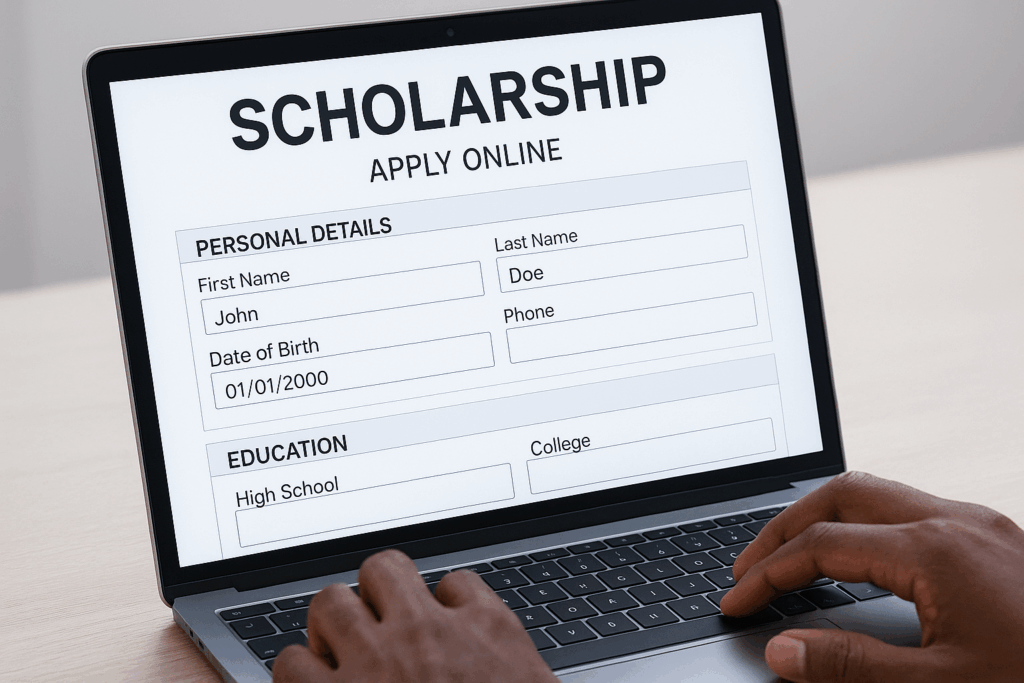
Simultaneously, all applicants must apply through CSC Central, the Commission’s own online portal at portal.csccentralonline.org.uk. The Commission cannot accept applications submitted outside this system. The form requires two-factor authentication, and applicants should use the save function frequently as refreshing the browser window causes unsaved data to be lost. Applications cannot be edited after submission.
A nomination from the FSB is not the same as a scholarship offer. The Commission makes its own selection from the pool of nominated candidates, and applicants are notified of outcomes by July in the award year.
Documents You Need to Submit
The Commission’s mandatory documents are specific, and missing any of them makes an application ineligible. These are the documents that must be uploaded to CSC Central:
A valid passport or national ID showing photograph, date of birth, and Nigerian citizenship. Full academic transcripts covering all higher education qualifications, including in-progress transcripts if currently enrolled. Where any transcripts are missing or incomplete, the application is automatically disqualified. Two reference letters from academic or professional contacts, in PDF format, signed and either on institutional letterhead or sent from an official email address that clearly identifies the sender.
PhD applicants have an additional requirement: a supporting statement from the UK university where they intend to carry out their research. This means PhD candidates must already have established contact with a potential supervisor at a UK institution before applying.
The FSB also requires proof of NYSC completion or exemption and, for its nomination process, evidence of admission from at least two UK universities. This two-admission requirement is specific to the Nigerian nomination process and is not a Commission-wide rule, but it applies to all applicants going through the FSB route.
What the Selection Committee Is Looking For
The Commission is explicit about its selection criteria. Academic merit matters, but it is evaluated alongside two other factors: the applicant’s potential to contribute to Nigeria’s development after returning, and the relevance of the proposed area of study to Nigeria’s development needs.
The Commission’s six development themes guide what counts as relevant: science and technology for development, strengthening health systems and capacity, promoting global prosperity, strengthening global peace, security and governance, strengthening resilience and response to crises, and access, inclusion and opportunity. Applications that connect proposed study to one of these areas are more competitive than those with no clear development rationale.
References play a more significant role than many applicants expect. The Commission gives referees a detailed list of what their letters should address, including the applicant’s analytical capacity, capacity for original thought, and potential to drive development in Nigeria. A reference that does not speak to these dimensions is weaker than one written with the Commission’s stated criteria in mind. Applicants should provide referees with the Commission’s guidance notes before asking them to write.
The personal statement is where the development commitment must come through clearly. Nigerian applicants have performed well in recent cycles with proposals in fields like renewable energy, public health, data science, education policy, and financial technology, because each of these connects directly to documented challenges in Nigeria. A proposal that could apply to any country, without specific grounding in Nigerian conditions or challenges, tends to be less convincing.
Application Timeline and Deadlines
The schedule runs on a fixed annual cycle. The Commission opens applications in September each year for the following academic year’s cohort. For the 2027/2028 cycle, applications are expected to open in September 2026, following the same pattern as previous years.
The FSB typically publishes its own announcement shortly after the Commission opens the cycle and runs its national application window through October. Nomination interviews follow in November, with the FSB forwarding nominations to the Commission by December. The Commission then runs its selection process through the first half of the following year, with results communicated to applicants by July.
One practical implication of this timeline is that Nigerian applicants need to begin securing UK university admissions well before September, since the FSB requires evidence of two admissions when submitting through the national process. This means applicants should be approaching UK universities for conditional or unconditional offers in the months before the scholarship cycle opens.
Mistakes That Get Nigerian Applications Rejected
Incomplete transcripts are the single most common eligibility-disqualifying error. The Commission’s rules are categorical: if any transcript pages are missing, the application is ineligible. Nigerian applicants dealing with universities that issue incomplete or delayed academic records need to resolve those issues before applying, not after.
Uploading reference letters as Word documents or in formats other than PDF also causes rejections. All supporting documents must be in PDF. Letters that arrive directly from referees to the Commission outside the online portal are not accepted regardless of timing.
Attempting to apply directly to the Commission without going through the FSB is another error specific to Nigerian applicants. Nigeria is a national nominating agency country, which means the CSC requires applications to come through the FSB first. A Nigerian who submits through CSC Central but is not nominated by the FSB is applying outside the correct channel.
On the FSB side, not having two UK university admissions secured by the time of the nomination application is a frequent disqualifier. Applicants should approach UK universities early, apply to multiple institutions where possible, and ensure they have at least conditional offers before the FSB window opens.
What Happens After You Win
Scholars who receive the award join a community that the Commission takes seriously as a long-term network. Upon completing the scholarship, recipients are expected to return to Nigeria for at least two years. This return obligation is a formal condition of the award, not a preference, and it reflects the program’s development mandate.
After returning, scholars join the Commonwealth Alumni network, which includes former awardees working across government, academia, civil society, and the private sector in Nigeria and across the Commonwealth. The network includes alumni who have gone on to hold senior government positions, lead research institutions, and run development-focused organizations. For Nigerian scholars returning to careers in fields like health policy, education reform, or technology, the network has practical professional value.
The Commission also runs a mentoring program and an Alumni Community Engagement Fund, which provides small grants for alumni-led projects that connect scholarship outcomes to development work in their home countries. Nigerian alumni who return with a clear plan for applying their UK training have access to this additional support.
Conclusion
The Commonwealth Scholarship is one of the most structured fully funded pathways available to Nigerian postgraduate students who want to study in the UK. The financial package is generous, the academic communities involved are among the strongest in the world, and the process, while demanding, is clearly documented. What distinguishes successful Nigerian applicants is not just their academic record but the clarity with which they connect their proposed study to real, verifiable challenges in Nigeria and the credibility of their plan to bring that training home.
The FSB nomination interview and the Commission’s own selection process both assess development impact, not just grades. Nigerian applicants who understand this from the beginning and build their applications accordingly will find themselves significantly better positioned than those who treat this as a generic scholarship competition. The next cycle is expected to open in September 2026. Applicants should begin preparing their UK university applications now.