On the morning of May 13, 2026, a Federal High Court in Abuja delivered one of the most consequential corruption verdicts in Nigerian history. The dock was empty. Saleh Mamman, the man being sentenced, was not there. His lawyer told the court he could not reach him. Phone calls had gone unanswered. Nobody knew where he was.
Justice James Omotosho proceeded anyway. When it was done, Mamman had been sentenced to 75 years in prison for laundering 33.8 billion naira that was earmarked for two of Nigeria’s most critical power infrastructure projects: the Mambilla and Zungeru hydroelectric plants. The sentences were ordered to run consecutively. He would not be eligible for any reduction option on most counts. The court ordered Interpol and all Nigerian security agencies to find him and deliver him to the Nigerian Correctional Service.
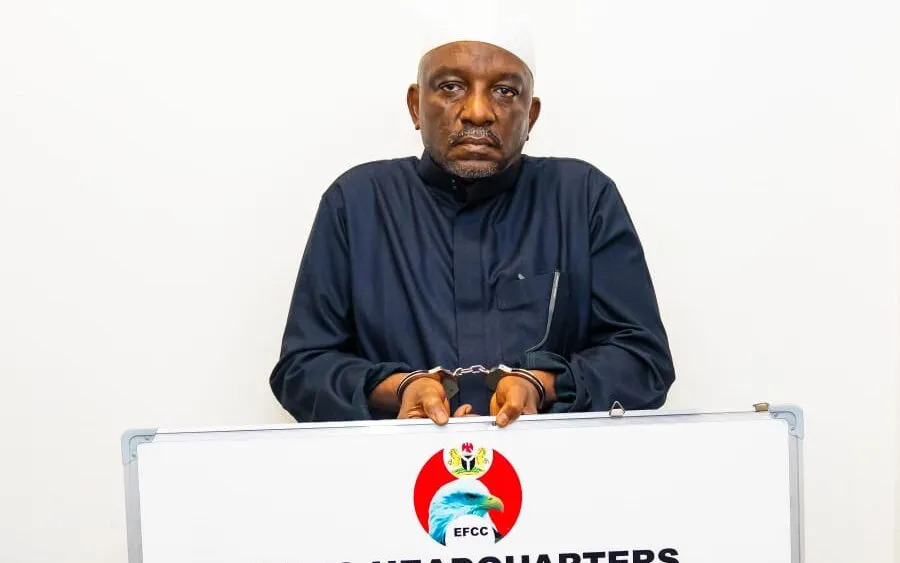
Six days later, at 3:30 in the morning on May 19, 2026, EFCC operatives located and arrested Mamman in Rigasa, Kaduna State, where he had been hiding with two others who were also taken into custody.
Why Saleh Mamman Was Sentenced to 75 Years in Prison
The sentence against former Minister of Power Saleh Mamman is rooted in a pattern the court found to be systematic, deliberate, and extensive. Over the course of a two-year ministerial tenure, billions of naira that should have gone toward building the electricity infrastructure Nigerians have waited decades for were instead routed through proxy companies, bureau de change operators, and private accounts. The 75-year sentence reflects not just the scale of the theft, but the court’s determination that every count would be accounted for separately.
Who Is Saleh Mamman?
Mamman Kwagyang Saleh was born on January 2, 1958, in Taraba State. He began his professional life in 1981 as a teacher at a technical school in Mubi, Adamawa State. In 1992, he transferred to the Taraba State Ministry of Works, eventually rising to the rank of Assistant Director in charge of Electrical Services. He retired from civil service in 2002 and moved into business and politics full-time.
He holds a Higher National Diploma in Electrical Electronics from Kaduna Polytechnic, which he obtained in 1988, and a Master of Business Administration from Bayero University Kano, which he completed in 2015. His background in electrical engineering and his political alignment with what became the All Progressives Congress made him a credible candidate for one of the most technical cabinet portfolios in the country.
President Muhammadu Buhari swore him in as Minister of Power on August 21, 2019. He served until September 1, 2021, when Buhari sacked him during a cabinet reshuffle and replaced him with Abubakar Aliyu, then Minister of State for Works and Housing. His successor at the ministry was Babatunde Fashola, who had held the combined Ministry of Power, Works and Housing in the previous cabinet.
The Two Projects at the Centre of the Case
The fraud charges centred on funds allocated to two specific hydroelectric power projects: the Mambilla Hydroelectric Power Project in Taraba State and the Zungeru Hydroelectric Power Project in Niger State.
The Mambilla project is, in scale, one of the most ambitious infrastructure proposals in Nigeria’s history. First conceived in 1972 under the military administration of General Yakubu Gowon, the plant is designed to generate 3,050 megawatts of electricity from a complex of four dams and two underground stations along the Taraba River. After more than five decades, billions of naira in feasibility studies, and a long-running international arbitration dispute with Sunrise Power and Transmission Company, the project has not broken ground in any meaningful sense. The story of Mambilla is, in many ways, a catalogue of every structural failure in Nigerian public administration: contract disputes, political interference, and recurring financial diversion.
Zungeru, the second project, is located in Niger State and has a planned generation capacity of 700 megawatts. It is further along in execution than Mambilla and is partially operational, though its development has been marked by delays and technical setbacks. Both projects received substantial federal budgetary allocations under the Buhari administration, and it is from those allocations that the EFCC alleged the diversions took place.
How the Fraud Worked: What the EFCC Established in Court
The EFCC arraigned Mamman at the Federal High Court in Abuja on July 11, 2024, on a 12-count charge of conspiracy and money laundering. The total value of the alleged diversion was 33,804,830,503.73 naira, slightly over 33.8 billion naira.
During the trial, the prosecution called 17 witnesses and tendered 43 exhibits. The picture they painted was methodical. Funds that had been released for the Mambilla and Zungeru projects were moved outside the regulated banking system. Large sums were converted into foreign currencies through bureau de change operators, bypassing the scrutiny that formal financial channels would have required. Properties in Abuja were purchased using cash transactions that violated Nigeria’s Money Laundering (Prohibition) Act of 2011.
One transaction the court examined closely involved a cash payment of $655,700, equivalent to approximately 200 million naira at the time, made in December 2019 to a company called Mohiba Investment Ltd for a piece of land in Abuja. The court found that Justice Omotosho was satisfied beyond a reasonable doubt that at least 22 billion naira had been siphoned through a network of relatives, ministry officials, and private companies acting as proxies. The prosecution established that the scheme involved people with direct access to the ministry’s financial operations.
After the EFCC closed its case, Mamman’s legal team filed a no-case submission on November 19, 2025, arguing the evidence was insufficient to require him to mount a defence. Justice Omotosho dismissed the application on December 11, 2025, ruling that the prosecution had established a prima facie case that required a response. The case was adjourned to February 23, 2026, for the defence to begin. Mamman never appeared.
Convicted in Absentia: How the Court Handled His Absence
Mamman’s disappearance before the defence phase of his trial created a procedural test for the court. His lawyer, Mohammed Ahmed, offered explanations for his client’s absence, but Justice Omotosho found them insufficient. On May 7, 2026, the court convicted Mamman in absentia on all 12 counts, ruling that the prosecution had proved its case beyond a reasonable doubt. The judge explicitly characterised the former minister’s absence as a deliberate attempt to obstruct the administration of justice.
Sentencing was fixed for May 13, 2026. On that date, Ahmed appeared in court and told Justice Omotosho that he did not know where Mamman was. Calls to his phone lines had failed to connect. The court proceeded. When asked for the full breakdown of the sentence, Justice Omotosho sentenced Mamman to seven years each on counts 1, 2, 3, 6, 7, 8, 9, 10, 11, and 12 without the option of a fine. He received three years on count 4, with the option of a 10 million naira fine, and two years on count 5 without the option of a fine. All sentences were ordered to run consecutively, bringing the total to 75 years.
The court also ordered the forfeiture of foreign currencies recovered from the convict, along with four properties in Abuja that had been traced to him. Beyond the prison term, Mamman was directed to refund the outstanding balance of the funds specifically tied to the Mambilla and Zungeru projects. Justice Omotosho ordered all security agencies to liaise with Interpol to ensure his arrest and transfer to the Nigerian Correctional Service.
The Manhunt: From Abuja Taxi to Kaduna Hideout
Between the sentencing on May 13 and the arrest on May 19, details emerged about how Mamman had fled. Court proceedings later revealed through testimony from a relative that he had left Abuja by taxi as the trial was closing in on its conclusion. The choice of transport was perhaps designed to avoid detection systems that might flag a prominent former minister travelling through formal channels.
He made his way to Rigasa, a neighbourhood in Kaduna State. EFCC operatives located him there and moved at 3:30 in the morning on May 19, 2026. He was arrested along with two individuals who had been sheltering him, both of whom were also taken into custody. EFCC Chairman Ola Olukoyede confirmed the arrest at a press conference in Abuja. He described the operation as a demonstration of the government’s commitment to pursuing convicted criminals regardless of their political backgrounds.
Mamman was subsequently produced before the Federal High Court in Abuja, which cleared the way for his transfer to Kuje Prison to begin serving his sentence. Under the terms of the judgment, the 75-year sentence officially commenced on the date of his arrest.
A Landmark in Nigeria’s Anti-Corruption Record
The significance of the Mamman conviction extends beyond the facts of a single fraud case. He is the first minister who served in Muhammadu Buhari’s cabinet to be convicted and jailed for corruption. This is not a trivial distinction. Buhari ran for the presidency on an explicit anti-corruption platform, and his administration was marketed, both domestically and internationally, as a credible break from the culture of impunity that had characterised previous governments. That one of his own ministers has now become one of the most heavily sentenced public officials in the country’s history raises uncomfortable questions about what oversight existed at the ministerial level during that period.
Other Buhari cabinet members currently face their own legal battles. Hadi Sirika, former Minister of Aviation, is standing trial. Abubakar Malami, who served as Attorney-General of the Federation, is facing charges. Chris Ngige, the former Labour Minister, is also in court. None of them have been convicted. Mamman, as of his sentencing, stands alone as the only member of that administration to have received a prison term.
The EFCC has described the conviction as a landmark moment in Nigeria’s anti-corruption enforcement. Whether it marks a genuine turning point or remains an isolated case will depend, in part, on how the system handles the other pending matters.
The Mambilla Problem: A Project That Has Defined Institutional Failure
Understanding the Mamman case in full requires understanding what the Mambilla project represents in Nigerian public life. Since it was first proposed in 1972, the dam has been referenced in budget after budget, allocated funds across administrations spanning military and civilian governance, and consistently failed to progress beyond preparatory stages. The core issue has never been the project’s technical feasibility or its strategic importance. Nigeria generates somewhere between 4,000 and 5,000 megawatts of electricity for a population of over 200 million people. A 3,050-megawatt addition would represent a transformative improvement. The project is real, the need is real, and the engineering is understood.
What has gone wrong, repeatedly, is governance. In 2003, the Mambilla contract was awarded to Sunrise Power and Transmission Company on a Build, Operate and Transfer basis by the then-minister Olu Agunloye, who is himself currently being prosecuted by the EFCC. Sunrise, a company with no prior record in major power projects, later took Nigeria to the International Chamber of Commerce in Paris after the federal government tried to cut it out and deal directly with Chinese firm Sinohydro. That arbitration case remains unresolved and has added a foreign legal dimension to the project’s already complicated history.
Mamman’s theft did not happen in a vacuum. It happened inside a project that had already been looted and delayed across decades. The EFCC also has a separate case before the FCT High Court in which Mamman is charged alongside seven others on nine counts of conspiracy, false pretence, and intent to defraud relating to an additional 31 billion naira in Mambilla funds. Co-defendants in that case pleaded not guilty during their arraignment in October 2025. The prosecution alleges that over 26 billion naira in that separate matter was diverted through bureau de change operators under Mamman’s instruction.
Nigeria’s Power Crisis and the Cost of Corruption at the Ministry Level
The most immediate consequence of the kind of diversion established in the Mamman case is that infrastructure that should have been built was not. Nigeria’s electricity problem is among the most discussed and least resolved challenges in its development history. The World Bank has estimated that more than 40 percent of Nigerians have no access to grid electricity. Businesses run generators at significant cost. Manufacturers factor power instability into production planning in ways that reduce competitiveness. The informal estimate used by economists is that unreliable electricity costs Nigeria several percentage points of GDP annually.
Against that background, the diversion of 33.8 billion naira from the Mambilla and Zungeru projects is not an abstraction. Zungeru is now partially operational but has faced delays and technical problems. Mambilla has barely moved. Every year the dam does not exist is a year in which Nigeria’s power deficit does not close. The Mamman conviction does not reverse that. But it does, for the first time, attach a definitive legal consequence to the ministerial-level decisions that perpetuated the deficit.
What Happens Next
Mamman is now in custody at Kuje Prison in Abuja. His 75-year sentence has begun to run. A separate 9-count case linking him and seven others to another 31 billion naira in alleged Mambilla funds is still before the FCT High Court. His co-defendants in that matter have pleaded not guilty.
The Mambilla project remains where it has been for most of the past five decades: unbuilt. The arbitration with Sunrise Power in Paris continues. The feasibility studies are done. The contracts have been awarded, disputed, cancelled, and re-awarded. What has not happened is construction.
For Nigerians who have watched ministers come and go while power supply remained unreliable, the Mamman sentence is significant less for its symbolism than for what it establishes as a precedent. A former federal minister has been convicted, sentenced to 75 years, attempted to flee, and been caught within a week. The EFCC delivered on every stage of that process. What the system does with the cases still pending will determine whether this becomes a pattern or remains, as many such moments have before, an exception.