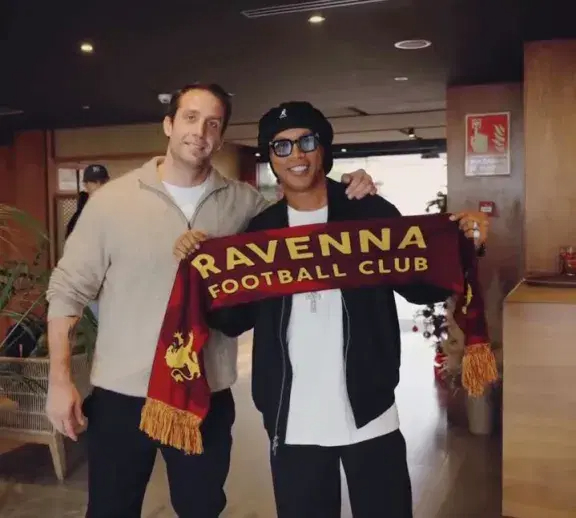
Ronaldinho is going back to Italian football. Not in boots, though, in a boardroom.
The Brazilian World Cup winner has agreed a deal with Serie C side Ravenna FC, the club confirmed on June 19, 2026, more than a decade after he last kicked a ball professionally for Fluminense in 2015. For a few hours after the news broke, social media did what social media does best: ran with the headline and skipped the small print. “Ronaldinho, 46, signs for Italian club” is the kind of sentence that writes its own viral moment, and plenty of fans genuinely believed he was about to turn out in Serie C colours next season.
He isn’t. Ravenna have been quick to clarify that this is an ownership and ambassador arrangement, not a playing contract.
So what exactly did he sign?
According to the club, Ronaldinho becomes a shareholder, strategic investor, and global marketing ambassador for Ravenna. He’ll hold equity in the club and represent it commercially, particularly in markets where his name still moves the needle, the United States and Latin America especially.
Ravenna vice-president Ariedo Braida put it plainly to Tuttosport: Ronaldinho will front a marketing event with the club, but he won’t be turning out in Serie C next season. Braida added that he wished Ronaldinho could still play, calling him “a phenomenon.”
Ronaldinho himself struck a sentimental note in the club’s announcement, saying he can’t wait to get back to “dancing on the ball” alongside Ravenna’s ownership, the Cipriani family, and that football has always been his source of joy. It’s the kind of quote built for a press release, but it’s also very on-brand for a player whose entire career was built on making the impossible look like play.
The formal unveiling is set for Miami on June 23, a deliberate choice of location given the deal’s clear focus on the US and Latin American fanbase rather than the Italian one.
The Braida connection goes back almost 20 years
This isn’t a random pairing of a famous name and a hungry lower-league club. Braida, Ravenna’s honorary vice-president, has known Ronaldinho since 2008, when Braida was AC Milan’s sporting director during the tail end of Ronaldinho’s career at Barcelona and his subsequent move to the Rossoneri. That relationship appears to be the thread that pulled this deal together, and it explains why a third-tier Italian club managed to land a Ballon d’Or winner when bigger names couldn’t.
Who’s actually paying for this — and why Ravenna?
Behind Ravenna sits Ignazio Cipriani, who took majority control of the club in 2024. Cipriani comes from serious money: he’s the son of restaurateur Giuseppe Cipriani Jr and Eleonora Gardini, granddaughter of the late industrialist Raul Gardini, one of Italy’s wealthiest and most storied business dynasties. Cipriani spent 24 years living in the United States before turning his attention to football in his home city.
In the club’s statement, Cipriani called Ronaldinho his childhood idol and said the Brazilian’s influence on the game “goes beyond what he did on the pitch”, the kind of line owners reach for, but in this case one that happens to be true. Cipriani has also said he hopes the move inspires a new generation of fans to fall in love with the club.
For Ravenna, the timing checks out. The club currently sits second in Serie C Group B, having narrowly missed automatic promotion last term, and head coach Andrea Mandorlini, who has Serie A experience, is building a squad capable of pushing up the table again in 2026-27. A name like Ronaldinho’s doesn’t change anything on the pitch, but it does change who’s paying attention, and attention tends to bring sponsors, broadcast interest, and investment that small clubs rarely get on merit alone.
A pattern, not a one-off
This isn’t Ronaldinho’s first commercial venture since retiring. His post-playing career has leaned heavily into ambassadorial roles, and not all of it has gone smoothly, his association with the STAR10 token in 2025 drew accusations of insider trading and was widely flagged by crypto analysts as a familiar celebrity-token cautionary tale, something Ronaldinho has previously denied wrongdoing over. Against that backdrop, a stake in an actual football club with an actual sporting project is, frankly, a far more straightforward use of his name than anything blockchain-related has been.
Quick facts
| Detail | Information |
|---|---|
| Player | Ronaldinho (Ronaldo de Assis Moreira) |
| Age | 46 |
| New club | Ravenna FC |
| League | Serie C, Group B (Italy’s third tier) |
| Role | Shareholder, strategic investor, marketing ambassador |
| Will he play? | No — club has confirmed it is not a playing contract |
| Announced | June 19, 2026 |
| Official unveiling | Miami, June 23, 2026 |
| Last played professionally | Fluminense, 2015 |
| Key connection | Ravenna VP Ariedo Braida, relationship dating to 2008 |
| Ravenna owner | Ignazio Cipriani (majority owner since 2024) |
| Head coach | Andrea Mandorlini |
Frequently asked questions
Is Ronaldinho actually playing for Ravenna FC? No. Despite headlines describing him as “coming out of retirement,” club officials including vice-president Ariedo Braida have confirmed Ronaldinho will not feature in competitive Serie C matches. His role is ownership and ambassadorial.
What division does Ravenna FC play in?
Ravenna competes in Serie C, the third tier of Italian football, in Group B. The club currently sits second in the table after narrowly missing promotion the previous season.
When was Ronaldinho’s deal with Ravenna announced?
The deal was announced on June 19, 2026. An official unveiling event is scheduled for Miami on June 23, 2026.
Why did Ronaldinho choose Ravenna FC specifically?
The connection runs through Ravenna’s honorary vice-president Ariedo Braida, a former AC Milan sporting director who has known Ronaldinho since 2008. Ravenna’s owner, Ignazio Cipriani, has also described Ronaldinho as a childhood idol.
When did Ronaldinho retire from professional football?
Ronaldinho last played professionally for Brazilian club Fluminense in 2015, ending a career that included World Cup glory with Brazil in 2002 and Ballon d’Or success in 2005.