There is a particular kind of hustle that has been going on quietly in Lagos, Abuja, Port Harcourt, and every other city where young Nigerians are trying to carve out a living outside the civil service ladder. A guy in Surulere takes a weekend design course, starts making flyers for small businesses in his estate, and within a year he is billing clients monthly. A girl in Warri teaches herself Canva on her phone, builds a small portfolio of social media designs, and lands her first international client through X before she even turns twenty-two. These are not outliers. Graphic design has become one of the clearest paths from zero to income in Nigeria, partly because the barrier to entry has collapsed over the past few years.
The businesses around you, the churches and mosques printing banners, the vendors running Instagram pages, the tech startups building their brand identities, all of them need someone who can make things look good. And the interesting thing is that many of them cannot afford to hire a full agency. They need a freelancer, a local person they can WhatsApp at 10pm with a brief and get a result by morning. If that person is you, money will come. The question that stops most people from getting there is not ambition. It is not even talent. It is not knowing where to start, especially when you are trying to do it without spending money you do not have.
That is exactly what this guide deals with. There are real free resources available to anyone with a device and an internet connection, and there is a realistic path from beginner to paid work that does not require you to spend money upfront. You do not need to enroll in a school in Victoria Island. You do not need to buy Adobe software. What you need is a clear-eyed plan and the discipline to follow it.
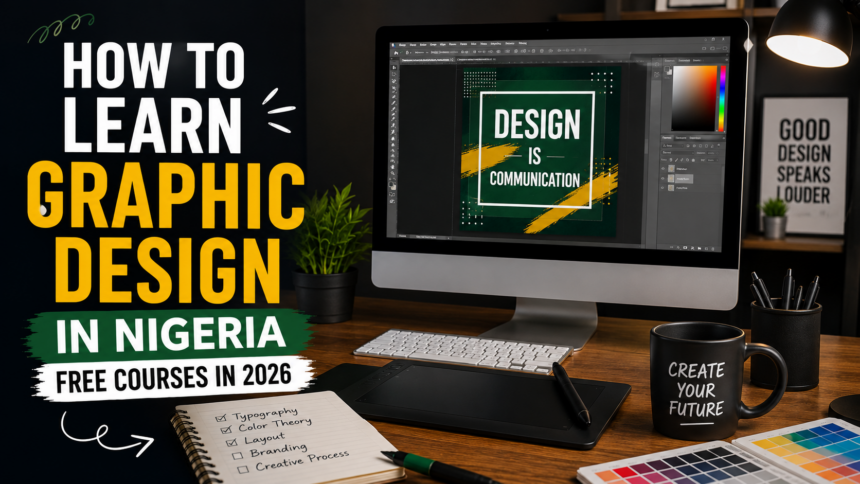
How to Learn Graphic Design in Nigeria: Free Courses (2026)
The opportunity to learn graphic design in Nigeria through free courses has never been more accessible, and in 2026, the tools and platforms available to a beginner with nothing but a phone or a modest laptop are genuinely good. What follows is a practical breakdown of where to start, what to use, what to expect in terms of how long it takes to get skilled enough to earn, and how to position yourself once you are ready to find work.
Why Graphic Design Is Worth Learning in Nigeria Right Now
The demand for visual content in Nigeria has grown faster than the supply of trained designers, and this gap is where opportunity sits. Every brand, whether it is a small food business in Ibadan or a fintech startup in Lagos, needs someone who can handle social media graphics, pitch deck visuals, promotional flyers, and brand identity materials. The ones that cannot pay agency rates, which is most of them, are actively looking for freelancers and in-house hires who charge reasonable rates.
Salary data reflects this demand. According to PayScale figures updated in late 2025, the median salary for a graphic designer in Nigeria sits at around 373,000 naira per year, but that number does not tell the full story. The top 10 percent of earners on that same dataset make up to 2 million naira per year in base salary alone. On Glassdoor, based on submissions collected through December 2025, designers in Lagos report average pay of 175,000 naira per year, with top earners clearing 736,000 naira at the 90th percentile. Freelance rates tell a different story: those who set their own prices and work with multiple clients are charging between 3,000 and 10,000 naira per hour, meaning a person handling four client accounts monthly can far exceed what any salaried role would pay.
Job board data reinforces this. In a single snapshot from HotNigerianJobs in March 2026, there were 63 active graphic designer vacancies in Nigeria. The salaries ranged from 150,000 to 250,000 naira per month for mid-level roles. One remote position, posted by a company called Soar With Us, was offering between $1,100 and $1,600 per month for a designer with two or more years of experience in paid social and performance ad creatives. That is dollar-denominated income for someone sitting in Nigeria, doing work they could learn starting today.
Beyond the raw numbers, graphic design skills sit comfortably inside the kind of portfolio that gives Nigerians access to global platforms like Toptal, Contra, Dribbble, and Behance, all of which allow you to work for clients overseas while billing in hard currency. The naira situation has made this particularly attractive. A designer charging even $500 per project to a client in the UK or Canada is earning what most salaried workers in Lagos take home in two or three months.
What You Actually Need to Start (No, Not a Laptop Worth Half a Million)
This is where a lot of people talk themselves out of starting before they even open a browser. The assumption is that graphic design requires a powerful computer, expensive software, and a stable high-speed connection. That assumption was mostly true ten years ago. It is no longer the full picture.
Canva, one of the most widely used design tools in the world right now, runs in a browser and works on any Android phone made in the last five years. You can build real, professional-looking designs on it for free, no installation required, and it does not demand the kind of processing power that Adobe Photoshop or Illustrator would. Plenty of Nigerian designers, especially those serving the social media content market, run their entire client operation from a phone. It is not ideal for every kind of work, but it is a completely valid place to start.
If you have a laptop, even an older one running Windows 10, GIMP is available as a free download and can handle a wide range of design work. The 3.0 release in 2025 was a significant upgrade, adding multi-select layers, better color management, and fixing a long list of stability issues. It is not Photoshop, but it is not pretending to be. For someone learning raster editing and photo manipulation, it is more than adequate. Inkscape, also free and open-source, handles vector work in a way that is close enough to Illustrator for most beginner and intermediate needs.
Affinity Designer, Photo, and Publisher, which were premium tools before Canva acquired the company, are now free. As of the Canva acquisition, the entire Affinity suite became available at no cost, which is a genuinely significant development for designers who want professional-grade tools without a subscription. Figma’s free Starter plan gives you three design files, three FigJam boards, and 150 AI credits per day. For anyone learning UI design or working on personal client projects, that is workable.
What you genuinely need, at minimum, is something to design on, access to the internet at least a few times a week to access course material and browser-based tools, and consistency. The internet situation in Nigeria is what it is, but most of the course content discussed in this guide can be downloaded or consumed in chunks. It does not require streaming video for six hours straight.
The Best Free Online Courses to Learn Graphic Design in 2026
The volume of free content available is not the problem. The problem is knowing which of it actually teaches you things in the right order, with enough structure to build skill systematically. Random YouTube tutorials will teach you how to do individual things. Structured courses teach you how to think like a designer, which is what clients are actually paying for.
Canva Design School runs completely free courses, and the Design Essentials course alone takes approximately 12 hours to complete. It covers fundamentals including color theory, typography, layout, and hierarchy, the four pillars that govern whether any design looks professional or amateur. You do not need a Canva Pro account to take these courses. The free account is enough.
Alison is one of the more underrated platforms for Nigerians because it is genuinely free to study and complete courses, and the certifications, while not from a university, are shareable and add something concrete to your portfolio. The platform has multiple graphic design courses ranging from a foundational certificate covering design history, semiotics, and visual communication, to a more applied course on visual and graphic design. All courses on Alison are free to enroll in and complete. Certificates carry a cost, but the learning itself does not, and the certificate is optional rather than a requirement to put skills to work.
Coursera hosts a graphic design specialization from CalArts that covers the core principles comprehensively. The course content is free to access; you only pay if you want the certificate. The four-week structure includes hands-on projects with peer feedback, which is more valuable than it sounds. Getting honest feedback on your work from strangers who are also learning is one of the few ways to accelerate your eye for design when you do not have a mentor physically nearby.
For Nigerians specifically interested in the social media design market, which is where a lot of the accessible local work comes from, the free Canva courses on Udemy and Class Central cover social media content creation in enough depth to get you billing clients. Instructors like Ronny Hermosa, a Canva Certified Creative, have courses available at no cost that walk through brand style guides, social media graphics, video editing in Canva, and creating animated posts. These are not shallow tutorials. They are substantial enough to take someone from zero to capable in a specific niche.
ALX Africa runs a Graphic Design programme that has produced working designers in Nigeria, including a designer named Qusim Adeyemi and another named Vivian Ike, both cited on the programme’s website as graduates who built professional portfolios and found clients. ALX takes a structured, portfolio-building approach rather than passive video watching. Each short course within the programme produces a completed project: concept boards, poster design, typographic layouts, editorial spreads, social media campaigns. By the time you finish, you have actual work to show. The programme is self-paced, which matters for Nigerians who are balancing this with other responsibilities.
YouTube remains a supplement worth mentioning even though it lacks structure. For specific software questions, searching for tutorials in Photoshop, Illustrator, CorelDRAW, or Figma on YouTube will give you step-by-step demonstrations that structured courses sometimes skip past. The way to use YouTube correctly is as a reference resource once you have a foundation from one of the platforms above. Watching YouTube tutorials from the start without a course framework usually produces someone who can follow instructions but cannot design independently.
Free Tools That Work Without Paying for Adobe
The Adobe Creative Suite is the industry standard, and knowing your way around Photoshop and Illustrator remains valuable for certain types of work. But Adobe charges in dollars, and even the cheapest individual app plan runs around $22 per month as of 2026. For someone in Nigeria who is still learning, that is not where to start. The honest truth is that several free alternatives are good enough to build real skill and win real clients, at least until you are earning enough to justify the Adobe subscription.
Canva is the most practical starting point for most Nigerians because it combines tools and templates in a way that lets you produce client-ready work quickly, even before you fully understand design principles. Its drag-and-drop interface keeps the friction low, which matters for building momentum in the early weeks when it is easy to get discouraged. The free plan is generous enough for most social media and print work.
GIMP handles raster editing and photo manipulation at a level that was previously only possible in Photoshop. The 3.0 release in 2025 addressed a lot of the historical complaints about the interface and improved stability significantly. If you are learning photo editing for brand photography, product shots, or social media image treatment, GIMP will take you a long way. The learning curve is steeper than Canva, but the depth of capability is much greater.
Inkscape is the Illustrator equivalent for logo work and vector illustration. Logos must be vector files, meaning they are built on mathematical paths rather than pixels, which is what lets a logo scale from a business card to a billboard without losing quality. Understanding this distinction and being able to work in vector format is something many self-taught designers skip, and it limits what clients they can serve. Inkscape teaches you vector thinking at no cost.
Figma’s free plan is most relevant for anyone interested in UI/UX design or brand identity work. If the type of client you are targeting includes tech startups or app developers, Figma is the tool they expect. Learning it on the free tier is realistic. Three design files is a constraint, but it is workable for a student who is learning rather than managing ten active client projects at once.
Photopea is a browser-based tool that runs entirely in your browser, handles PSD files natively, and includes layers, masks, and most of the editing tools you would expect from Photoshop. It is maintained by a single developer and the free version has no feature restrictions. For someone without a strong enough laptop to run heavy software, Photopea is a serious option.
How Long It Takes to Get Good Enough to Charge
There are two different questions buried in this one. The first is: how long until you can make something that looks decent? The second is: how long until you have the skill and the portfolio to charge money with confidence? The answer to the first is a few weeks of consistent work. The answer to the second is realistically two to six months, depending on how seriously you treat the learning and whether you are practicing on real briefs or just playing around.
The most common mistake people make is treating design as something they will practice when they feel ready. Skill in design is built by doing actual work, not by watching tutorials. Every week spent only consuming content without producing designs is a week of slow progress. The way to accelerate is to complete the structured courses and simultaneously create designs from real briefs: take a local business you know, imagine you are their designer, and build them a set of social media graphics or a simple logo. Do this repeatedly with different types of businesses until you have a body of work.
The learners who move fastest are the ones who start taking small-paying work early, even before they feel confident. Working with a real client creates a kind of urgency and feedback loop that self-directed practice cannot replicate. You will make mistakes. A client will reject something and explain why. You will redesign it, and in doing so you will understand something about design that no tutorial could have taught you in that way. Getting paid while still learning is not dishonest. It is how every professional graphic designer in Nigeria started.
Industry estimates suggest that learning design basics takes two to three months with dedicated study, and becoming genuinely proficient requires six to twelve months of consistent practice. That range tracks with what you see from Nigerians who document their learning journeys online. The ones who are earning within six months are those who treated it like a job from day one.
Where Nigerians Are Finding Graphic Design Work and Clients
The local market and the international market operate differently, and smart designers work both at once. Local clients, meaning Nigerian businesses, churches, event planners, fashion brands, and food businesses, are your first customers because trust is lower-barrier. Someone will hire you because their neighbor recommended you, or because you are in the same WhatsApp group as them. These clients often pay in naira but provide consistent work and referrals that compound over time.
Twitter, now X, has been particularly good for Nigerian designers. The design community there is active, and posting your work consistently attracts attention from both local and diaspora clients. Several Nigerian designers report landing their first international clients through X simply by posting work regularly and being visible in conversations about design. The same applies to LinkedIn for more corporate and B2B clients, and Instagram for lifestyle brands and the fashion market.
Fiverr and Upwork remain the most common entry points to international freelancing for Nigerians. Fiverr suits designers who can package specific services clearly, for example, a social media kit, a logo package, or a flyer set. Upwork favors designers with a history of completed jobs and strong reviews. Both platforms are competitive, which means your first priority when you join either is accumulating reviews quickly, even at lower rates, before you push prices up. The platforms also make it possible to display your work portfolio to prospects who might never otherwise find you.
Behance and Dribbble are portfolio platforms specifically for designers, and being visible there matters more than most beginners realize. International creative directors and marketing managers browse both platforms when they need to hire. Nigerian designers who maintain a strong, active presence on Behance have been hired by global agencies without ever applying to a job formally. Your portfolio on these platforms is essentially a passive job application running at all times.
Building a Portfolio When You Have Nothing to Show Yet
Almost every designer who has successfully freelanced has at some point built a portfolio that included work that was not commissioned by a paying client. Spec work, which means designs created for real or imaginary brands without a brief, is how designers demonstrate what they are capable of before they have client work to show. This is not a shortcut or a trick. It is simply what you do when you are building reputation with nothing yet behind you.
Pick five Nigerian brands you know and admire, whether they are established companies or small businesses in your area, and design something for each of them. Redesign a menu. Create a social media campaign for a local restaurant. Build a brand identity concept for a startup that does not exist yet but could. The quality of thinking you put into these pieces, the understanding of the business, the audience, the message being communicated, is exactly what sophisticated clients are evaluating when they look at your portfolio.
The ALX programme referenced earlier specifically builds portfolio pieces through its course projects: poster design, typographic layouts, editorial spreads, brand strategy work. If you go through a structured programme like that, you graduate with artifacts that can be displayed immediately. This is part of why structured courses beat random tutorials for anyone serious about finding clients: they produce work you can show.
When you do start getting early client work, even small unpaid or low-paid work for family and friends, document everything carefully. Take screenshots, export high-quality final files, note what the brief was and how you solved it. The ability to explain your design decisions, not just show the finished product, is what separates a designer who wins good clients from one who only wins clients who want cheap.
What Makes the Difference Between Designers Who Earn and Those Who Struggle
Nigeria has produced enough working graphic designers at this point that patterns have emerged. The ones who build stable income are not necessarily the most technically gifted. They are the ones who understand clients, communicate clearly, meet deadlines, and keep building their visibility even when work is coming in. The ones who struggle are often technically decent but inconsistent, poor at managing client relationships, or simply invisible because they never built a presence anywhere that potential clients look.
Specialization matters more than most beginners expect. A designer who positions themselves as the person for food and restaurant brands, or for Nigerian fashion businesses, or for fintech startups, will find it easier to win clients and justify higher rates than a generalist who does everything. Clients in a specific industry prefer someone who has clearly worked in that space before. Specializing early is counterintuitive when you are trying to build experience, but it pays off faster than staying broad.
Understanding basic business communication is the part nobody teaches in design courses. Responding to enquiries quickly. Writing a clear proposal. Setting scope expectations before you start a project. Knowing when and how to follow up. These are not design skills, but they determine whether clients come back, refer you to others, and pay you without argument. Many Nigerian designers lose repeat business not because their work is bad but because the experience of working with them is frustrating.
Keeping up with tools also matters in a field that moves as quickly as design. Canva, Figma, and Adobe all release significant updates regularly. The designers who stay ahead are the ones who stay curious and adopt new features early. AI tools inside Canva and Figma, image generation tools, and AI-assisted layout suggestions are already changing how fast professional work can be produced. A designer who integrates these effectively can handle more clients with less time, which is the math that makes income grow.
Starting Is the Only Move That Matters
The free resources available to someone learning graphic design in Nigeria in 2026 are genuinely good. Canva Design School, Alison, Coursera’s CalArts course, the ALX programme, Udemy’s free tier content, all of it is accessible to anyone with a browser and the willingness to sit with it consistently. The tools, whether you are working on Canva, GIMP, Inkscape, Figma, or the now-free Affinity suite, are capable of producing professional work that clients will pay for.
What remains is the discipline to show up and build. The designers in this country who have turned graphic design into a full income did not wait for perfect conditions. They started on whatever they had, produced bad work before they produced good work, and kept iterating until the quality and the clients both arrived. That path is available now in a way it has not always been, and the cost of entry for anyone starting today is close to zero.
Nigeria’s creative economy is real. The brands spending money on design are multiplying. The global platforms that connect designers to international clients have not gone away. If you are sitting on this information and not acting on it, the only barrier left is a decision.