Walk into any phone shop from Computer Village in Lagos to Game Blast on Ogbete Market in Enugu, and the conversation almost always comes down to the same two names. Not Samsung, not iPhone. Tecno and Infinix. These are the phones Nigerians are actually buying, arguing about, and returning to buy again. The debate between them has become a permanent fixture in every WhatsApp group that has ever discussed gadgets.
What makes the argument interesting is that both brands come from the same parent company. Transsion Holdings, the Shenzhen-based company that set up its Nigerian subsidiary back in 2008, manufactures both Tecno and Infinix, along with Itel. Same factory pipeline in some cases, same MediaTek chips showing up in both lineups, same Carlcare centres handling repairs across the country. And yet they are not the same phone, and they do not serve the same buyer. The differences are real, they matter, and they are worth understanding before you spend your money.
As of February 2025, Tecno held 23.55% of Nigeria’s smartphone market while Infinix sat just behind at 21.73%. Together, the two brands account for nearly 45% of every phone in active use in this country. The question is not which brand is more popular, because at that scale the answer is essentially both. The question is which one gives you more for what you spend.
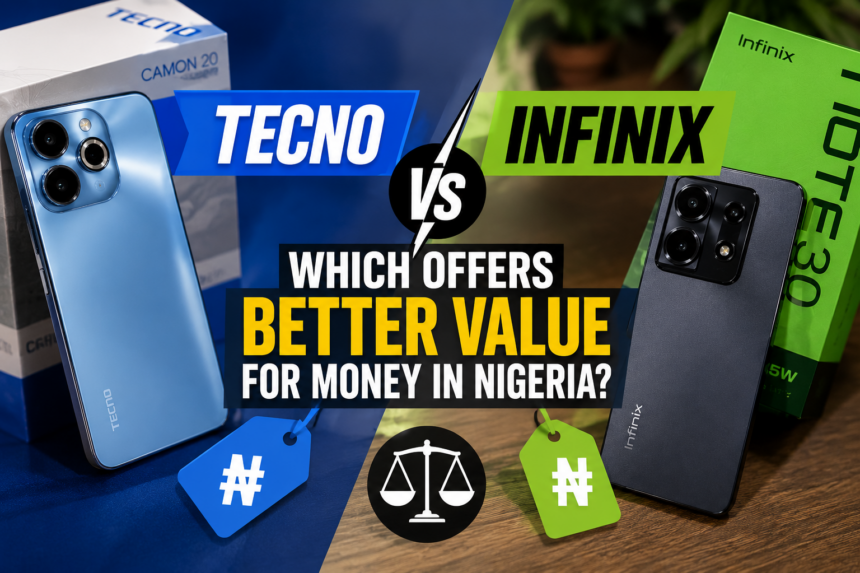
Tecno vs Infinix: Which Offers Better Value for Money in Nigeria
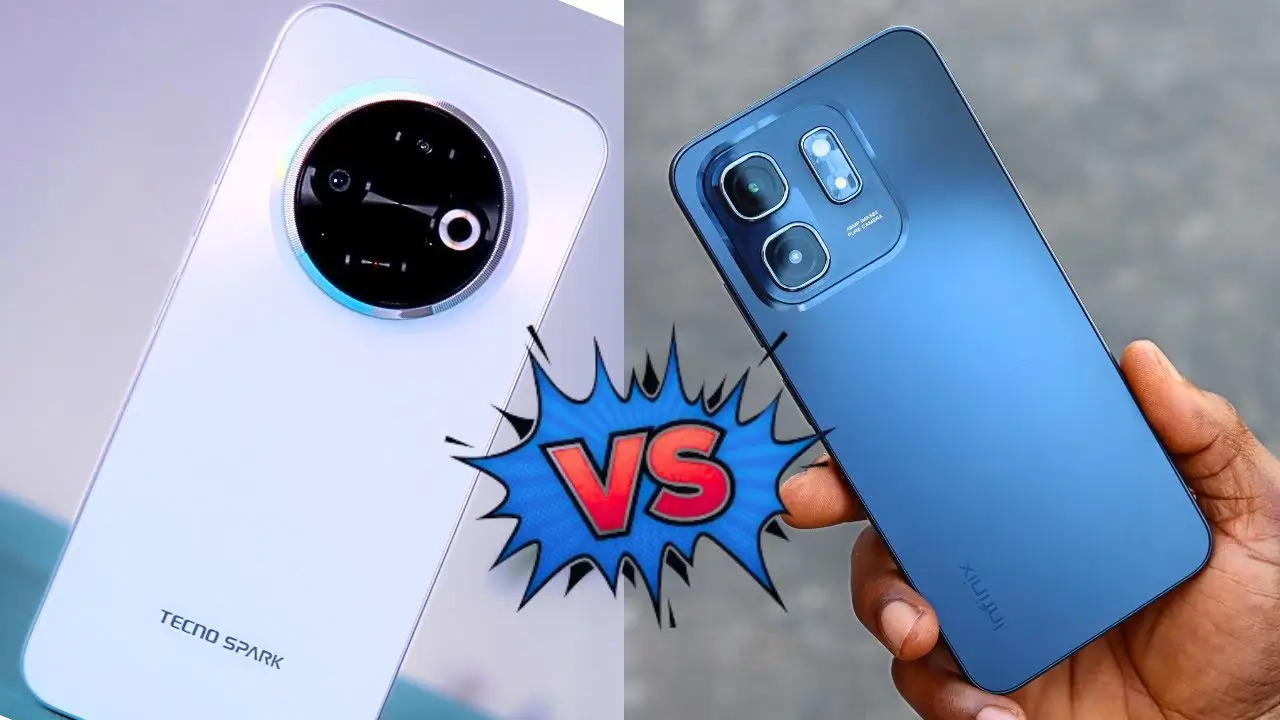
The Tecno vs Infinix debate is not really about brand loyalty, even though it sometimes looks that way online. It is about understanding what each brand is actually optimising for, because the two companies have made different bets on what Nigerian buyers care about most. One is betting heavily on camera performance and a broad reach across price points. The other is banking on raw specs, charging speed, and design language that appeals to a younger, more performance-conscious crowd. Neither bet is wrong. But one of them might be wrong for you.
Two Brands, One Company, Still Two Different Bets
The shared parentage of Tecno and Infinix is not just corporate trivia. It explains why comparing them feels slightly different from comparing, say, Samsung to Xiaomi. Transsion built Tecno first, entering Nigeria with the brand in 2008 when the market was still dominated by Nokia feature phones. Tecno grew up solving very specific problems for the average Nigerian buyer: long battery life, support for multiple SIM cards, and a camera that could handle darker skin tones without washing out the subject. These were not marketing talking points. They were engineering priorities, and they built genuine trust.
Infinix came into the picture later, formally founded in 2013, and was positioned differently from the start. The brand was never trying to be the most affordable thing on the shelf. It was positioned slightly upmarket within the Transsion ecosystem, aiming at buyers who wanted something that looked and felt more premium without crossing into Samsung territory. Infinix’s design language has always reflected this: slimmer profiles, glass-like finishes, AMOLED displays in mid-range models before competitors were offering them at those price points, and an emphasis on charging speed that remains one of its clearest selling points today.
The result is a natural segmentation. Tecno occupies a wider range of price points, from budget Spark and Pop models to the Camon and Phantom flagship tiers. Infinix concentrates more on the mid-range and pushes hard on spec density within that band. A buyer choosing between them is ultimately choosing between two philosophies: Tecno’s broader, camera-first approach versus Infinix’s leaner, performance-first positioning.
What Your Budget Actually Gets You Right Now
Prices have shifted significantly since the naira’s devaluation in 2023. What used to cost N60,000 now sits at N150,000 or more. Both Tecno and Infinix have had to adjust, and their current lineups reflect a market where even budget devices command prices that felt mid-range two years ago.
At the entry level, the Infinix Hot 50 starts from around N125,000 for the base variant, giving you 8GB RAM, 128GB storage, a Helio G100 chip, and an IPS LCD display. The Tecno Spark 30C, a rough equivalent, comes in at similar levels with a 120Hz IPS LCD, 8GB RAM, 50MP main camera, and a Helio G81 processor. At this tier, Tecno edges Infinix on refresh rate for the price, but the performance difference between the Helio G81 and the G100 is not negligible. The G100 is the faster chip.
Step up to the mid-range and things get more interesting. The Infinix Note 50 Pro (8GB/256GB) has been trading from around N250,000 on secondary markets, with official retail closer to N290,000 to N310,000. For that, you get a 6.78-inch 144Hz AMOLED display, a Helio G100 Ultimate processor, 5,200mAh battery with 90W fast charging, IP64 dust and water resistance, and aerospace-grade aluminium framing. That is a lot of phone for the price bracket.
The Tecno Camon 40 (8GB/128GB) sits between N270,000 and N300,000 depending on where you buy. It also runs the Helio G100 Ultimate, has a 6.78-inch AMOLED display at 120Hz, a 5,200mAh battery, and 45W charging. The camera setup is where Tecno plays its card: AI-assisted imaging, OIS, and the FlashSnap mode that the brand has marketed aggressively. Move up to the Camon 40 Pro and you are looking at N374,000 to N380,000 at Slot, with a 50MP autofocus selfie camera added to the front.
At the top of what most Nigerians are realistically spending on these brands, the Infinix Note 50 Pro+ (with a Dimensity 8350 chip, triple rear cameras including a periscope telephoto, and 90W wired plus 30W wireless charging) competes against the Tecno Camon 40 Premier, which packs a Dimensity 8350, 5G support, LTPO AMOLED display at 144Hz, and 70W charging, priced from around N601,000 to N694,300. These are not budget phones anymore, and they are targeting buyers who want serious performance without paying Samsung Galaxy S-series prices.
The Camera Argument: Photography vs Versatility
Camera performance is where the Tecno vs Infinix debate gets loudest, and for good reason. Photography is a primary use case for most Nigerian smartphone buyers, from capturing events to content creation to the everyday social media documentation of Nigerian life. Neither brand is offering the same camera system at the same price point, and understanding the difference matters.
Tecno has been sharpening its camera identity through the Camon series for years. The Camon name is practically synonymous with camera-focused smartphones in the Nigerian market. Tecno’s approach prioritises portrait processing, skin tone accuracy, and low-light performance through its Super Night Mode. The AI photography pipeline has been refined across multiple generations, and in everyday shooting conditions, particularly portraits and food photography, Tecno produces results that tend to be more processed and Instagram-ready out of the camera app.
Infinix’s camera story is more uneven across price points but stronger at the top. The Note 50 Pro’s main 50MP sensor with OIS, f/1.9 aperture, and 8MP ultrawide delivers a more versatile kit than most Tecno devices at the same price. The Note 50 Pro+ goes further with a periscope telephoto at 3x optical zoom, which is genuinely uncommon at this price category in Nigeria. For a content creator who needs range and flexibility, not just processed portraits, the Note 50 Pro+ becomes genuinely compelling.
The selfie camera is another point of real divergence. Tecno’s Camon 40 Pro ships with a 50MP autofocus selfie camera, which is significant for a mid-range device. Infinix’s Note 50 Pro comes with a 32MP front shooter that is very capable but lacks autofocus on some variants. For Nigerians who depend heavily on front-facing cameras for videos, content, and everyday photography, Tecno’s selfie system is a meaningful advantage in the mid-range.
The honest summary: if you mostly shoot selfies, portraits, and social media content, Tecno’s camera processing will serve you well and feels more polished at similar price points. If you want rear camera versatility, wider focal length options, and you are buying at the N400,000 and above tier, Infinix’s Note 50 Pro+ offers features that Tecno simply does not match at the same price.
Battery and Charging: Where Nigerians Feel the Difference Most
Power supply is not a background concern for Nigerian phone buyers. It is a primary selection criterion. The unreliability of electricity supply means battery capacity and charging speed directly affect daily productivity in a way that is harder to explain to someone buying a phone in Europe. A phone that charges from zero to full in 30 minutes is not a luxury feature here. It is the difference between being ready for the day and being stranded.
Both brands have taken this seriously. The standard 5,000mAh battery appears across most of both lineups, which covers most people through a full day of use comfortably. But charging speed is where Infinix has consistently pulled ahead.
The Infinix Note 50 Pro carries a 5,200mAh battery with 90W fast charging, taking it from flat to full in roughly 30 minutes under testing conditions. The Note 50 Pro+ adds 30W wireless charging to that, which is rare at the price point. Tecno’s Camon 40 series comes with 45W charging on the Camon 40 and Camon 40 Pro, and 70W on the Camon 40 Premier. The gap between 45W and 90W is not marginal. At 45W, you are looking at a charging window closer to 50 to 60 minutes for a similar battery size. In a household that relies on generator power or inverter time windows, that difference is concrete.
Tecno’s Camon 40 Premier does close the gap at the premium tier with 70W charging, and the Pova series (Tecno’s gaming-oriented line) has historically pushed larger batteries. But for the majority of buyers spending between N250,000 and N380,000, Infinix’s charging advantage is real and sustained.
Performance and Chipsets: Specs That Matter for Daily Use
The MediaTek Helio G100 and G100 Ultimate chips appear in both brands at the mid-range, which creates some parity on paper. But the way each brand configures RAM, storage options, and software matters as much as the raw chip specification.
Infinix’s XOS interface has been criticised historically for bloatware, but recent versions have improved. The Note 50 series shipped on XOS 15 over Android 15, with Infinix committing to two major Android upgrades and three years of security patches. Tecno’s HiOS has undergone similar refinements and similarly promises Android update support, though the real-world update delivery across Nigeria has been inconsistent for both brands on older devices.
For gaming, Infinix’s GT series (the GT 20 Pro was the flagship gaming device in 2024) is the more focused option. Tecno does not have a dedicated gaming sub-line in the same way. If you are buying a phone primarily to run BGMI, Call of Duty Mobile, or eFootball on reasonable settings, Infinix’s gaming-positioned devices give you more configuration control around frame rates, touch response, and cooling than anything in Tecno’s lineup at a comparable price.
For general daily use, social media, video streaming, WhatsApp, banking apps, and light multitasking, the difference between any G100-equipped device from either brand is not something most users will notice in practice. The chip handles these tasks without friction. Where you will notice a difference is sustained multitasking: keeping many apps open simultaneously, editing video on the phone, or running multiple large apps in split-screen. At those tasks, devices with more RAM and faster UFS 2.2 storage (which the Note 50 Pro offers) will respond more smoothly over time.
After-Sales Support and the Carlcare Reality in Nigeria
Both Tecno and Infinix are serviced through Carlcare, Transsion’s after-sales brand. By 2024, Carlcare had established 86 official service centres and over 1,000 repair stations across Africa, making it the largest mobile service network on the continent. In Nigeria, Carlcare centres operate in Lagos, Abuja, Port Harcourt, Kano, Ibadan, Enugu, and other major cities, with authorised repair agents filling the gaps in smaller towns.
The shared service infrastructure is one of the most underappreciated advantages of buying within the Transsion ecosystem. When a Samsung or Xiaomi user in Owerri needs a screen replaced, the options are often third-party technicians or a journey to a major city. A Tecno or Infinix user in the same situation has more official repair access than most competing brands offer.
The practical distinction for a buyer choosing between the two brands is minimal on the after-sales side. Both phones go to the same technicians, often the same spare parts supply chain, and the same warranty terms. Where there are differences, they tend to be model-specific rather than brand-wide. The Camon 40 Premier, for example, has 5G components that not every Carlcare centre may stock initially. Infinix Note 50 Pro+ users have reported similar delays with parts for the telephoto module in some locations. These are the natural friction points of buying premium-tier devices within an ecosystem built around the mid-range.
Which One Is Actually Selling More in Nigeria
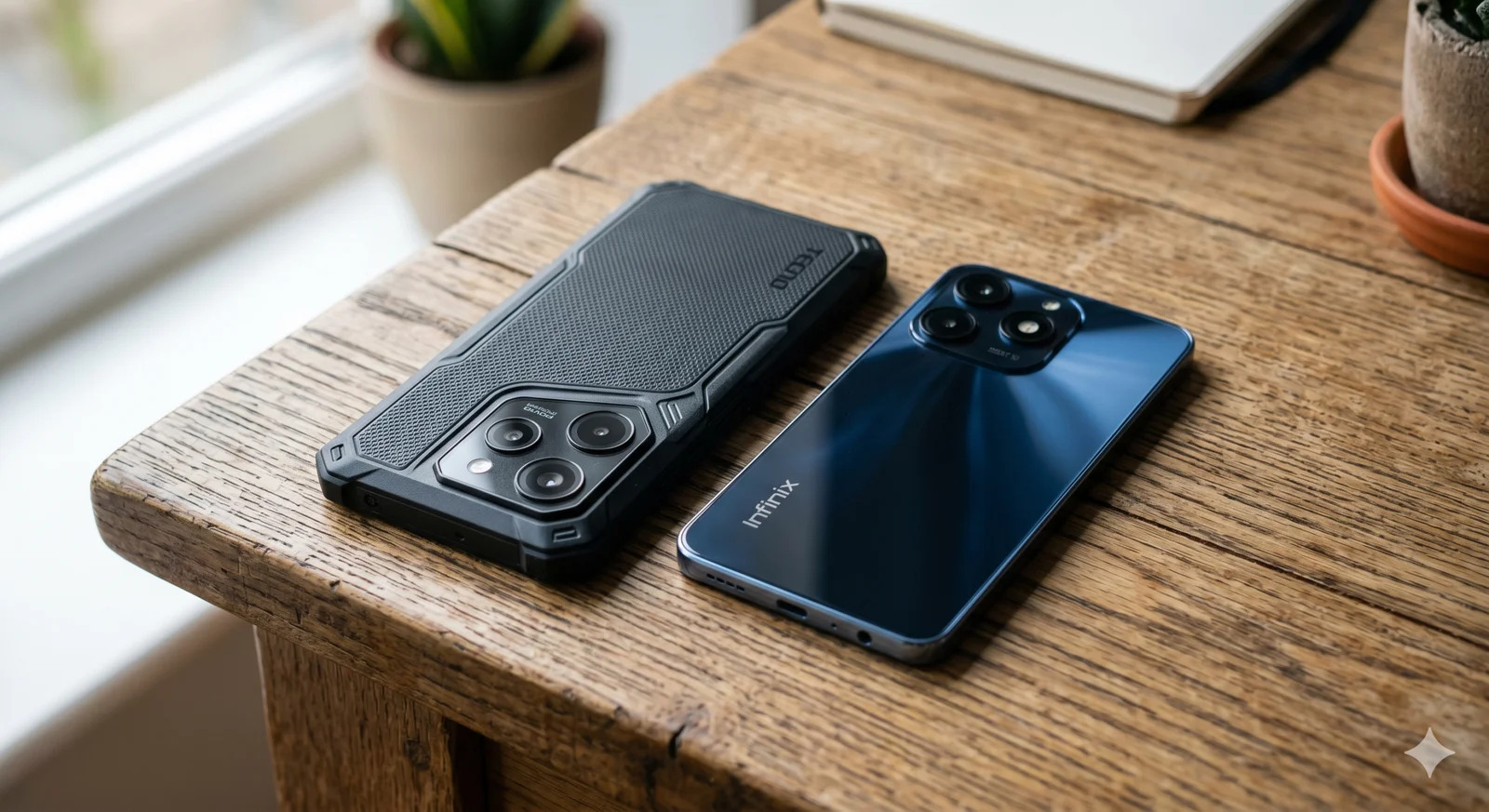
The market data is clear. As of February 2025, Tecno leads Nigeria’s smartphone market at 23.55%, with Infinix at 21.73%. The roughly two-percentage-point gap has been consistent for some time, and it tells a story about distribution and price-point breadth rather than product quality.
Tecno’s wider range of entry-level devices, the Spark and Pop series, means that buyers at the very bottom of the market, the person spending N90,000 to N130,000 on their first smartphone, are more likely to encounter a Tecno than an Infinix. Infinix does not push as deep into the sub-N150,000 range with the same number of models. This is a structural advantage for Tecno in terms of total units moved, but it does not mean Tecno builds a better phone at every price point.
Together, Tecno and Infinix account for nearly 45% of Nigeria’s entire smartphone market. Samsung follows at 12.36%, and Apple at 9.43%. That is the scale of Transsion’s grip on the Nigerian market. Both brands exist in an ecosystem that is specifically built for this country, and the competition between them is as much internal product differentiation as it is genuine market rivalry.
So Which Brand Wins Your Money?
The honest answer is that it depends on what you are actually using a phone for and how much you are willing to spend.
If you spend most of your time on social media, you are heavy on selfies and portrait photography, and your budget sits between N200,000 and N380,000, Tecno’s Camon 40 series makes a strong case. The camera processing is polished, the selfie system is genuinely excellent for the price, and the distribution network means you will find it easily whether you are buying in Lagos or Abeokuta. The Camon 40 Pro at around N374,000 to N380,000 gives you the 50MP autofocus front camera that content creators specifically appreciate.
If performance density is your priority, you want faster charging, and you are drawn to a phone that packs more hardware into a similar price range, Infinix’s Note 50 series wins that comparison. The 90W charging alone is a meaningful quality-of-life upgrade in Nigeria’s power situation. The Note 50 Pro’s AMOLED display at 144Hz, IP64 protection, and aerospace aluminium framing add up to a phone that feels more premium than the price tag suggests.
At the very top end, where both brands are pushing N600,000 and above, the Tecno Camon 40 Premier’s 5G support and 70W charging compete with the Infinix Note 50 Pro+’s triple camera setup and periscope zoom. For a buyer at that tier who values camera versatility above everything else, the Note 50 Pro+ wins. For a buyer who wants 5G readiness and a faster charging cycle, the Camon 40 Premier is the better fit.
What this comparison ultimately reveals is that the Tecno vs Infinix question does not have a clean winner. Both brands are Transsion products built for Nigerian buyers, both use competitive hardware at honest prices, and both have closed the design gap that used to exist between them and the competition. The difference is in emphasis: camera processing and breadth for Tecno, spec density and charging speed for Infinix. Neither emphasis is wrong. What matters is which one aligns with how you actually use a phone.