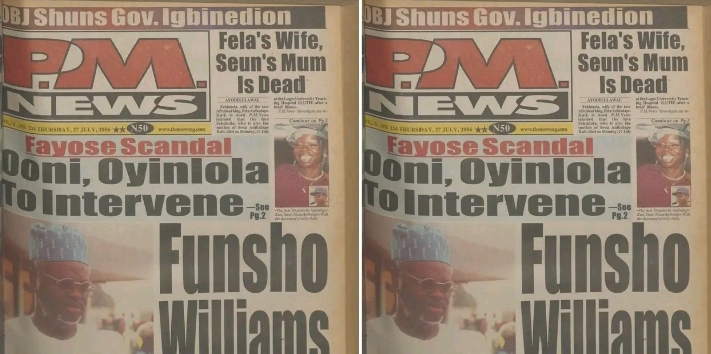
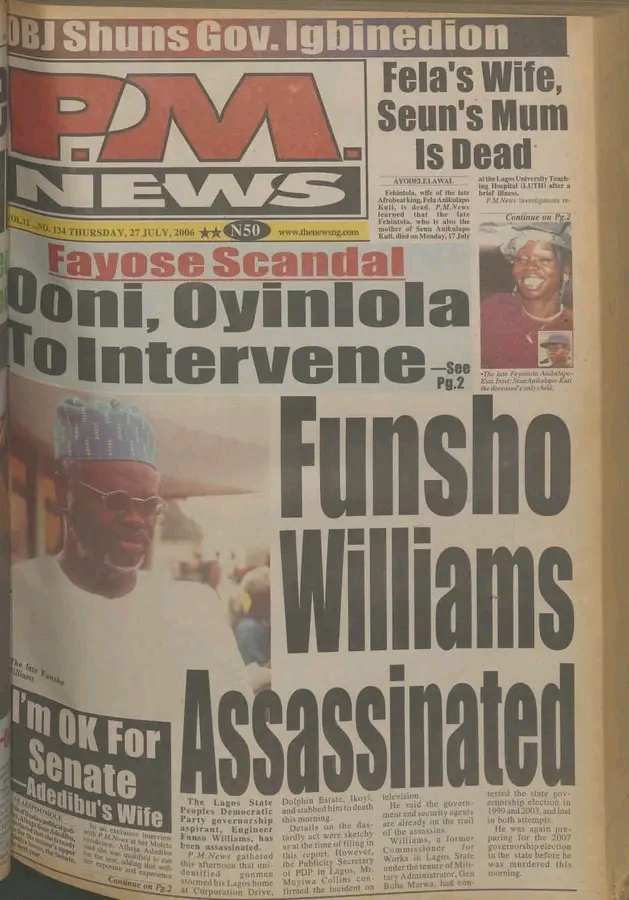
There are days when the country feels like it’s holding its breath. Days when the radio sounds different and the streets move a little slower, not because of traffic, but because people are thinking too hard about the news they just heard. July 27, 2006 was one of those days, especially for anyone who held that News edition in their hands.
The paper didn’t just report stories. It felt like a mirror, a cracked, uneven one, reflecting Nigeria exactly the way she was living: restless, grieving, and somehow stubbornly pushing forward.
Below is a walk back into that moment, the week when headlines didn’t just land, they stayed.
1. Funsho Williams — Lagos Woke Up to the Worst Kind of Gist
If you lived in Lagos in 2006, you remember where you were when the news first dropped. Not because someone marked the calendar, but because some headlines burn themselves into your memory and refuse to leave. The assassination of Engr Funsho Williams did that to the whole state.
Williams wasn’t your regular politician. People called him soft-spoken, principled, almost too calm for the storm that Lagos politics could be. He was the kind of man whose posters didn’t need to scream. His face alone told people he meant business, and more interestingly, that he meant well.
So when word came that he had been murdered inside his Dolphin Estate residence, not shot on the road, not attacked in traffic, but killed right in his own home, something snapped across the city.
Morning commuters started whispering it. Workers pulling into Marina and VI got calls from colleagues asking, “Have you heard? They killed him o” and everyone initially said, “No, check again, maybe it’s another Williams,” because the mind doesn’t quickly accept news that heavy.
But as the confirmations rolled in, the vibe changed. People who understood power began murmuring about political desperation.
People who understood elections felt the ground shifting. People who didn’t understand anything at all still felt uneasy, because Lagos politics had just crossed a line you don’t cross without consequences.
The assassination wasn’t just an attack on one man. For many, it felt like someone slapped Lagos directly across the face.
That headline alone could have carried the newspaper. But the week wasn’t done with Nigeria yet.
2. Fehintola Kuti — When a Music Dynasty Felt Another Crack
One thing about Nigeria is this: even when politics is boiling and tempers are bouncing like rubber balls, culture still holds her space. The death of Fehintola Anikulapo-Kuti carried that kind of cultural weight, not loud, not dramatic, but deep.
Fehintola wasn’t a celebrity in the loud, flashing-camera sense. She wasn’t the type to grab headlines every month. But she was part of the Kuti legacy, one of Fela’s wives, and the mother of Seun Kuti. That alone made her a figure with history in her shadow.
She passed on July 17, 2006, at LUTH, and for the older Afrobeat lovers, the news dropped like a soft punch to the stomach. The kind that doesn’t knock you down but forces you to sit still for a bit.
The Kuti family has always carried more story than most families can handle. Music, activism, fights with the military, raids, the Kalakuta fire, the marriages, the chaos, the genius, all of it lived inside that family like a second heartbeat. People sometimes forget that women like Fehintola were part of that engine room. They lived through the heat, the danger, the intensity of being close to Fela.
Her death didn’t trend. This was 2006, no X, no Instagram noise, no reposts. But it mattered to the people who understood the weight of her quiet contribution to the culture. It mattered to Seun, whose own sound was still forming in those years. It mattered to those who saw the Kuti women as the backbone of that movement.
In a week drowning in political drama, Fehintola’s passing was a reminder that cultural grief rests differently. It doesn’t shout. It lingers.
3. Politics No Gree Calm Down — Fayose Wahala Still Dey Boil
Meanwhile, while Lagos mourned and the music world held its chest, the political theatre in Ekiti was still serving fresh episodes. The so-called “Fayose scandal” was refusing to fade away. It kept popping up like a stubborn rumor that somehow always finds new oxygen.
Ayo Fayose, then governor of Ekiti, was battling allegations and political battles that were becoming messier by the week. Different camps had different versions, and depending on who you listened to, he was either fighting for survival or fighting for redemption.
Names like Doni and Olagunsoye Oyinlola surfaced in the conversations, politicians who, according to reports, might step in to calm the situation or at least stop the PDP boat from leaking water all over the table. Nigerian politics has always been a blend of shadow moves and public statements, and this one had enough shadows to confuse even political insiders.
P M News didn’t go deep into the details on that front page, but simply dropping the headline was enough to stir eyebrows and start arguments in taxis and buka tables. Nigerians didn’t need long essays to know when something big was brewing.
Ekiti was boiling, And people could smell it from Lagos.
4. Adedibu’s Family — “Me? Senate? Why Not?” Type Confidence
Now this one, ehn, this headline had its own attitude. It had that typical Ibadan flavour, bold, fearless, and slightly mischievous. One of the wives of Chief Lamidi Adedibu, the strongman of Oyo politics, reportedly saying she was “OK for Senate”.
If you knew Adedibu, the “Garrison Commander” of Ibadan politics, you wouldn’t be surprised. That household ran on pure political energy. Ambition wasn’t just encouraged; it was almost compulsory.
So hearing that the Madam of the house was eyeing the Senate didn’t sound far-fetched. Nigerians joked about it, debated it, or shrugged depending on who they were. But everybody agreed on one thing, Adedibu’s corner never lacked gist.
The headline wasn’t just political. It was attitude. It was swagger, the kind of statement only someone soaked in the Adedibu political universe could make.
A Front Page That Froze the Country’s Mood in One Sweep
Looking back now, that July 27, 2006, edition of Newspaper reads like a condensed documentary of a tense period. You had assassination. You had a cultural loss. You had political scandals bubbling like overcooked stew. You had ambition flying where people didn’t expect it.
It was Nigeria in full, noisy, grieving, dramatic, unpredictable, resilient. A country that somehow carries multiple crises in one week without breaking apart.
When you held that paper, you weren’t just reading. You were witnessing, the kind of witnessing that sits with you long after the newsprint fades.