Before Nigeria discovered oil in commercial quantity in the 1960s and became the major revenue earner for the country in the decades that followed which brought about the Dutch disease that has continued to beset the country to date, the mainstay of the Nigerian economy was agricultural produce, particularly cocoa, the proceed of which the the Western Region of yore both in the last decade of colonial rule and the early years of independence used to development not just the region — through massive investment in free education, housing and critical infrastructural project — but also in other part of the country as it heralded an era of healthy rivalry among the three regions that made up Nigeria at the time as they all strived to outdo each other in every area of governance and human development index.
But that was decades ago, when the flush of oil money that poured into the Nigerian economy and the jarring mismanagement of the money saw cocoa become a move from the nation’s mainstay to a fringe commodity, whose role the modern Nigerian state is scant and insignificant in the grand scheme of things. The case is largely the same in major cocoa-producing countries in Africa. While cocoa remains a key raw material for the production of exciting and profitable edible items, the deadly combination of rapacious foreign companies and the indifference to how the international mechanism and dynamics of the cocoa trade work by the governments of these African countries has robbed the countries of the rightful proceeds and development that their market share and dominance are worth.
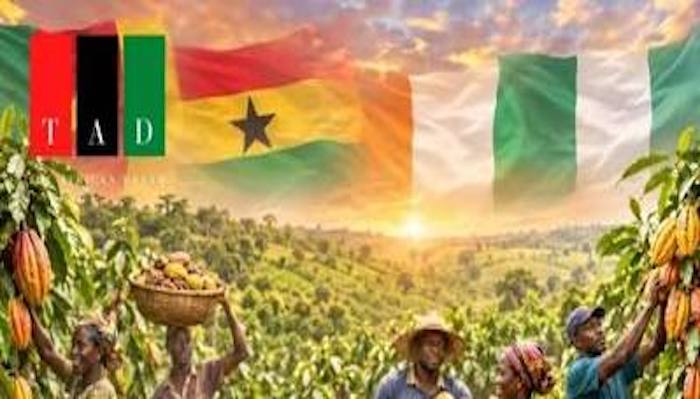
But this is about to change. On Tuesday, Nigeria, Ghana, Côte d’Ivoire and Cameroon, the four nations that control about 75 per cent of global cocoa production, signed the Abuja Declaration.
What does the accord entail
The accord wants to reassert the dominance of the countries and put them in the driver’s seat of the global cocoa trade, which will see them take full advantage of their position as the indispensable producers of the critical product for the benefit and growth of member states. The declaration will see them form a strategic alliance to end the export of raw cocoa beans and jointly negotiate with international buyers as a unified bloc.
Nigeria was bold, ambitious, and unambiguous about why it is driving and leading the push to reposition Africa from a supplier of raw cocoa beans to a producer and exporter of finished cocoa products.
“We are not interested in exporting anonymous sacks anymore. We are interested in exporting value,” the Minister of State for Industry, John Owan Enoh, said at the 2026 Cocoa Value Addition Summit, where the declaration was signed, adding that the new alliance would allow cocoa-producing countries to capture a greater share of the global chocolate market, valued at more than $130 billion.
President Bola Tinubu, represented by the Minister of Agriculture and Food Security, Abubakar Kyari, declared that Nigeria would halt the decades-old practice of exporting raw cocoa while importing finished chocolate products. “Nigeria will no longer export raw beans while importing finished value,” the president said.
“We will grind our beans at home, we will press our butter at home, we will make our chocolate at home, brand it at home and sell it to the world on our own terms.”
According to him, investors are building a 70,000-tonne cocoa processing facility in Sagamu, Ogun State, which he described as the largest in Nigeria’s history. He disclosed that Nigeria’s installed cocoa grinding capacity now exceeds 120,000 tonnes annually, while noting that the Bank of Industry (BOI) has financing available for viable cocoa value-addition projects.
Enoh announced that the bloc would use a common position on the European Union Deforestation Regulation (EUDR), which takes effect for large and medium-sized cocoa operators on December 30, 2026.
According to him, the four countries will push for international recognition of their national traceability systems while ensuring that transfer compliance costs are not shouldered by smallholder farmers.
Enoh further disclosed that Nigeria had adopted a Cocoa Value Addition Accord, committing the federal government, cocoa-producing states, farmer organisations, industry associations and development finance institutions to measurable targets on local processing and improved farmer incomes.
He said a delivery council would be established to oversee implementation of the accord and publish annual progress reports.
The Managing Director of BOI, Olasupo Olusi, said Nigeria produces more than 300,000 tonnes of cocoa annually but currently utilises only about 50,000 tonnes of its installed grinding capacity.
Olusi disclosed that the bank disbursed more than N164 billion to over 3,500 agro-processing businesses in 2025 and recently secured a €60 million credit facility from the European Investment Bank to support cocoa value addition. He said BOI would create dedicated financing windows for cocoa processing, ingredient manufacturing, packaging and chocolate production.
“We are not approaching cocoa as a lending programme; we are building an industrial ecosystem,” Olusi said.
Despite producing between 75 and 77 per cent of the world’s cocoa, Africa receives less than 10 per cent of the value generated by the global chocolate industry, the Chief Executive of the Ghana Cocoa Board (COCOBOD), Ransford Abbey, said
“We do not need charity. We deserve equity. The time has come for Africa to process its own wealth, protect its farmers and negotiate with one voice in the global cocoa market,” Abbey said.
He added that global cocoa prices had fallen sharply after peaking above $11,000 per tonne in late 2024, forcing Ghana and Côte d’Ivoire to reduce producer prices.
The summit concluded with the formal adoption of both the Abuja Declaration and the Cocoa Value Addition Accord, indicating a strategic and coordinated drive by Africa’s leading cocoa-producing nations to strengthen local processing, increase export earnings and secure a greater share of the global cocoa value chain.