Conversations about a common West African currency have returned with fresh momentum after years of repeated delays, missed targets, policy debates, economic uncertainty, political changes, rising inflation, currency pressures, countless regional meetings. For many people across the region, the latest development feels different because it arrives with a clearer direction, a renewed commitment, a timeline that places the long discussed project back at the centre of West Africa’s economic future. Businesses, investors, travellers, financial institutions, governments are once again paying close attention as the next chapter begins to take shape.
Questions are already spreading across homes, offices, markets, banks, social media platforms, boardrooms. Many Nigerians are asking whether the naira will soon disappear, whether prices could change, whether cross border trade will become easier, whether travelling across West Africa could become simpler, whether businesses should begin preparing for a major financial transition. While those questions continue to attract widespread attention, the latest announcement offers a clearer picture of where the regional bloc intends to go next, even though several important stages still lie ahead before any major changes become reality.
ECOWAS renews commitment
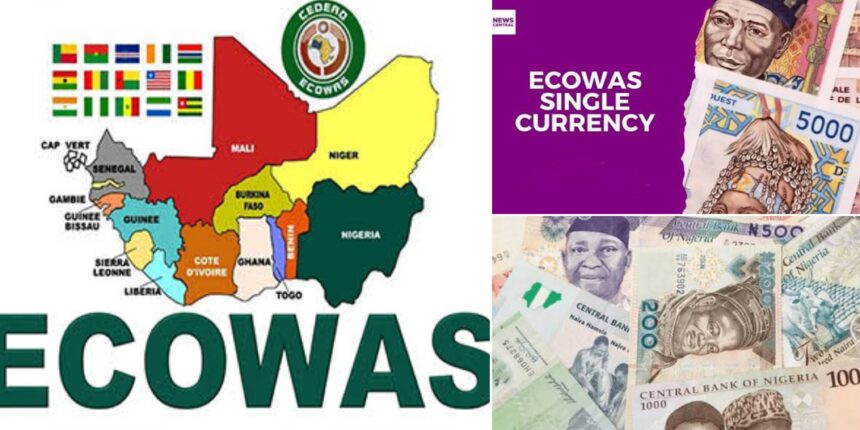
The Economic Community of West African States has officially renewed its commitment to introduce a regional single currency known as the Eco, setting 2027 as the latest target for its launch. The announcement was made by ECOWAS Commission President Dr Omar Alieu Touray during the Sahel Governance Forum held in Banjul, The Gambia. His remarks represented one of the clearest statements from the regional bloc in recent years regarding the future of the long awaited monetary union.
Rather than delaying the project until every member country satisfies the required economic conditions, ECOWAS says it now plans to begin with countries that are fully prepared. Member states that successfully meet the agreed standards will participate first, while those still working toward the benchmarks will continue receiving support until they are ready to join. This gradual approach marks an important change from previous strategies that depended on every participating country reaching the same level of readiness before the currency could be introduced.
Launch location
Banjul, the capital city of The Gambia, has become closely associated with this latest milestone after hosting the announcement that revived discussions across the region. ECOWAS has also indicated that the official regional unveiling of the Eco is expected to take place there as part of the planned launch activities, provided the remaining institutional processes receive final approval before the target date.
Holding such an important event in Banjul reflects the broader regional nature of the project. Rather than focusing on one of West Africa’s largest economies, the choice highlights ECOWAS’ intention to present the single currency as a shared regional initiative that belongs equally to every participating member state.
Planned launch date
Current planning by ECOWAS points toward 1 July 2027 as the intended launch date for the Eco. Although that timeline remains subject to final approval, legal preparations, institutional readiness, monetary coordination, the announcement provides the clearest timetable the organisation has publicly embraced since earlier targets failed to materialise.
The date should therefore be viewed as a planned objective rather than an automatic guarantee. Several technical processes still need to be completed before the currency becomes operational, including the establishment of the required financial structures, legal frameworks, monetary institutions, operational systems that will support a regional currency across multiple independent economies.
Journey spanning decades
Plans for a single West African currency did not begin recently. Discussions date back more than 2 decades as ECOWAS pursued deeper economic integration among its member states. Leaders believed that sharing one currency could strengthen regional trade, improve financial cooperation, reduce exchange rate complications, encourage stronger economic partnerships across national borders.
Despite those ambitions, the project encountered repeated setbacks. Earlier target dates included 2003, 2005, 2010, 2015, 2020. Each deadline passed without implementation because many participating countries struggled to satisfy the agreed economic conditions required for a successful monetary union. Economic realities consistently moved faster than regional preparations, forcing ECOWAS to postpone the project several times instead of introducing a currency that lacked the necessary foundation.
The latest commitment to 2027 therefore carries added significance because it introduces a different implementation strategy. Rather than waiting indefinitely for every country to qualify simultaneously, ECOWAS now plans to move ahead with countries that are ready while allowing others to join later after meeting the required standards.
Current ECOWAS membership
ECOWAS currently consists of 12 member states following the withdrawal of Burkina Faso, Mali, Niger. Those remaining members include Nigeria, Ghana, Benin, Côte d’Ivoire, Togo, Senegal, Guinea, Liberia, Sierra Leone, The Gambia, Guinea Bissau, Cabo Verde.
Although membership has changed, the regional bloc continues pursuing its broader economic integration agenda. The introduction of a common currency remains one of its most ambitious objectives because it would represent one of the deepest forms of economic cooperation among sovereign nations within West Africa.
Nigeria’s position
Nigeria occupies a particularly important place within every discussion surrounding the Eco because it possesses the region’s largest economy, one of its largest populations, one of its biggest financial markets. Decisions taken by Nigeria therefore have enormous implications for the success of any future regional currency.
Despite widespread public attention following the latest announcement, there has been no declaration that Nigeria will automatically abandon the naira once the Eco launches in 2027. That distinction remains extremely important because many social media discussions have created confusion regarding what the announcement actually means for Nigerian citizens.
Before Nigeria can officially adopt the Eco, the country must first satisfy ECOWAS’ agreed monetary convergence criteria. Beyond meeting those economic conditions, both the Federal Government, the Central Bank of Nigeria would still need to complete the legal, monetary, institutional processes required before replacing the naira with the regional currency. Until every necessary procedure is completed, the naira remains Nigeria’s official legal tender.
Why the naira remains
Currency changes involving sovereign nations rarely happen overnight because they affect every part of an economy. Salaries, savings, loans, taxes, pensions, banking operations, government spending, imports, exports, retail transactions, financial contracts would all require careful adjustment before a new currency could fully replace an existing national currency.
Nigeria therefore cannot simply stop using the naira because ECOWAS has announced a regional target. Extensive preparation would be required across commercial banks, payment systems, government agencies, financial institutions, businesses, international partners before any formal transition could occur. Those preparations involve legal changes, technical upgrades, public education, financial coordination that usually take considerable time.
Citizens should therefore understand that the latest ECOWAS announcement represents a regional commitment rather than an immediate currency replacement programme for Nigeria. Daily transactions across Nigerian markets, banks, businesses continue using the naira exactly as before unless future official decisions state otherwise.
Economic conditions required
Every participating country seeking to adopt the Eco must satisfy several agreed economic benchmarks designed to promote long term stability across the monetary union. Those standards exist because sharing one currency requires participating economies to maintain similar levels of financial discipline.
One major requirement involves maintaining single digit inflation. Stable prices help protect the purchasing power of households while reducing economic uncertainty across member countries. Excessively high inflation within one participating economy could create wider challenges for the entire monetary union if left uncontrolled.
Countries must also maintain fiscal deficits within agreed regional limits. Governments are expected to manage public finances responsibly by avoiding excessive spending that creates unsustainable borrowing pressures. Strong fiscal discipline helps strengthen confidence among investors while reducing financial risks throughout the regional economy.
Another important benchmark limits direct financing of governments by central banks. This requirement encourages independent monetary management while reducing excessive money creation that could fuel inflation or weaken confidence in the shared currency over time.
Participating countries must also maintain adequate foreign exchange reserves capable of supporting financial stability during periods of external economic pressure. Healthy reserves improve confidence within international markets while helping countries respond more effectively to unexpected economic shocks.
Stable exchange rates represent another major condition because significant currency volatility may indicate deeper structural weaknesses within an economy. Countries seeking membership are expected to demonstrate reasonable exchange rate stability before joining the regional monetary union.
Sustainable public debt also forms part of the convergence criteria. Excessive government borrowing increases financial risks that could eventually affect every country sharing the same currency. Strong debt management therefore remains an important requirement before participation becomes possible.
Reasons behind repeated delays
High inflation has consistently prevented several member countries from satisfying the agreed convergence benchmarks. Rapid increases in consumer prices reduce economic stability while making it more difficult for countries to qualify for a shared monetary system.
Government debt has also increased substantially across several economies during recent years. Larger debt burdens create additional fiscal pressures while limiting governments’ flexibility during periods of economic uncertainty. Those conditions have repeatedly delayed regional preparations for monetary union.
Budget deficits have presented another persistent obstacle because governments often spend considerably more than they generate through revenue. Maintaining fiscal discipline across multiple independent economies has proven far more challenging than originally anticipated when discussions first began decades ago.
Currency instability has further complicated implementation plans. Sharp exchange rate movements create uncertainty for businesses, investors, consumers while making economic coordination more difficult among participating countries with different financial structures.
Political instability has also disrupted regional progress at different periods. Changes in government, military coups, constitutional crises, shifting national priorities have interrupted long term economic planning across parts of West Africa, making sustained regional coordination increasingly difficult.
Large differences between member economies have added another layer of complexity. Countries vary significantly in population, economic output, industrial development, government revenue, export dependence, financial systems. Creating one monetary framework capable of serving every participating economy equally has therefore required far more preparation than originally expected.
Gradual implementation strategy
One of the most significant elements within the latest announcement is ECOWAS’ decision to adopt a phased implementation model. Rather than postponing the project indefinitely until every member state qualifies simultaneously, the organisation now intends to begin with countries that successfully satisfy the agreed conditions.
This approach allows the regional project to move forward without becoming permanently tied to the slowest progressing economies. Countries that complete the required reforms may begin participating while others continue strengthening their economies until they become eligible for future membership.
Such a strategy could also encourage stronger economic reforms among countries still working toward qualification because membership would remain available once the agreed standards are achieved. Rather than creating a permanent division, ECOWAS intends the phased approach to provide flexibility while maintaining the long term objective of wider regional participation.
Potential economic benefits
Successful implementation of the Eco could reduce the costs associated with exchanging different national currencies across West Africa. Businesses involved in regional trade currently face additional expenses whenever transactions require converting one currency into another. A shared currency could reduce those costs considerably.
Cross border trade may also become simpler because businesses would no longer need to manage multiple exchange rates for transactions involving participating countries. Greater pricing certainty could improve commercial planning while encouraging increased regional trade among neighbouring economies.
Investment opportunities may also improve under a stable regional monetary framework. Investors often prefer environments where currency risks remain relatively predictable because stable monetary conditions reduce uncertainty when making long term business decisions.
Travellers moving across participating countries could also experience greater convenience through the use of one common currency. Rather than exchanging money repeatedly when crossing national borders, travellers could potentially conduct transactions more easily throughout participating member states.
Regional economic integration could strengthen further because businesses, financial institutions, governments would operate within a more unified monetary environment. Deeper financial cooperation may support broader economic development objectives pursued by ECOWAS over many years.
A successful single currency could also strengthen West Africa’s collective position within international financial markets by presenting participating economies through a more integrated regional framework rather than as entirely separate monetary systems.
Remaining challenges
Although the planned launch represents an important milestone, significant challenges remain before full implementation becomes possible. Managing one monetary policy across multiple independent economies requires careful coordination because each country experiences different economic conditions, inflation trends, growth patterns, fiscal priorities.
Countries participating within a monetary union surrender part of their independent control over monetary policy. National authorities would no longer possess complete freedom to adjust interest rates or other monetary tools solely according to domestic economic conditions once responsibilities shift toward the regional framework.
Economic differences among member states also require careful management because stronger economies, weaker economies may respond differently to the same monetary policies. Achieving balance across diverse national circumstances remains one of the most technically demanding aspects of establishing any successful monetary union.
Institutional preparation remains equally important because regional financial bodies, legal frameworks, payment infrastructure, banking systems must all function effectively before a common currency can operate smoothly across multiple sovereign nations.
Next steps before implementation
Several important stages remain before the planned 2027 launch can become reality. Member states must continue working toward the agreed convergence criteria while ECOWAS completes outstanding institutional preparations required for the regional monetary framework.
Legal agreements, operational procedures, financial regulations, central banking arrangements, payment systems, currency distribution mechanisms all require careful coordination before implementation begins. Every participating country must also complete its own domestic legal processes where necessary before adopting the shared currency.
Public education will also become increasingly important as the launch date approaches because citizens, businesses, financial institutions need accurate information regarding how the transition would operate, what changes would occur, what existing financial arrangements would remain unchanged during each stage of implementation.
Bottom line
ECOWAS‘ latest announcement marks one of the most important developments in the long history of the Eco project because it confirms a renewed commitment to pursue the regional single currency through a gradual implementation strategy beginning in 2027. Rather than waiting indefinitely for every member country to satisfy the required economic conditions, the regional bloc now intends to move ahead with countries that are fully prepared while supporting others until they become eligible.
For Nigeria, the announcement does not signal the immediate end of the naira. The country’s national currency remains fully in place, continues serving as legal tender across every sector of the economy. Before any future transition becomes possible, Nigeria must satisfy ECOWAS’ convergence requirements while completing every necessary legal, institutional, monetary process through the appropriate national authorities.
Attention will now shift toward the progress made by member states during the months leading to the planned 1 July 2027 target. Whether the Eco finally becomes reality after more than 2 decades of delays will ultimately depend on how successfully participating countries complete the remaining economic, legal, institutional preparations required for one of West Africa’s most ambitious regional integration projects.