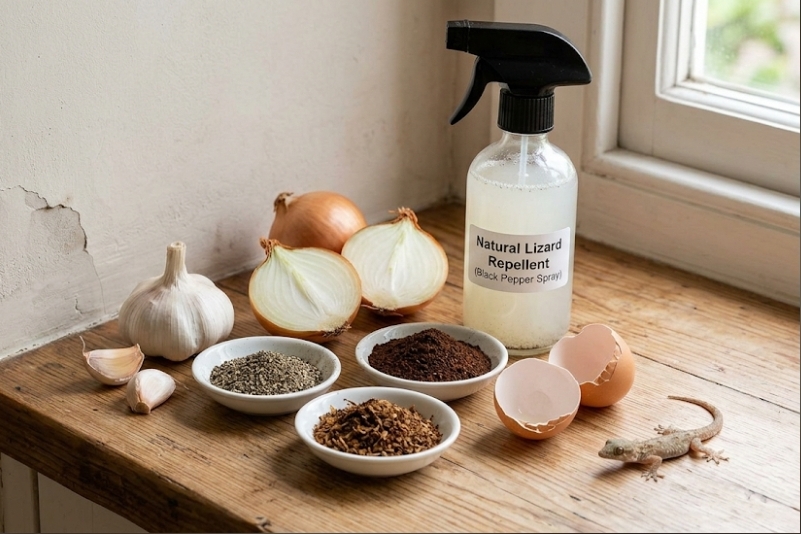
Wall lizards are common visitors in many homes, and although they help reduce insect populations, many homeowners consider their presence, droppings and sudden appearances undesirable.
Instead of relying on chemical repellents, several household ingredients are widely used as natural alternatives to discourage lizards from entering living spaces.
Experts note that wall lizards are particularly sensitive to strong smells and spicy substances, making certain kitchen ingredients effective as deterrents when placed around areas where the reptiles frequently appear.
Garlic
Garlic is widely regarded as one of the most effective natural lizard repellents because it contains allicin, a sulphur compound responsible for its strong smell.
The pungent odour is believed to interfere with the reptiles’ ability to detect their surroundings, prompting them to avoid treated areas.
Fresh garlic cloves can be placed near windows, doorways, ventilation openings and other entry points, while crushed garlic soaked in warm water can be strained into a spray bottle and applied to walls, corners and hiding spots.
Onions
Like garlic, onions contain sulphur compounds that produce a strong scent many believe wall lizards dislike.
Slices of fresh onion can be positioned behind household appliances, near outdoor lights or in locations where lizards are commonly seen.
The slices should be replaced every few days to maintain their potency and ensure the smell remains effective.
Black pepper spray
Black pepper is another commonly recommended natural repellent because it contains piperine, a compound that may irritate lizards and discourage them from returning to treated surfaces.
A simple mixture can be prepared by combining freshly ground black pepper with warm water in a spray bottle before applying it around cupboards, furniture, wall cracks and other areas where lizards hide.
Care should be taken to avoid contact with the eyes and skin while using the mixture.
Coffee grounds and tobacco powder
A mixture of coffee grounds and tobacco powder has also been promoted as a traditional method of controlling wall lizards.
Supporters of the method claim that while the scent of coffee attracts the reptiles, the nicotine contained in tobacco acts as a toxic substance when ingested.
The mixture is typically formed into small balls with a few drops of water and placed in concealed areas where lizards are frequently observed.
However, because tobacco contains nicotine, which is poisonous, this method should be used with extreme caution and kept out of the reach of children and pets.
Eggshells
Eggshells are often recommended as a non-toxic option for discouraging wall lizards from entering homes.
The method is based on the belief that lizards perceive broken eggshells as evidence of larger predators nesting nearby and instinctively avoid such locations.
Clean eggshell halves can be placed near windows, kitchen counters and doorways, with regular replacement helping to keep the area tidy while maintaining the intended deterrent effect.
Although these household remedies are commonly used, their effectiveness may vary depending on the environment and the extent of the lizard presence, and maintaining good sanitation by eliminating insects, sealing wall cracks and blocking entry points remains one of the most reliable ways to reduce lizard activity indoors.