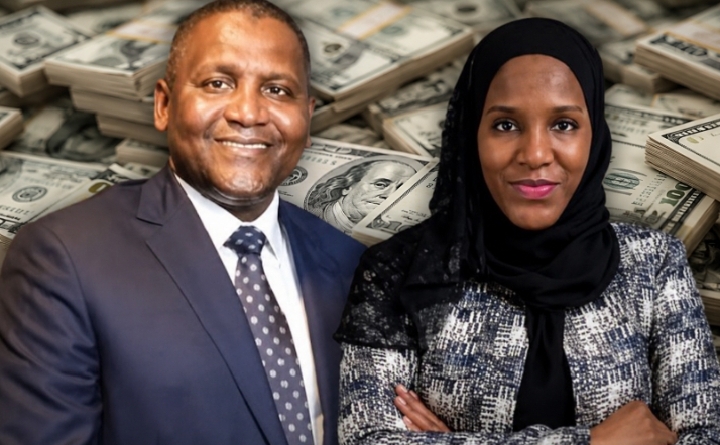
For decades, Aliko Dangote’s name has represented ambition, industrial growth and one of Africa’s most remarkable business journeys. From a young entrepreneur who started with commodity trading to becoming the founder of one of the continent’s largest business groups, Dangote has built a fortune that has placed him among the world’s wealthiest individuals. Yet, beyond the factories, companies and billions attached to his name, a deeper question is now attracting attention: how does one of Africa’s biggest fortunes continue after its creator?
A recent revelation from his daughter, Halima Dangote, has offered a rare insight into the billionaire’s private wealth planning, revealing how family inheritance, Islamic principles and long term philanthropy have been brought together in a structured plan. The discussion centres around a 33 per cent allocation connected to his foundation, a decision that reflects Dangote’s desire to ensure that part of his wealth continues serving humanity for generations.
The issue is not simply about the size of the money involved. It is about the thinking behind one of Africa’s most successful entrepreneurs as he prepares a legacy that combines business success with social responsibility. Behind the headline is a story of how wealth is created, protected and transformed into something that extends beyond one individual.
The Daughter’s Revelation About Dangote’s Wealth Structure
The discussion surrounding Aliko Dangote’s one third wealth plan emerged after his daughter, Halima Dangote, spoke about her father’s approach to philanthropy, inheritance and the future of his fortune.
She explained that Dangote had created a structure designed to ensure that charitable activities continue beyond his lifetime, particularly focusing on areas such as healthcare and education through the Aliko Dangote Foundation.
Speaking about the arrangement, Halima said:
“He sort of put all the structure in place whereby we focus a lot on health and education. He actually donated 25 per cent to the foundation. If you look at it, it is what we call in Sharia Code in Islam; it means he has donated 33 per cent of his whole inheritance to his foundation.”
She explained that the decision was connected to the importance Dangote places on ensuring philanthropy survives across generations.
“That is how important it is to him because philanthropy needs to be in existence generation after generation.”
Halima also described giving back as part of the family’s values and business philosophy.
“So giving back is part and parcel of what we do. We believe we’re here, that our business is successful because of the giving back and because of the philanthropic aspect. That is why the 33 per cent is important.”
She further revealed the involvement of family members in recognising the arrangement.
“And that is why he made an announcement and he asked myself, my two sisters and his mother to sign under that will that he is able to give that 33 per cent to humanity.”
The revelation brought attention to how one of Africa’s wealthiest men is preparing for the future and how Islamic inheritance principles can influence the management of a billionaire’s estate.
Understanding The One Third Principle In Islamic Inheritance
The one third concept mentioned in relation to Dangote’s plan comes from Islamic inheritance principles that allow a person to make a charitable bequest through a will.
Under the principle, a Muslim can generally allocate up to one third of an estate for purposes such as charity before the remaining wealth is distributed among eligible heirs according to Islamic inheritance rules.
The purpose of the provision is to create room for personal charitable wishes while also protecting the rights of family members who are entitled to inherit.
For individuals with significant wealth, this principle provides a recognised framework for balancing personal values, family obligations and social responsibility.
In Dangote’s case, the focus is not only on the amount involved but on creating a structure that allows his charitable vision to continue beyond his lifetime.
What One Third Could Mean For A Billion Dollar Fortune
The possible value of Dangote’s charitable allocation depends on the size of his estate at the time the plan takes effect.
Aliko Dangote’s wealth has changed over the years because much of his fortune is connected to company valuations, investments and ownership stakes rather than cash holdings.
Different global wealth rankings have estimated his fortune at various levels, with several estimates placing it above $30 billion.
Using a simple calculation based on a $30 billion fortune:
$30 billion ÷ 3 = above $10 billion approximately
However, this figure is only a theoretical estimate. The actual value of any future charitable allocation would depend on the value of his assets, companies and investments at that time.
A billionaire’s wealth is often tied to businesses rather than money sitting in personal accounts, meaning the final value of an estate can change significantly over time.
The important point is that the arrangement represents a long term plan rather than an immediate transfer of billions of dollars.
Dangote’s Own Words About Wealth, Success And Giving
The idea of using wealth for social impact is not new in Dangote’s public statements. Over the years, the billionaire has spoken about how his understanding of success changed as his business empire expanded.
During an interview in 2019, Dangote spoke about his journey from pursuing financial milestones to focusing more on impact and contribution.
Reflecting on his early business ambitions, he said:
“When you start business, your target is to make your first million, okay, fine, I did that.”
Dangote explained that meeting global philanthropists influenced how he viewed wealth and responsibility. He specifically spoke about his encounter with Bill Gates and how the Microsoft founder’s commitment to humanitarian work affected his thinking.
He said:
“This is somebody that has nothing to do with us in Africa or Nigeria but he is putting his money and his soul, everything. He is very committed to helping humanity and that really surprises.”
Dangote later added:
“My only prayer is that in the next few years, I will try and give my chunk of wealth to charity.”
The statement showed that philanthropy had become part of his long term thinking years before the recent discussion about his estate structure.
The Beginning Of Dangote’s Billion Dollar Journey
The fortune at the centre of the discussion was built over several decades through a combination of entrepreneurship, industrial investment and expansion into strategic sectors.
Aliko Dangote was born on April 10, 1957, in Kano, Nigeria, and grew up in a business environment that shaped his interest in commerce.
At the age of 21, he established Dangote Group in 1977, starting with trading activities before gradually moving into manufacturing.
The company expanded into areas including cement, sugar, salt, flour and other essential goods, positioning itself as one of Nigeria’s biggest industrial players.
The decision to move from trading into manufacturing became one of the most important moments in Dangote’s career because it allowed him to build companies focused on long term production rather than short term transactions.
Over the years, Dangote Group expanded across Africa, turning the businessman into one of the continent’s most influential industrialists.
The Companies Behind Dangote’s Wealth
Dangote’s fortune is closely connected to the success of his companies, particularly Dangote Cement Plc, which became one of Africa’s largest cement producers.
The company expanded into several African countries, helping strengthen Dangote’s position as a leading industrial figure on the continent.
Beyond cement, Dangote Group developed interests in fertilizer production, food manufacturing and petroleum refining.
The Dangote Petroleum Refinery became one of the most ambitious private industrial projects in Africa, designed to increase local refining capacity and reduce dependence on imported petroleum products.
The scale of these businesses explains why succession planning has become a major issue. The future of Dangote’s wealth involves not only inheritance but also the continuity of companies employing thousands of people.
The Aliko Dangote Foundation’s Role In His Legacy
While Dangote’s business empire created the financial foundation of his wealth, the Aliko Dangote Foundation became the main platform through which his charitable vision was developed.
Established in 1994, the foundation was created to organise and expand Dangote’s philanthropic activities, moving beyond individual acts of giving into a more structured approach focused on long term social development.
Over the years, the foundation has concentrated on areas that directly affect millions of Nigerians and Africans, including healthcare, nutrition, education, poverty reduction and emergency support.
The foundation’s approach reflects a belief that philanthropy should not only respond to immediate needs but should also create systems capable of producing lasting change.
Through its programmes, the organisation has supported vulnerable communities, contributed to public health initiatives and invested in projects designed to improve opportunities for young people.
The reported one third wealth arrangement connected to the foundation represents an extension of this philosophy, with the aim of ensuring that charitable activities continue even beyond Dangote’s personal involvement.
Dangote’s Major Philanthropic Commitments Over The Years
Before discussions about his future estate plan emerged, Dangote had already established himself as one of Africa’s biggest private donors.
His charitable activities have covered several areas, including healthcare interventions, education support, humanitarian assistance and economic empowerment programmes.
During major national and global challenges, the foundation has played a role in providing support to affected communities.
During the COVID 19 pandemic in 2020, the Aliko Dangote Foundation contributed to response efforts by supporting healthcare facilities and providing assistance aimed at reducing the impact of the crisis.
The billionaire has also supported initiatives aimed at improving healthcare infrastructure and strengthening access to essential services.
These efforts have contributed to the perception that philanthropy is not a separate activity from Dangote’s business journey but part of how he defines success.
December 2025 Education Commitment
The education sector became another major focus of attention in December 2025 following reports about a significant commitment linked to the Aliko Dangote Foundation.
Reports highlighted an education support initiative worth ₦100 billion aimed at supporting students across Nigeria.
The commitment aligned with the foundation’s wider focus on education as a tool for creating opportunities and improving the future prospects of young people.
For Dangote, investment in education represents a long term approach because the impact extends beyond immediate beneficiaries and can influence families and communities.
The reported commitment also reflected the foundation’s transition from short term charity projects into larger programmes designed to address national development challenges.
Why Wealth Succession Is Important For Dangote
For many entrepreneurs, creating wealth is the first major challenge, but ensuring that the wealth survives across generations can become an even bigger responsibility.
The transition from founder led businesses to future leadership often determines whether a company continues growing or struggles after the original owner steps away.
Dangote’s situation carries additional importance because his wealth is connected to companies that operate across multiple industries.
The future of his fortune involves questions about family inheritance, business leadership and the continuation of charitable commitments.
A carefully prepared succession plan provides direction and reduces uncertainty by establishing how assets should be managed and how responsibilities should be shared.
The reported structure surrounding Dangote’s wealth shows an effort to address these issues before they become future challenges.
The Family Members Connected To The Plan
Halima Dangote’s revelation highlighted that the billionaire’s wealth planning involved communication with members of his immediate family.
She explained that she, her two sisters and their grandmother were asked to sign under the will arrangement connected to the charitable allocation.
The involvement of family members shows the level of preparation required when managing a fortune of such size.
For wealthy families, inheritance planning is not only about dividing assets. It is also about ensuring that family members understand the founder’s intentions and the responsibilities attached to inherited wealth.
In Dangote’s case, the plan combines family inheritance considerations with his desire to maintain a long term philanthropic legacy.
The Future Of Dangote Group After His Leadership
Beyond personal wealth, one of the biggest questions surrounding Dangote’s legacy is the future of the companies he created.
Dangote Group has developed into a major industrial organisation with interests spanning several important sectors of the economy.
The company’s future direction will depend on leadership decisions, corporate structures and the ability of future managers to maintain the vision that helped build the empire.
Many global family businesses have faced difficulties during leadership transitions because companies built around a founder’s personality often require careful preparation for the next generation.
Dangote’s succession planning therefore involves more than personal inheritance. It also involves protecting a business system that has become an important part of Africa’s industrial landscape.
Timeline Of Dangote’s Wealth, Business, Philanthropy
1957: Aliko Dangote was born on April 10 in Kano, Nigeria.
1977: Dangote Group was established as a trading company before expanding into manufacturing.
1994: The Aliko Dangote Foundation was established as a structured platform for philanthropy.
2000s: Dangote Group expanded heavily into manufacturing, especially cement and consumer goods.
2010s: Dangote Cement grew into one of Africa’s largest cement producers, increasing Dangote’s global business influence.
2013: Construction of the Dangote Petroleum Refinery began, becoming one of Africa’s largest private industrial investments.
2019: Dangote publicly spoke about his desire to dedicate a significant part of his wealth toward charity.
2020: The Aliko Dangote Foundation supported humanitarian efforts during the COVID 19 pandemic.
2024: The Dangote Petroleum Refinery began operations, marking a major milestone in Nigeria’s energy sector.
December 2025: Reports highlighted a ₦100 billion education focused commitment linked to the Aliko Dangote Foundation.
2026: Halima Dangote’s comments brought renewed attention to the billionaire’s estate planning and the 33 per cent charitable allocation.
What The Wealth Plan Says About Dangote’s Legacy
The conversation surrounding Aliko Dangote’s one third wealth arrangement is ultimately about how one of Africa’s largest fortunes is prepared for the future.
His journey has always been associated with building businesses, creating industries and expanding economic opportunities, but the latest discussion focuses on preserving values beyond financial success.
The reported plan combines Islamic inheritance principles, family responsibility and a commitment to philanthropy that has been visible throughout his career.
Rather than viewing wealth only as something to accumulate, Dangote’s approach reflects the idea that great fortunes also come with responsibilities toward communities and future generations.
The revelation from his daughter has provided rare insight into the private planning behind a public fortune, showing that the story of wealth does not end with how much someone builds, but also with how that wealth is managed, shared and remembered.