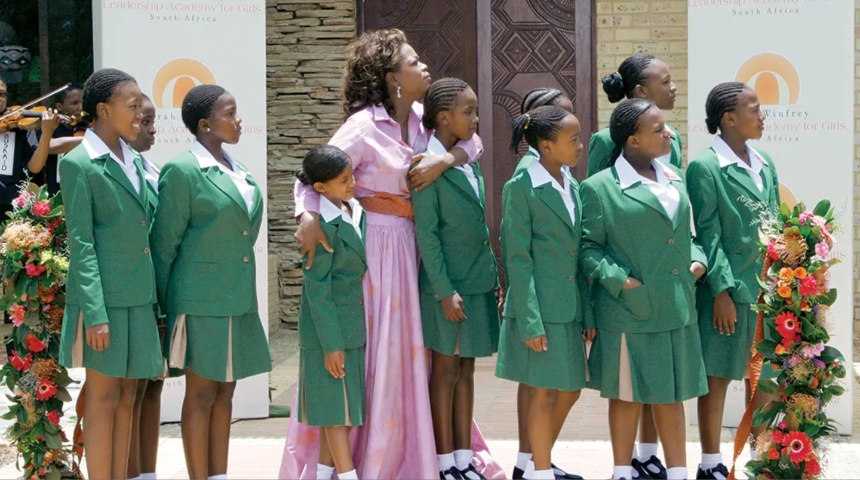
Oprah Winfrey has announced she’s shutting down the boarding school that made headlines, sparked a scandal, and changed hundreds of young lives over the past two decades. The Oprah Winfrey Leadership Academy for Girls (OWLAG), the $40 million campus she built outside Johannesburg in 2007, will close its doors for good after the 2027 academic year.
For a lot of people, the news landed as a shock. This wasn’t some quiet passion project; it was one of Winfrey’s most publicized, most scrutinized, and most personal undertakings. But once you look at what she’s replacing it with, the decision starts to make a different kind of sense.
How OWLAG Started
The idea for the school didn’t come out of nowhere. Winfrey has said it traces back to a 2002 conversation with Nelson Mandela, who encouraged her to invest in South African girls’ education. Five years and $40 million later, she opened the doors to the Oprah Winfrey Leadership Academy for Girls in Henley-on-Klip, Gauteng Province, a boarding school built specifically for academically gifted girls from disadvantaged backgrounds, covering grades eight through twelve.
Winfrey called it, at the time, “a supreme moment of destiny.” She wasn’t exaggerating about how personal it was to her, either. She’s spoken openly about her own childhood, including surviving abuse, and has framed the school as a chance to give girls the kind of protected, resourced environment she didn’t have.
The Scandal That Almost Ended It Early
It’s worth being honest about the rockier chapters here, because they’re part of why this closure feels significant.
Just months after OWLAG opened in 2007, the school was hit with an abuse scandal. A dorm matron, Tiny Virginia Makopo, was accused of physically and sexually abusing several students. Winfrey flew to South Africa, apologized to parents in person, suspended school leadership, and rebuilt how the campus was run from the ground up. Makopo was eventually acquitted on all 14 charges in 2010, a verdict Winfrey said left her “profoundly disappointed,” even as she praised the students who came forward to testify.
That wasn’t the only legal headache, either. The academy’s former headmistress, Nomvuyo Mzamane, later sued Winfrey. The early years of the school were, by most accounts, far messier than the polished ribbon-cutting suggested.
What’s notable is that the school survived all of it. Over the following years, OWLAG rebuilt its reputation and became known as one of South Africa’s stronger schools for girls from disadvantaged backgrounds, not the story it started out as.
Why Winfrey Is Closing It Now
According to Winfrey’s own statement, released Wednesday and first reported by Oprah Daily, the residential campus will close at the end of the 2027 academic year and be handed back to South Africa’s Gauteng Department of Education. That’s not a surprise move on Winfrey’s part, it’s actually what was written into the original partnership agreement when the school opened in 2007.
In other words, this was always the plan. Winfrey isn’t walking away from an obligation; she’s reaching the point the agreement was built around.
Here’s her explanation, in her own words:
“The dream was never simply to build a school. It was to invest in the limitless potential of young women. That mission doesn’t end with one campus. It continues in every girl whose future can be transformed through education.”
Instead of continuing to fund and operate a single residential campus, Winfrey says she wants to reach more girls, not fewer. A representative for her foundation put a number on it, telling reporters the new approach should mean “double the amount of girls who will have access to education through this model.”
What Happens to Current Students
If you’re wondering whether girls currently enrolled are getting displaced mid-program, they’re not. Winfrey has confirmed that current students will be allowed to finish out their education at OWLAG with uninterrupted academic, financial, and other support right through to the transition. Nobody currently enrolled is losing their spot early.
What Replaces the School
Once the campus is handed over, Winfrey’s foundation will shift its resources into an expanded scholarship program for young women across South Africa, not tied to one physical location. The new model is expected to launch once OWLAG’s remaining students graduate.
It’s a genuine change in strategy: instead of investing heavily in one residential campus that can only serve a fixed number of girls per year, the money moves toward scholarships and educational partnerships that, in theory, can scale further and reach girls in more parts of the country.
Winfrey has said the mission hasn’t changed, just the shape of it: “To help young women discover their own power, transform their own lives, and in doing so, transform the future of South Africa.”
The Numbers Behind the Legacy
Over its nearly 20 years, OWLAG has graduated more than 1,000 students. Winfrey, now 72, has stayed personally invested in tracking what those graduates went on to do, and she rattled off the list herself in a video posted to Oprah Daily: “Spanning every area of the workforce, they are businesswomen and lawyers, mothers, doctors, digital content creators, artists, managers, CEOs.”
She described watching their careers unfold as something she’s “dazzled and in awe of.”
What It Means Going Forward
OWLAG’s closure isn’t the end of Winfrey’s involvement in South African education, it’s a pivot. The residential school model that dominated the last two decades is giving way to something built for wider reach: scholarships and partnerships rather than one flagship campus.
Whether that new model delivers on the “double the girls” promise is something we’ll only really know once it’s up and running post-2027. But for the 1,000-plus women who came through OWLAG’s doors, and the students still finishing out their time there now, the legacy Winfrey set out to build in that 2002 conversation with Mandela is already in place, she’s just betting the next chapter can reach further than one campus ever could.