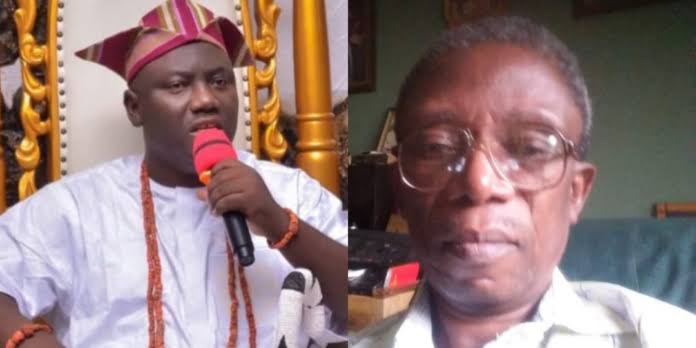
A respected traditional institution, a prominent academic voice, and a statement about a public appearance have combined to create a debate that goes beyond a simple question of timing. The unfolding disagreement between the palace of the Alaafin of Oyo, Oba Abimbola Akeem Owoade, and University of Ibadan Professor Ademola Dasylva has drawn attention because it touches the sensitive space where royal tradition, public accountability, scholarship, and cultural identity meet. What began around an observation made about an event in Oyo has now developed into a conversation about how important figures are represented in public discussions.
The issue revolves around the inauguration of the Alaafin Institute of Yoruba Studies at Emmanuel Alayande University of Education, Oyo, on July 14, 2026. The event was designed to highlight Yoruba knowledge, history, language, and cultural preservation, bringing together figures connected to traditional leadership and academic research. However, a comment made afterward about the monarch’s arrival time changed the focus of attention from the purpose of the gathering to a dispute over accuracy, reputation, and public perception.
How the controversy began
The controversy reportedly started after Professor Ademola Dasylva, a scholar connected with Yoruba studies, referenced the Alaafin’s conduct during the July 14, 2026 inauguration in an article titled “Of Mythography of Mythognosis: A Complementary Perspective on Yoruba Mythology and The Relevance, Today,” published on the Toyin Falola Network on Wednesday.
Within the article, Professor Dasylva reportedly stated that the Alaafin arrived 3 hours late to the event. The comment quickly attracted attention because it involved the occupant of one of Yoruba land’s most historically significant traditional stools. For many observers, the statement was not viewed simply as an observation about attendance time but as a public assessment of the monarch’s conduct during an important cultural gathering.
The Alaafin’s palace later challenged the claim, arguing that the description of the monarch arriving 3 hours late was inaccurate. According to the palace’s position, the Alaafin attended the programme based on the schedule that had been communicated to the organisers and relevant participants. The palace maintained that the timing of the monarch’s arrival followed official arrangements rather than showing disregard for the event.
The disagreement therefore moved from the original academic discussion into a public exchange between the traditional institution and the scholar whose article contained the statement.
Palace response, demand for apology
The palace of the Alaafin of Oyo responded by demanding a retraction of the statement and a public apology from Professor Dasylva. The request was based on the argument that the claim created a false impression about the monarch’s respect for official engagements and traditional responsibilities.
A statement attributed to the palace response said:
“The Alaafin did not come ‘late.’ He came according to schedule, as duly communicated.”
The palace reportedly argued that comments about the monarch’s actions must be supported by accurate information, especially when they involve issues that could affect the public image of the throne. The representatives acknowledged Professor Dasylva’s contributions to Yoruba scholarship but expressed concern over what they described as criticism that lacked factual support.
The demand for an apology highlights the seriousness with which traditional institutions view public statements concerning royal conduct. For the palace, the issue is not merely about minutes or hours but about ensuring that information connected to the Alaafin’s office reflects the reality of events.
Professor Ademola Dasylva’s role, academic background
Professor Ademola Dasylva is known as a scholar involved in Yoruba studies, literature, and cultural research. His involvement in the discussion makes the dispute significant because it places an academic voice against a traditional authority that represents centuries of Yoruba history.
The disagreement has attracted attention because both sides occupy important positions within Yoruba cultural development. The palace represents the continuity of traditional leadership, while Professor Dasylva represents academic inquiry, research, and intellectual interpretation of cultural matters.
The situation also reflects a long standing relationship between Yoruba monarchs and scholars. Traditional institutions have often worked with academics in preserving history, documenting indigenous knowledge, and promoting cultural identity. However, questions can arise when scholarly commentary appears to challenge the conduct or image of traditional leaders.
The current dispute has placed that relationship under public attention, especially because the subject involves the Alaafin institution, which carries deep historical significance.
Significance of the Alaafin stool
The Alaafin of Oyo remains one of the most recognised traditional positions in Yoruba history. The throne is connected to the former Oyo Empire, an influential political structure that played a major role in the history of the Yoruba people.
Over generations, the Alaafin institution has been associated with cultural preservation, traditional authority, historical knowledge, and indigenous leadership. The office represents more than an individual occupying a royal position because it carries memories, expectations, and responsibilities built across centuries.
Public events involving the Alaafin often attract attention because appearances by traditional rulers are guided by protocol, communication, and ceremonial expectations. The timing of attendance at official programmes can therefore carry symbolic meaning beyond ordinary public engagements.
This background explains why a statement about lateness became a major issue. The palace viewed the comment through the wider importance attached to the institution, while the discussion surrounding the professor’s article brought attention to how traditional leadership is examined in modern society.
The event that triggered the debate
The event at the centre of the controversy was the inauguration of the Alaafin Institute of Yoruba Studies at Emmanuel Alayande University of Education, Oyo, on July 14, 2026.
The institute was connected to efforts aimed at promoting Yoruba studies, indigenous knowledge, language development, and cultural research. The gathering brought together individuals interested in strengthening academic attention toward Yoruba heritage.
However, following the event, attention moved away from the institute’s purpose after the comment about the Alaafin’s arrival time emerged. The claim of a 3 hour delay became the central issue because it involved questions about official schedules and the conduct expected from a traditional ruler.
The palace’s response focused on correcting the impression created by the statement, while the professor’s reported comments remained at the centre of the disagreement.
Tradition, scholarship, public conversation
The controversy has highlighted the complicated relationship between traditional authority and academic freedom. Scholars often examine cultural institutions, historical figures, and public events as part of intellectual discussions. Traditional institutions, however, also place importance on protecting the dignity and reputation of their offices.
The disagreement shows how a single statement can carry different meanings depending on the perspective from which it is viewed. A scholar may present an observation within a wider analysis, while a royal institution may see the same statement as a reflection on the honour attached to the throne.
The debate surrounding the Alaafin and Professor Dasylva is therefore connected to broader questions about communication, responsibility, and the balance between criticism and respect.
Questions surrounding the controversy
Several issues remain at the centre of the disagreement. One major question is whether the professor’s statement about the 3 hour lateness accurately reflected the official timing of the event. Another issue is whether the statement was intended as a direct criticism of the monarch’s conduct or as part of a wider academic discussion about cultural institutions.
The palace has clearly stated its position by requesting a retraction and apology. However, a detailed public response from Professor Dasylva has not been widely reported at the time of the latest information available.
The next development may determine whether the matter ends with clarification or continues as a wider discussion involving Yoruba tradition, scholarship, and public expression.
Current state of the dispute
The disagreement between the Alaafin’s palace and Professor Ademola Dasylva remains focused on the accuracy of the 3 hour lateness claim made regarding the July 14, 2026 event. The palace maintains that the monarch arrived according to the communicated schedule and has requested a correction.
The matter has gained attention because it involves two influential parts of Yoruba society: the traditional institution represented by the Alaafin of Oyo and the academic community represented by a university professor.
Beyond the immediate disagreement, the controversy has opened a conversation about how public figures, cultural institutions, and scholars engage with one another. As the situation develops, attention remains on whether both sides will provide further explanations regarding the statement that sparked the dispute.