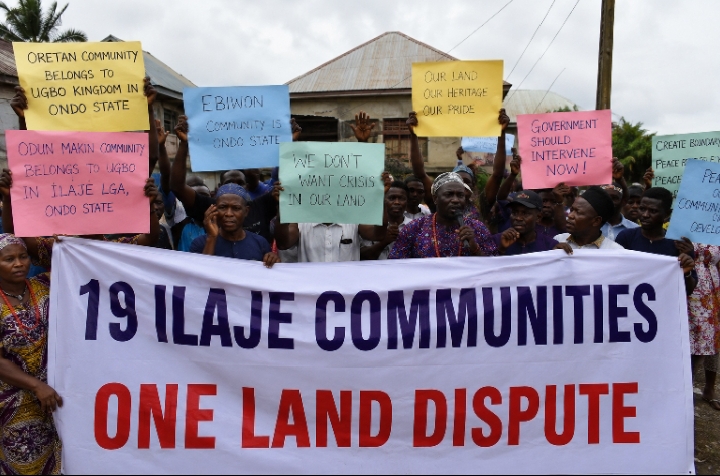
Along the quiet waterways of Nigeria’s coastal belt, land is rarely just land. A stretch of mangrove, a riverbank, a fishing settlement or a piece of seemingly isolated waterfront can carry memories that reach back generations, traditional authority that still matters today and economic value that becomes harder to ignore as new resources are discovered. That reality is now sitting at the centre of growing tension involving 19 communities in Ugbo Kingdom, Ilaje Local Government Area of Ondo State, where residents have taken their concerns beyond their communities and into the public space. Their protest on Friday, August 21, 2026, has drawn attention to a territorial disagreement that touches history, identity, traditional authority, government administration, security and the increasing value of Nigeria’s coastal communities.
For the residents who came out with placards and messages calling for government intervention, the matter is deeply personal because the places being discussed are not distant locations on a map. They are communities where families have lived, raised children, maintained ancestral connections and built relationships with neighbouring populations over generations. The language used during the protest was therefore carefully framed around peace, dialogue and intervention, even as the protesters made it clear that they believe their ancestral territory is being threatened. Their concern is that a dispute that remains unresolved for too long can become much more difficult to control once emotions rise, communities take positions and competing claims become entrenched.
The development has also brought renewed attention to a part of Ondo State where geography can be complicated, traditional territories can stretch across waterways and modern administrative boundaries do not always tell the complete historical story. The 19 communities at the centre of the August 21 protest are being presented by their leaders as Ugbo communities within Ilaje Local Government Area, with their own historical connection to Ugbo Kingdom. Their complaint, however, extends beyond traditional history because they are also asking for clearer government recognition, stronger security and physical boundary identification in an area they say has become increasingly important because of its natural resources and proximity to offshore economic activity.
The August 21 Protest
Friday, August 21, 2026, became an important date for the affected communities after residents and leaders from 19 oil producing and coastal settlements publicly protested what they described as alleged encroachment or incursion into their ancestral lands by people from neighbouring communities in Delta State. The protest was not presented as a call for confrontation, but as an appeal for government action before the disagreement develops into something more difficult to contain. Community representatives repeatedly stressed the need for dialogue, government intervention and clearly established boundaries, while warning that continued uncertainty could create a wider crisis between communities on opposite sides of the state boundary.
The protesters carried placards designed to communicate a simple message about ownership and identity, with several specifically connecting the affected settlements to Ugbo Kingdom in Ondo State. One of the messages read, “Odun Makin Community belongs to Ugbo in Ilaje LGA, Ondo State,” while another stated, “Oretan Community belongs to Ugbo Kingdom in Ondo State.” A separate placard carried the words, “Ebiwon Community is Ondo State,” while another message captured the mood of the demonstration in a more direct way, reading, “We Don’t Want Crisis in Our Land.” The messages showed that the protesters wanted their territorial concerns heard without suggesting that they were seeking violence.
That distinction matters because the communities are operating in a region where communal disputes have historically carried consequences far beyond the original disagreement. Their decision to publicly describe themselves as peace loving residents seeking government intervention reflects an awareness of the sensitivity surrounding land, traditional authority and resources in the Niger Delta. Rather than portraying the protest as an attempt to take matters into their own hands, the community representatives placed responsibility on government authorities to examine the claims, engage the relevant parties and prevent the disagreement from becoming a security problem.
The 19 Communities At The Centre
The communities identified in reports surrounding the protest are Odun Ebiwon, Odun Makin, Ilu Titun, Odun Odunjo, Odun Maha, Eke Nla, Eke Kekere, Ubajakere, Eke Itiola, Odun Okoro, Odun Yonren, Odun Beku, Odun Ogungbeje, Odun Oyinbo, Odun Oriretan, Ubale Kekere, Ubale Nla, Ikuyinminu and Odun Igo. Their leaders describe them as communities within Ugbo Kingdom in Ilaje Local Government Area of Ondo State, with historical ties to the kingdom and longstanding relationships with surrounding riverine populations.
The significance of the list is that this is not a complaint presented as an isolated disagreement involving one household, one family or one small settlement. Nineteen communities have been named together as part of the concern, giving the protest a broader territorial character. The residents are effectively asking authorities to look at the geographical area collectively and determine how the affected settlements fit within existing administrative boundaries, traditional claims and official records. That makes the dispute considerably more sensitive than a conventional private land disagreement.
The communities also exist within a wider social environment where people have historically moved between settlements, married across community lines and maintained relationships that do not necessarily follow present day state boundaries. That history helps explain why the residents are not describing their neighbours simply as strangers. Their argument is that peaceful relationships and social connections can exist alongside a firm belief in ancestral ownership, meaning that living together peacefully does not automatically remove a community’s historical claim to its land.
The Question Of Ancestral Ownership
At the heart of the protesters’ argument is their claim that the affected settlements have been part of Ugbo Kingdom for generations. Community leader Olumide John Ebiwonjumi said the settlements have existed for more than 200 years and argued that their historical connection to Ugbo predates many of the administrative arrangements that now define state boundaries. According to the community position, the settlements have traditionally operated under the authority of the Olugbo of Ugbo Kingdom, making their connection to Ugbo more than a recent political argument.
That historical argument is important because traditional land ownership in many parts of coastal Nigeria cannot always be understood through modern maps alone. Communities often trace their rights through settlement histories, traditional institutions, ancestral migration, family records and long established relationships with traditional rulers. Those forms of history remain important to residents even when modern government administration operates according to different legal boundaries. The protesters are therefore presenting their position as a matter of inherited territorial identity rather than a claim that emerged suddenly because the area has become economically valuable.
The claim that the communities have existed for more than 200 years also gives the dispute a deeper historical dimension. It means that the people protesting are not simply asking government officials to decide who currently occupies a particular piece of land. They are asking authorities to consider the history of settlement, traditional jurisdiction and government administration when examining the territory. That is why the demand for official boundary clarification has become such a central part of their appeal.
Government Projects As Part Of The Argument
The community leaders have also pointed to government projects which they believe demonstrate a longstanding connection between the affected settlements and Ondo State. They cited projects associated with the Ondo State Oil Producing Areas Development Commission, as well as a school constructed during the administration of former Governor Olusegun Agagu and a walkway constructed during the administration of former Governor Olusegun Mimiko.
Their argument is straightforward. If Ondo State authorities have historically carried out public projects in these communities, the residents believe that this forms part of the evidence of government responsibility and administrative connection. For communities that already regard themselves as part of Ugbo Kingdom in Ilaje Local Government Area, such projects are viewed as more than infrastructure because they are seen as examples of the state exercising practical responsibility in the area.
Government projects, however, are not automatically conclusive evidence of a legal state boundary or land title. Public infrastructure can show government involvement, but the final determination of territorial boundaries would require consideration of official maps, administrative records, surveys, historical documents, legal instruments and any relevant court decisions. That distinction is particularly important here because the protesters are asking for precisely the kind of official clarification that would move the disagreement beyond competing community narratives.
The Alleged Incursion
One of the more serious claims raised during the dispute came from Orimisan Ebiwonjumi, identified as a leader in Ebiwon Community. He alleged that people from Delta State had recently entered the community by boat, raising concerns among residents about the security of the territory and the possibility of further incursions.
Some accounts went further by describing the alleged intruders as armed persons, but that aspect remains an allegation from the community side and has not been independently established in the material available. It is therefore important not to present an alleged armed entry as a confirmed invasion or as evidence that Delta State authorities ordered any action against the communities. The available reporting does not establish that the people allegedly involved were acting on behalf of the Delta State Government.
That distinction does not make the residents’ concerns insignificant. For people living in remote coastal settlements, reports of unfamiliar groups entering community territory can quickly create anxiety, particularly when the area is already subject to competing claims. The residents are therefore asking government authorities to establish the facts, strengthen security and ensure that any disagreement over boundaries does not become a physical confrontation between communities.
Why The Land Matters
The economic value of the territory has added another layer to the disagreement. Community spokesman Busayo Julius Ebiniyi alleged that the disputed area has become increasingly attractive because of oil and other mineral resources, as well as its location close to the Atlantic and offshore oil activities. Another account quoted him as linking the growing concern to mineral resources discovered within communities in Ugbo Kingdom.
That factor matters because land disputes become considerably more sensitive when the territory involved has economic potential. A community that believes its ancestral land contains valuable resources is unlikely to treat questions of ownership as ordinary boundary disagreements. Questions about who controls the territory can eventually become questions about who has access to resources, who receives benefits from development and which government or traditional institution is recognised as having authority.
The protesters have not presented the dispute as being solely about oil, but the resource dimension helps explain why the issue has attracted attention. A remote coastal area may appear economically insignificant until oil, minerals, maritime activity or other development opportunities increase its value. Once that happens, historical claims, government responsibilities and community interests can become much more closely connected.
What The Communities Want
The protesters’ demands are broader than a simple request for alleged encroachers to leave. They want the Ondo State Government to intervene urgently, engage the Delta State Government and bring relevant traditional leaders into discussions aimed at preventing the disagreement from escalating. They also want clearer boundaries and official boundary signs that would make the state’s position more visible within the affected territory.
Security is another major part of their appeal. The communities want stronger security arrangements because they believe uncertainty over the boundary creates room for further disputes and alleged incursions. They also called for basic infrastructure including hospitals, potable water, decent housing, solar power and telecommunications coverage, pointing to the difficulties faced by residents of remote riverine settlements.
Those infrastructure demands may appear separate from the territorial dispute, but they are closely connected to the communities’ broader concern about government presence. Where public institutions, roads, communications facilities and security services are weak, disputes over boundaries can remain unclear for long periods. Residents may have limited access to authorities when tensions rise, while official records and physical signs may be difficult to verify on the ground.
The Ondo Government Responds
The Ondo State Government has not dismissed the concerns raised by the protesters. Commissioner for Information and Orientation Idowu Ajanaku said the government would examine the matter and work to ensure that peace continues among the people. That response is significant because it indicates that the state government is treating the complaint as an issue requiring attention rather than simply rejecting the residents’ concerns.
At the same time, the reported government response does not amount to a formal declaration that Delta State has encroached on Ondo territory. No detailed official determination has been publicly presented in the material available that settles the ownership question surrounding the 19 communities. That leaves room for the relevant authorities to examine the claims, compare official records and engage the communities involved before making a definitive position known.
The absence of a detailed public response from the Delta State Government on the specific allegations also leaves an important part of the story unresolved. The current public narrative has largely come from the Ugbo and Ilaje side, meaning that a fuller understanding of the dispute would require the Delta side’s account, alongside official boundary documentation and any relevant legal or administrative records.
Why The Ondo Delta Boundary Matters
The disagreement sits within a region where modern administrative boundaries do not always correspond neatly with traditional territories. Ilaje communities are concentrated in Ondo State, while Itsekiri communities have deep historical roots in Delta State, and relationships between neighbouring riverine populations have developed over generations through migration, marriage, trade, fishing and cultural interaction.
That history makes simple descriptions of the dispute potentially misleading. It is tempting to reduce the situation to an argument between Ondo and Delta, but the communities involved have histories that existed before the creation and evolution of Nigeria’s present administrative structures. Traditional territories, local government areas, state boundaries and ancestral land claims can therefore overlap in ways that are difficult to explain through a single map.
The protesters’ insistence that their communities belong to Ondo State reflects their present administrative identity, while their reference to Ugbo Kingdom points toward a much older traditional identity. The two ideas can coexist, but resolving a dispute between communities requires authorities to establish how those identities correspond with official boundaries and legal ownership.
A Region Familiar With Land Disputes
The wider Niger Delta has a long record of disputes in which land, traditional authority, political representation and natural resources have intersected. Historical conflicts involving Ilaje, Ijaw and Itsekiri communities demonstrate how disagreements that begin around land or local authority can become much more complicated when questions of resources, political control and identity are added.
The region has previously experienced serious communal tensions involving neighbouring populations, making today’s calls for restraint particularly significant. The history does not mean that the current dispute will automatically follow the same path, but it explains why residents and authorities have reasons to take early warnings seriously.
The protesters themselves appear conscious of that history. Their message, “We Don’t Want Crisis in Our Land,” is less a declaration of confrontation than an appeal to prevent confrontation. Their demand for dialogue also suggests that they want the disagreement addressed through official channels before competing claims become more deeply entrenched.
The July 2026 Dispute
Another development from July 2026 has added context to the current concerns surrounding Ugbo and Ilaje communities, although it is important not to merge the 2 disputes into one. The Akpata Community Youth Council in Arogbo Ijaw Kingdom, Ese Odo Local Government Area of Ondo State, objected to an alleged plan to resettle some Ugbo Ilaje people on Opu Akpatakubu.
The Akpata youths claimed that the land was ancestrally theirs and warned that unilateral action could reignite the longstanding Ugbo Ilaje and Arogbo Ijaw dispute. That disagreement involved different communities in Ese Odo Local Government Area, while the August 21 protest concerns 19 Ugbo communities in Ilaje Local Government Area and allegations involving neighbouring Delta communities.
The connection between the 2 events is therefore not that they represent one continuous dispute. The relevance is that they demonstrate how questions surrounding ancestral land, settlement, traditional authority and community boundaries remain sensitive in parts of Ondo State. The August protest should therefore be treated on its own terms while recognising the broader environment in which it has emerged.
The Role Of Traditional Authority
Traditional institutions remain an important part of the argument because the protesters’ claims are not based solely on modern government administration. Their repeated reference to Ugbo Kingdom and the Olugbo reflects a belief that traditional authority remains relevant to understanding the history of the settlements.
That does not mean traditional claims automatically override modern legal boundaries. It means that any serious attempt to resolve the dispute is likely to require an understanding of both traditional history and formal administrative records. Ignoring either side could leave communities dissatisfied with the eventual outcome.
Dialogue involving traditional rulers could therefore provide an avenue for establishing the historical narratives held by each community, while government officials can examine those narratives alongside maps, surveys and legal documentation. Such a process would be more useful than allowing competing claims to develop through public accusations alone.
The Unanswered Boundary Question
One of the biggest issues still hanging over the dispute is the exact status of the 19 communities within official boundary records. The residents are confident in their position and have publicly stated that the communities belong to Ugbo Kingdom in Ilaje Local Government Area of Ondo State. Their protest, however, has also made clear that they want stronger official confirmation and clearer physical identification of the boundary.
That is why maps, survey records, administrative documents and relevant legal decisions will matter greatly if the disagreement proceeds beyond the current stage. Community history is important, but a definitive territorial determination requires more than public declarations from either side. It requires the relevant authorities to examine the records that formally establish state and local government boundaries.
The issue also demonstrates why government presence matters in remote areas. When communities are physically distant from major government institutions, boundary signs may be limited, communication may be weak and residents may rely heavily on traditional knowledge to understand territorial limits. Strengthening official documentation and visibility could therefore reduce the opportunity for future disputes.
Where The Dispute Stands
As of the reports surrounding August 21 and August 22, 2026, the situation should be described as an allegation driven territorial dispute rather than a confirmed interstate conflict between Ondo and Delta States. Nineteen communities have protested, their leaders have raised allegations of encroachment, they have pointed to ancestral history and economic resources, and they have asked the government to intervene before the disagreement escalates.
There is currently no established evidence in the available reporting that Delta State has formally claimed the 19 communities. There is also no established evidence that the communities have been legally transferred to Delta State, that alleged intruders acted under instructions from the Delta State Government or that an armed invasion has been independently verified.
Those distinctions are important because the language surrounding the dispute can influence how communities perceive one another. A territorial disagreement can be addressed through investigation, dialogue and official clarification, but accusations presented as established facts before the evidence is examined can make resolution more difficult.
The Stakes For The Communities
For the people living in the 19 communities, the dispute is not an abstract argument about administrative boundaries. It concerns places they identify as home, territories connected to their families and communities they believe have belonged to Ugbo Kingdom for generations. That is why the protest carried such strong messages about identity, ownership and the need to prevent crisis.
For government authorities, the challenge is to respond before the disagreement develops beyond the point where dialogue remains effective. That means listening to the affected communities, engaging neighbouring authorities, examining the relevant records and ensuring that security agencies are able to prevent physical confrontations while the matter is being investigated.
For the wider region, the dispute is another reminder that coastal communities can sit at the intersection of history, traditional authority, modern administration and economic resources. A boundary that appears simple on a government document can carry a very different meaning to the people who have lived around it for generations.
What Comes Next
The next stage will depend heavily on whether the relevant authorities move from general assurances toward a structured examination of the dispute. The Ondo State Government has indicated that it will look into the matter, while the protesters are calling for engagement with Delta authorities and traditional leaders. That creates an opportunity for the issue to be addressed through official channels before allegations harden into permanent community positions.
A serious resolution would require more than placing signs along waterways. It would involve examining the history of the affected settlements, reviewing official maps and boundary records, determining the responsibilities of the relevant governments and listening to the traditional institutions and communities connected to the territory. If resource interests are involved, transparency over development activities will also become increasingly important.
The central concern expressed by the protesters remains simple: they want their communities recognised, their territory protected and the matter resolved peacefully. Their placards did not merely identify places on a map; they reflected a deeper concern about belonging, ancestral history and the fear that uncertainty over territory could eventually produce conflict.
The Bigger Picture
The August 21 protest has placed 19 Ugbo communities at the centre of a dispute that reaches beyond the immediate allegations. It brings together ancestral land claims, present day state boundaries, traditional authority, natural resources, government projects, security concerns and the complicated history of neighbouring riverine communities.
For now, the most accurate description is not that Ondo and Delta are already in an interstate conflict. The available evidence does not support that conclusion. What exists is a serious community level dispute in which residents from 19 Ugbo communities in Ilaje Local Government Area say their ancestral territory is being encroached upon by neighbouring communities associated with Delta State, while government intervention is being sought to establish the facts and prevent escalation.
The unanswered questions are therefore central to the story rather than peripheral to it. What do the official boundary records show about the 19 communities, how do historical Ugbo claims correspond with modern administrative boundaries, what position will Delta authorities take, and what evidence exists to support or challenge the competing territorial claims? Those questions will determine whether the August protest becomes the beginning of a structured resolution or another chapter in the long history of land disputes across Nigeria’s coastal belt.
For the residents who gathered on August 21, however, the immediate message was already clear. They want the government to act before uncertainty becomes confrontation, before economic interests deepen the disagreement and before a dispute over territory becomes a crisis that reaches far beyond the communities where it began. The coming response from the relevant authorities will therefore matter not just to the 19 communities named in the protest, but to the wider relationship between neighbouring populations living along the Ondo and Delta coastal frontier.