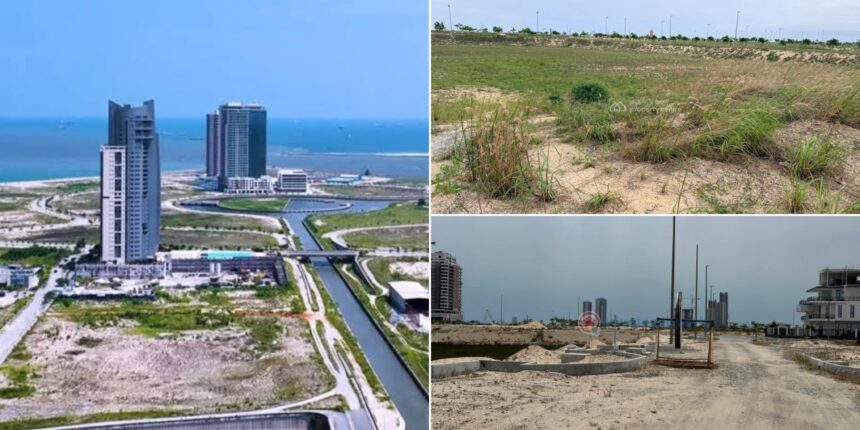
Eko Atlantic has become one of the clearest symbols of how far the value of prime land in Lagos has travelled. A figure from the 2025 State of Lagos Housing Market report places a plot in the development at more than ₦2 billion. That valuation immediately raises a bigger question about how a piece of land in a city built from reclaimed Atlantic territory reached such a level, especially when compared with the much lower figure of about ₦180 million cited for the early 2000s.
The story is therefore less about the price of one plot and more about the transformation of Lagos property values, infrastructure, luxury demand, scarce prime land and the emergence of an entirely new coastal district.
The ₦2 billion figure behind the story
The figure of more than ₦2 billion per plot did not come from an announcement by Eko Atlantic declaring that every plot in the development now carries the same price. It came from the 3rd edition of the State of Lagos Housing Market report produced by the Roland Igbinoba Real Foundation for Housing and Urban Development. The report examined the dramatic appreciation of land across different parts of Lagos and used Eko Atlantic as one of the strongest examples of how quickly values have risen in some of the city’s most sought after locations. Several Nigerian newspapers reported the finding in July 2025 and drew attention to the enormous difference between the historical figure and the reported 2025 valuation.
That distinction matters because land within Eko Atlantic is not necessarily sold at one universal price. The eventual value depends on factors such as the size of the plot, its district, location within the development, proximity to major roads or waterfront areas, permitted development, phase of the project and other conditions attached to the particular property. The ₦2 billion figure should therefore be understood as a market level valuation cited by the housing report rather than a blanket official price tag placed on every available plot across the entire city.
From ₦180 million to more than ₦2 billion
The numbers tell the story more clearly than almost any description could. The housing report placed the earlier value at about ₦180 million and the 2025 figure at more than ₦2 billion, creating a difference of more than ₦1.82 billion between the 2 points. The later figure represents more than 11 times the earlier valuation and amounts to an increase of roughly 1,011 percent when the 2 nominal values are compared directly. It is a remarkable movement that helps explain why Eko Atlantic has become such an important reference point whenever the conversation turns to expensive land in Lagos.
Yet the comparison also needs to be understood within the context of Nigeria’s changing economy. ₦180 million in the early 2000s does not have the same purchasing power as ₦180 million today, while the naira itself has experienced major changes in value over the decades. The comparison is therefore a nominal one rather than a calculation of the real inflation adjusted return on the land. Even with that qualification, the movement remains striking enough to show how dramatically the value of prime property in Lagos has expanded over time.
Eko Atlantic’s unusual beginning
The history of Eko Atlantic makes the price story even more interesting because the modern city did not simply grow from an old neighbourhood that had existed for generations. Instead, the development emerged from one of the most ambitious urban reclamation projects in Lagos. It transformed part of the Atlantic coastline into a planned district beside Victoria Island and created an entirely new piece of urban land where there had previously been open water and coastline.
Construction of the development began in the late 2000s as the former Bar Beach shoreline was transformed through reclamation and extensive coastal engineering. The Great Wall of Lagos became one of the most important elements of the project because the newly created city required a major defence system against the force of the Atlantic. The reclaimed territory itself also had to be raised and prepared for roads, utilities, buildings and other forms of modern urban development.
That history also explains why the early 2000s comparison should be read carefully. Eko Atlantic as the large scale reclaimed city known today was not already functioning as the finished urban district during that period. The ₦180 million figure cited by the housing report should therefore be understood within the historical valuation context used by the report rather than as evidence that the present day city already looked the way it does today.
The making of a new Lagos city
Eko Atlantic now occupies approximately 10 million square metres of reclaimed land beside Victoria Island. The developer, South Energyx Nigeria, describes the project as a major new coastal city with residential, commercial, retail, financial and recreational uses. The masterplan provides for 10 districts and thousands of buildings as the development continues to expand.
The scale is important because it shows why Eko Atlantic cannot be viewed simply as another residential estate where people buy land to construct individual houses. The project was conceived as a large urban district with roads, utilities, commercial areas, residential towers, offices, hospitality facilities and other major developments that require a completely different approach to land acquisition and development.
The city’s planned districts include the Business District, Harbour Lights, Marina District, Downtown, Eko Island, Avenues, Four Bridges, Eko Drive, East Side Marina and Ocean Front. These create different environments within the wider development and give land values room to vary depending on where a particular plot sits within the masterplan.
Why location carries such a premium
Location remains one of the biggest reasons behind the value of Eko Atlantic land because the development sits directly beside Victoria Island, one of the most commercially important and expensive parts of Lagos. It is close to major businesses, financial institutions, luxury residences, hotels, restaurants, entertainment venues and other important parts of the city’s economy.
Prime land becomes especially valuable when the supply is naturally limited. Central Lagos has very little room for the creation of large new areas of developable land. The emergence of a master planned city beside Victoria Island therefore created a rare combination of location, scale and development potential that is difficult to reproduce elsewhere within the same part of Lagos.
A developer buying land in Eko Atlantic is therefore not simply paying for square metres of physical ground. The acquisition also provides access to a location connected to one of Lagos’ strongest commercial corridors, with the potential to develop properties aimed at buyers and tenants who are prepared to pay premium prices for proximity, infrastructure, prestige and modern urban facilities.
Infrastructure becomes part of the value
Eko Atlantic’s infrastructure is another major part of the pricing story because the development was planned as a purpose built city rather than an ordinary estate where individual developers have to solve most infrastructure problems separately. The developer highlights services such as power, water, telecommunications, fibre connectivity, roads and other utilities as part of the wider development.
That infrastructure changes the calculation for a property developer because the value of land is not determined entirely by what exists on the ground at the moment of purchase. It is also influenced by what the surrounding development allows the owner to build and how easily that property can connect to the wider city. This creates an infrastructure premium that can make land inside a planned urban district significantly different from an isolated parcel elsewhere.
The attraction becomes stronger when infrastructure is combined with location. A developer acquiring a site near Victoria Island while also gaining access to an established masterplan and major urban services is operating in a very different environment from someone purchasing undeveloped land in a location where roads, electricity, drainage, water and telecommunications still have to be developed gradually.
The Great Wall of Lagos
The physical engineering behind Eko Atlantic is another reason the project stands apart from ordinary Lagos property. The Great Wall of Lagos forms a major coastal protection structure designed to shield the reclaimed city from the Atlantic. It creates the foundation for a new urban district built on land that required extensive engineering before buildings could rise.
Historical project material has described the reclaimed city as being raised to approximately 8 metres above sea level behind the coastal protection system. The sea defence itself extends for several kilometres and forms a crucial part of the city’s protection. The development is therefore an example of how enormous infrastructure investment can create new areas of valuable urban land.
That engineering story is easy to overlook when attention focuses on the price of a plot, but it sits at the heart of the development. The land being sold to investors is not simply naturally existing beachfront property. It forms part of an engineered coastal city supported by roads, utilities, drainage, sea defence and a carefully planned urban structure.
The price has not always looked the same
Eko Atlantic’s expensive land market did not suddenly appear in 2025. Historical reports show that prices had already been moving upward for years as the development became more established and investors increasingly recognised its potential.
A 2012 report cited a minimum acquisition size of about 2,000 square metres and a reported price of approximately $850 per square metre at the time. That provided an early glimpse into the scale of the land market being created within the development.
By 2019, reported prices had risen significantly. Some locations were said to command approximately $1,800 per square metre for inner city plots, about $2,500 per square metre for plots along roads and approximately $3,000 per square metre for waterfront locations. The figures demonstrated how the value could change depending on the position of the land within the development.
Those figures help place the 2025 ₦2 billion report figure into a longer sequence. The story is not simply about one dramatic increase appearing from nowhere. It is part of a property market that has developed over many years as infrastructure expanded, buildings rose, investors arrived and the city moved closer to becoming a functioning urban district.
Plot size changes the calculation
Plot size is another detail that can easily disappear beneath the ₦2 billion headline because Eko Atlantic has historically operated with much larger development parcels than the familiar 500 square metre or 600 square metre residential plots found across many Nigerian estates.
Historical project information has cited plot sizes beginning at around 2,000 square metres. That means the value of a parcel can become enormous once a per square metre price is applied across the entire site.
A simple illustration shows how quickly the numbers can grow. A hypothetical 2,000 square metre plot priced at $1,500 per square metre would produce a land value of $3 million, while the same size plot at $3,000 per square metre would reach $6 million. Those calculations are illustrations rather than current official quotations for a specific Eko Atlantic property.
The calculation also explains why the development is heavily associated with large commercial projects and high rise buildings. Expensive land becomes easier to justify when a developer can use the site for a substantial project containing many apartments, offices, retail spaces or other revenue generating units rather than a single private residence.
The luxury market behind the demand
Eko Atlantic is aimed at a market that operates very differently from the wider Nigerian housing market. Its location, infrastructure and development model attract high net worth individuals, major property developers, corporations, institutional investors and people seeking premium residential or commercial assets.
Luxury property markets are often driven by a combination of scarcity and purchasing power. Lagos has a sizeable population of wealthy residents and businesses seeking properties that provide a combination of prestige, security, convenience, modern infrastructure and access to important commercial areas.
Diaspora investors also form part of the wider demand for premium Lagos property, particularly where property can serve as a long term store of wealth or as an investment asset. Dollar linked pricing can make some high value properties easier to evaluate for people whose earnings or capital are held partly outside Nigeria.
That does not mean every buyer is purchasing land simply to hold it indefinitely. Developers may acquire large parcels with the intention of constructing towers, offices, hotels, retail centres or mixed use developments where the final value of the completed project can be many times greater than the initial cost of the land.
Why developers build upward
The economics of expensive land naturally encourage greater density. Eko Atlantic provides a clear example of why high rise construction becomes increasingly attractive as land values climb.
Suppose a developer commits billions of naira to acquire a large parcel. Building one luxury house on that land would leave the entire acquisition cost concentrated on a single asset, while a tower containing dozens or hundreds of residential or commercial units can distribute the cost of the land across many properties.
That calculation helps explain the skyline emerging across Eko Atlantic, where towers make economic sense because the development is designed for dense urban use rather than sprawling low rise housing. This allows developers to maximise the amount of saleable or lettable space created from valuable land.
The result is a simple property equation. Expensive land encourages higher development density, higher density encourages taller buildings, taller buildings create more units and more units provide a way for developers to recover the enormous cost of acquiring prime land.
The wider Lagos land boom
Eko Atlantic may be one of the most dramatic examples, but the same housing report shows that the rise in land values is happening across several parts of Lagos. This makes the ₦2 billion figure part of a much larger story about how infrastructure and development are changing the geography of property investment.
Ibeju Lekki provides one of the clearest examples. The report indicates that plots which sold for approximately ₦500,000 to ₦1.5 million in 2013 had risen to around ₦5 million to ₦10 million by 2018 before reaching approximately ₦25 million to ₦40 million by Q1 2025. That represents an extraordinary increase over a relatively short period.
Lekki Phase 1 tells another part of the story. Land that reportedly sold for approximately ₦10 million to ₦15 million in 2005 was valued at more than ₦400 million to ₦500 million by 2025. This shows that the appreciation of land in Lagos is not confined to one reclaimed city.
Those examples demonstrate how roads, commercial development, population growth, infrastructure and investor demand can transform the value of land over time. Locations that were once considered distant from the traditional centres of Lagos have become increasingly important as the city expands.
Eko Atlantic’s growing physical reality
The development has also moved beyond the stage where it could be described simply as a future city. Completed buildings, functioning infrastructure and ongoing construction now form part of the physical reality of Eko Atlantic.
The official Eko Atlantic material states that Phase 1 and Phase 2 infrastructure have been completed, with infrastructure operational and towers continuing to rise across the development. The wider masterplan provides for approximately 3,000 buildings and a future population target of about 300,000 residents.
That progression matters to land values because investors are not assessing an entirely theoretical project anymore. They can see buildings, roads, utilities and active developments occupying the reclaimed land, providing tangible evidence of the city taking shape around the plots being offered to investors.
The transformation also strengthens the connection between land value and development value. An empty parcel surrounded by established infrastructure and completed buildings can have a very different investment profile from an empty parcel sitting in an undeveloped location with little certainty about when major infrastructure will arrive.
Institutional interest adds another layer
Eko Atlantic has attracted interest beyond individual wealthy property buyers. Major institutional projects demonstrate the scale of investment associated with the development.
One notable example is the United States Consulate project. The Nation reported in 2019 that the United States acquired approximately 50,000 square metres from South Energyx for its Lagos consulate project through a reported 200 year lease arrangement.
The transaction is important because it shows that the development has been considered suitable for a major diplomatic and institutional project. It reinforces the wider positioning of Eko Atlantic as a location for organisations that require large sites within a strategically important part of Lagos.
Such projects also contribute indirectly to the value proposition of surrounding land because major institutions can increase the attractiveness of an area, support commercial activity and reinforce the perception of the development as a serious urban destination rather than simply a collection of luxury residential towers.
What the ₦2 billion figure does not mean
The most important clarification is that saying Eko Atlantic land is now worth more than ₦2 billion does not mean every plot currently available in the development costs exactly ₦2 billion. Land values differ according to district, size, location, development conditions and the particular terms attached to the property.
A recent 2026 investment guide from Makaya Consult gave an indicative range of approximately $1,500 to $3,400 per square metre depending on district and phase. That figure is a consultant’s market guide rather than an official Eko Atlantic price list and should therefore be treated as an indication of market variation rather than a universal selling price.
The distinction becomes especially important for anyone reading the headline and assuming that ₦2 billion is the fixed entry price for every parcel. The actual economics of acquiring land in Eko Atlantic depend on the specific property being considered and what can legally and commercially be developed on it.
The headline is therefore strongest when presented as a report based market valuation, with the 2025 State of Lagos Housing Market report placing Eko Atlantic land at more than ₦2 billion per plot rather than describing ₦2 billion as a universal official price for every plot in the city.
Land value is not the same as profit
A ₦2 billion plot may sound like an extraordinary investment opportunity, but the price of the land alone does not determine whether the eventual development will be profitable.
A developer still has to account for construction costs, financing, professional fees, taxes, marketing, infrastructure obligations, service charges, exchange rate movements, development restrictions, market demand and the amount buyers or tenants will eventually be willing to pay for the completed property.
A developer acquiring a site for ₦2 billion and spending several more billions constructing a tower must ultimately generate enough revenue from apartments, offices, retail units or other uses to cover the combined cost of the project and provide an acceptable return on capital.
That is why the value of the land should not be confused with the value of the finished building. A highly valuable piece of land can support a much larger development whose completed value runs into several billions of naira, but the difference between those figures represents development activity, not an automatic profit from the land itself.
What makes the story bigger than Eko Atlantic
The rise of Eko Atlantic land prices reflects a broader change in the way Lagos is developing. Prime property is increasingly tied to infrastructure, accessibility, commercial concentration and the ability to create high value developments on scarce land.
Traditional high value areas such as Victoria Island and Ikoyi remain important, while Lekki and Ibeju Lekki have expanded the city’s investment frontier. This has created a wider corridor in which new infrastructure and large developments can generate fresh property demand.
Eko Atlantic sits directly within that transformation, offering something particularly unusual because it combines the scarcity of prime central Lagos land with the scale of a newly created master planned city.
The development therefore represents more than another luxury estate. It demonstrates how Lagos can create new urban land through engineering, connect it to an existing economic centre and then transform that land into one of the most valuable property markets in the country.
The 2025 figure becomes more revealing
Looking at the 2025 figure alongside the historical price makes the scale of the transformation much easier to understand. The story moves from about ₦180 million to more than ₦2 billion rather than simply saying that Eko Atlantic has expensive land.
That sequence captures the rise of an entirely new part of Lagos, the growth of luxury property demand, the importance of infrastructure and the increasing value attached to land located close to the city’s strongest commercial centres.
It also shows why property prices cannot be understood simply by looking at the physical size of a plot. The real value of land comes from the economic activity that surrounds it, the infrastructure that supports it, the rights attached to it and the revenue that can potentially be generated from development.
Eko Atlantic has effectively turned reclaimed coastal territory into an urban asset. The price attached to that asset reflects decades of investment, development and rising demand for premium space in one of Africa’s largest cities.
Where the market stands in 2026
As of August 2026, there is no authoritative new Eko Atlantic announcement that replaces the 2025 RIRFHUD figure with a single official universal price of ₦X for every plot across the development. The most defensible figure therefore remains the more than ₦2 billion valuation reported by the 2025 State of Lagos Housing Market report.
Current Eko Atlantic material continues to present the development as an operational investment destination, with completed infrastructure, occupied buildings and new towers continuing to rise. The availability of land and the range of districts mean that individual prices can differ substantially depending on the property being considered.
The 2026 market guides that provide indicative per square metre ranges reinforce this point. The land market cannot realistically be reduced to one number for every plot, especially within a development where different districts and locations are designed for different forms of use.
That leaves the ₦2 billion figure as an important marker rather than a universal price list. It is precisely that distinction that makes the story more interesting because the real question is not simply how much one plot costs today, but how Lagos created the conditions for land in a reclaimed coastal city to reach such a remarkable valuation.
The real story behind the price
Eko Atlantic’s land price story is ultimately a story about Lagos itself. The development brings together several forces that have shaped the city’s property market for decades, including limited prime land, rising demand, population growth, luxury consumption, commercial expansion and enormous infrastructure investment.
The journey from the approximately ₦180 million historical figure cited by the housing report to more than ₦2 billion in 2025 shows how dramatically the value of strategically located land can change when a major development turns a location into a functioning urban destination.
Its reclaimed foundation makes the story even more unusual because the land did not simply become valuable through natural scarcity. It was created, engineered, protected and connected to one of Lagos’ most important commercial areas through a massive urban development programme.
That is why the ₦2 billion figure is more than an eye catching property price. It is a snapshot of how far Lagos real estate has travelled, how expensive prime urban space has become and how infrastructure can reshape the value of land over time, with Eko Atlantic standing at the centre of that transformation as one of the clearest examples of Lagos turning limited space into a high value urban market.