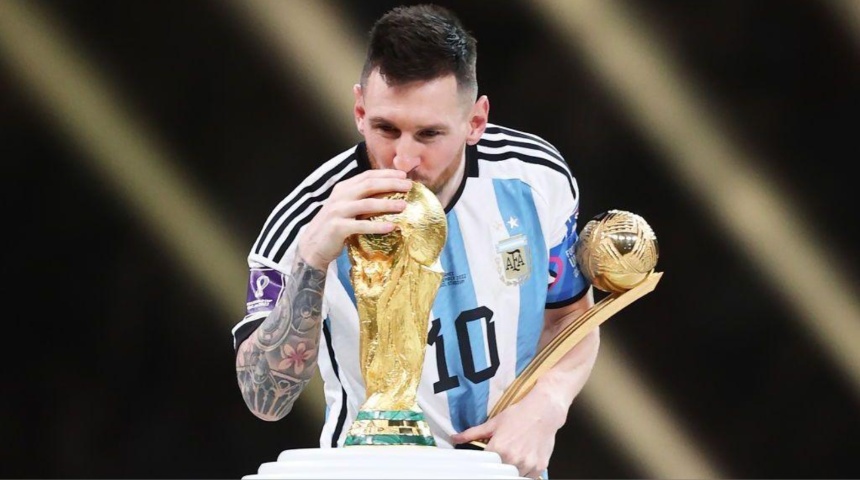
Football in Argentina stopped this week, quite literally, for a man who has spent two decades making sure it never did.
The Argentine Football Association (AFA) announced late Wednesday that every match played in the country this weekend, across men’s and women’s football, futsal and beach football, will be paused at the 10th minute for a full minute of applause. The gesture is Argentina’s collective tribute to Lionel Messi, who confirmed earlier this week that his international career with La Albiceleste is over.
It is the kind of moment Argentine football has reserved for very few players. This time, it belongs to the man who wore the number 10 for longer, and more effectively, than almost anyone in the history of the game.
Why Messi Is Retiring From International Football
Messi’s announcement came on Monday, delivered the way he has increasingly chosen to speak to the public in recent years: a handwritten note, posted to Instagram, without a press conference or a formal statement from the federation. In it, the 39-year-old confirmed that his final appearance for Argentina was the 2026 World Cup final, a 1-0 extra-time defeat to Spain that denied him a second world title as captain.
He didn’t try to dress the decision up. “I leave with the peace of mind and pride of having given you, along with my teammates, moments we once only dreamed of,” he wrote, adding that playing for Argentina had been incredible and that he loved the people who watched him do it.
There was no mention of whether this also marks the end of his club career at Inter Miami, where he is currently in his fourth season and coming off an MLS Cup title and back-to-back league MVP awards.
Why the AFA Chose the 10th Minute
The timing of the tribute is not accidental. Messi wore the number 10 for the vast majority of his career, both at club level and with Argentina, and the number has carried outsized meaning for Argentine football since Diego Maradona wore it in the 1980s. Pausing play in the 10th minute lets every stadium in the country mark the moment at the same time, in a shirt number the whole football world associates with him.
The AFA’s statement, issued Wednesday evening, read in part: for the upcoming matchday across all men’s and women’s divisions and disciplines, matches will be paused in the 10th minute of the first half for a minute of applause in recognition of Messi’s career with the national team. The federation also instructed clubs with video screens to play a tribute montage before kickoff, the same one the AFA had already shared across its own social media channels.
The tribute began almost immediately. During Thursday’s Argentine Cup tie between Vélez Sarsfield and Boca Juniors, both sets of fans and players observed the pause, giving an early look at how the weekend’s full round of Clausura fixtures is expected to play out.
A Second Retirement, a Different Ending
This isn’t actually the first time Messi has walked away from the national team. Back in 2016, after Argentina lost the Copa América final to Chile on penalties for the second year running, a visibly gutted Messi announced he was done with international football. He missed a penalty in that shootout, and at the time it looked like his Argentina story would end on a low note, without a major trophy to show for a career that had already delivered everything at club level.
He reversed that decision a few months later. What followed was arguably the most successful decade in Argentine football history: two Copa América titles, a Finalissima win over Italy, and, in December 2022, the World Cup title that had eluded him and the country since 1986. This time, when Messi confirmed his exit, there was no ambiguity and no talk of a comeback. Nine major finals, four trophies and 207 caps later, he closed the book on his own terms.
Messi’s Argentina Career, By the Numbers
| Category | Total |
|---|---|
| Appearances | 207 |
| Goals | 125 |
| Assists | 68 |
| International debut | August 2005 vs. Hungary |
| Final appearance | 2026 World Cup final vs. Spain |
| World Cups played | 6 (2006–2026) |
| World Cup goals | 21 |
| World Cup appearances (matches) | 34 |
| Hat-tricks for Argentina | 10 |
| Best single-match haul | 5 goals vs. Estonia, June 2022 |
| Favourite opponent (goals) | Bolivia (11 goals) |
Goals By Competition
| Competition | Goals |
|---|---|
| Friendly matches | 54 |
| CONMEBOL World Cup qualifiers | 36 |
| FIFA World Cup | 21 |
| Copa América | 14 |
Messi’s 36 goals in South American World Cup qualifying make him the all-time top scorer in CONMEBOL qualifying history, a record that reflects just how long he carried Argentina through the region’s notoriously brutal road to the World Cup.
Major Trophies and Finals
| Year | Tournament | Result |
|---|---|---|
| 2007 | Copa América | Runner-up |
| 2014 | FIFA World Cup | Runner-up |
| 2015 | Copa América | Runner-up |
| 2016 | Copa América | Runner-up |
| 2021 | Copa América | Champion |
| 2022 | Finalissima | Champion |
| 2022 | FIFA World Cup | Champion |
| 2024 | Copa América | Champion |
| 2026 | FIFA World Cup | Runner-up |
Four titles from nine finals is a return most players would take without hesitation, but it’s worth pausing on how long the wait was. Messi played in four losing finals before he won anything with the senior national team. By the time Argentina finally broke through in 2021, there were genuine questions about whether he would ever lift a trophy for his country at all. What came after answered that question about as emphatically as possible.
What the Tribute Says About Messi’s Place in Argentine Football
Only Maradona is spoken of in the same breath as Messi in Argentina, and even that comparison has always come with an asterisk attached to the number of trophies each man won. Maradona had one World Cup and 91 caps. Messi leaves with 207 caps, 125 goals and a trophy cabinet that Maradona’s generation never managed to fill. The AFA’s decision to halt an entire weekend of domestic football, across every division and discipline in the country, is a fairly direct answer to where the federation now places him in that conversation.
For a country where football is treated as something close to religion, stopping the clock for Messi isn’t just ceremony. It’s an acknowledgment that the national team spent two decades being built, quite literally, around one man’s left foot, and that his departure closes a chapter Argentine football is unlikely to see repeated for a very long time.
Messi hasn’t said whether Inter Miami will also be his final club stop, and MLS insiders don’t expect that decision until closer to the end of the current season. For now, the attention stays on Argentina, where fans up and down the country will spend this weekend applauding a number and a name that, for the first time in over two decades, won’t be walking out in the sky-blue-and-white shirt again.