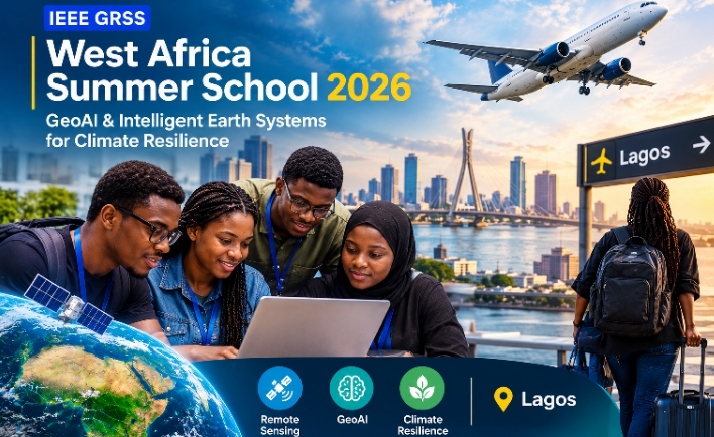
There are opportunities that catch attention because of the money attached to them, while others become interesting because of where they can take a person professionally. This one sits in a different space, combining travel support, specialised training, practical learning and access to a professional environment in Lagos. For anyone following opportunities around artificial intelligence, satellite technology, climate resilience or geospatial work, the details surrounding this programme are worth looking at closely.
The dates are already fixed, the application window is moving toward its final stage, and the support attached to selected participants makes the opportunity more significant than an ordinary training programme. The real picture becomes clearer when the programme is broken down from the application stage through the 5 days participants are expected to spend learning, connecting and working with modern Earth observation technologies.
The Opportunity Taking Shape
The programme is the IEEE GRSS West Africa Summer School 2026, organised under the IEEE Geoscience and Remote Sensing Society, with the theme “GeoAI and Intelligent Earth Systems for Climate Resilience.” Its focus brings together artificial intelligence, remote sensing, geospatial analytics, intelligent sensing and environmental applications, creating a programme that sits at the meeting point of technology and some of Africa’s most pressing climate challenges. The Summer School is scheduled to take place in Lagos, Nigeria, with the specific Summer School dates given as 31 October to 4 November 2026. The wider event calendar has also carried 29 October to 4 November 2026, but the Summer School programme itself is identified as running from 31 October to 4 November 2026.
That distinction matters because applicants are not simply signing up for another conference where the main expectation is to sit through presentations and leave with a certificate. The programme has a practical direction, with expert led sessions and hands on laboratory activities using real African datasets. That gives the opportunity a more technical character, particularly for participants who want to understand how satellite information, artificial intelligence and geospatial tools can be applied to real problems affecting communities, cities, agriculture and the environment. The setting in Lagos also means participants attending from Nigeria can take part without the complication of travelling outside the country.
The Deadline Has Moved
The application timeline has already gone through an important change. The original travel grant deadline was 30 August 2026, but the deadline was subsequently extended to 15 September 2026. That means the date applicants should now work with is 15 September 2026 rather than the original August deadline. For anyone who discovered the opportunity after the first deadline passed, the extension creates another window to prepare an application and confirm eligibility before the revised closing date.
The extension also makes timing important because the Summer School itself does not begin until 31 October 2026. There is therefore a gap between the application deadline and the physical programme, but applicants should not interpret that gap as a reason to delay preparation. Eligibility requirements, IEEE GRSS membership status and any information requested during the application process should be checked before submission. Waiting until the final hours can create unnecessary problems, especially where an applicant needs to resolve membership or documentation issues before completing the process.
Who Can Receive the Support
The travel support is not presented as an open application for every person living in West Africa. The stated eligibility focuses on IEEE GRSS Student, Graduate Student and Professional Members who are citizens or residents of West African countries. That requirement is one of the most important details to understand before anyone begins treating the programme as a general travel opportunity.
For a Nigerian applicant, the geographical requirement is straightforward because Nigeria is part of West Africa and the programme itself is being hosted in Lagos. The more important question is whether the applicant falls within the membership categories specified for the travel grant. Being a Nigerian student, researcher or technology professional by itself should not be treated as automatic qualification for the travel support. The IEEE GRSS membership requirement needs to be considered alongside the citizenship or residency condition.
Nigeria Has a Clear Advantage
The Lagos location gives Nigerian applicants an interesting advantage, particularly those already living in the city. Travelling to an international programme can quickly become expensive once flights, accommodation, local movement and feeding are considered, so having the Summer School hosted in Lagos removes the international travel element for people who are already in Nigeria. It also means eligible participants can focus more directly on the programme rather than dealing with visa applications or international flight arrangements.
For successful travel grant recipients, the announced support includes accommodation and local transportation during the programme, alongside participation in the Summer School. That combination can significantly reduce the practical cost of attending. It is important, however, to keep the description accurate. The available information does not establish that international airfare into Lagos will be reimbursed, so applicants travelling from Ghana, Sierra Leone, Liberia, Senegal or another West African country should not automatically assume that their flight will be covered.
What the Travel Support Actually Means
The word travel support can easily create the wrong impression if it is read as a promise of a complete international travel package. The support described for this programme is better understood as assistance that helps selected participants attend and remain at the Summer School. Accommodation and local transportation are among the key elements highlighted, while participation in the programme itself provides access to the training activities.
That makes the opportunity different from a cash grant. Applicants should not approach it expecting money to be deposited into their accounts for personal use. The value is largely connected to expenses and access surrounding the programme. A successful participant can potentially have accommodation and local movement handled through the support while also receiving access to the educational activities and professional environment created around the Summer School.
The 5 Day Experience
The core programme runs from 31 October to 4 November 2026, giving participants 5 days around the Summer School activities. Those 5 days are expected to revolve around GeoAI, Earth observation, remote sensing, geospatial analytics and climate resilience, with the practical sessions giving participants an opportunity to work with real datasets rather than limiting the experience to theory.
The importance of those 5 days is not simply the number of days spent in a venue. The programme is designed to connect different areas of technical knowledge. A participant interested in artificial intelligence may see how machine learning can be connected to geographical information, while someone from a GIS background may gain a clearer understanding of how AI can be used to analyse Earth observation data. Someone working around climate or environmental monitoring can also see how these technologies can support practical decision making.
GeoAI Takes Centre Stage
GeoAI is one of the strongest themes running through the programme. At its simplest, the field brings artificial intelligence together with geographical and Earth observation data, creating possibilities for analysing information about places, environments and changes across the Earth’s surface. Satellite images, mapping information and other geospatial datasets can contain enormous amounts of information, and AI techniques can help researchers process and interpret those datasets.
That becomes especially relevant when the discussion moves from technology to African problems. Flooding, drought, agricultural changes, urban expansion and environmental degradation are not abstract issues for many communities. They create direct consequences for people, businesses, infrastructure and public planning. Technologies capable of detecting patterns, monitoring changes and supporting early warnings can therefore have practical importance beyond the classroom.
Remote Sensing Brings the Earth Into the Classroom
Remote sensing is another major area participants can expect to encounter. Satellite and Earth observation technologies allow researchers to collect information about the planet without having to physically visit every location being studied. Such data can be used to understand changes in vegetation, land use, water bodies, settlements and environmental conditions.
The value becomes even greater when remote sensing is connected with other technologies. Satellite imagery can provide the raw information, geospatial tools can help organise and analyse it, while artificial intelligence can assist with recognising patterns across large datasets. A programme that brings these elements together can give participants a broader understanding of how modern Earth observation works rather than treating each technology as a separate subject.
Climate Resilience Is Central
Climate resilience provides the wider purpose behind the programme. Technology becomes more useful when it helps people understand environmental changes and prepare for their consequences. For African communities dealing with flooding, drought, changing agricultural conditions and other environmental pressures, reliable information can influence how governments, researchers and organisations respond.
The Summer School’s focus on intelligent Earth systems therefore places technical learning within a practical setting. Participants are not simply learning how a particular tool works in isolation. The wider direction is toward using geospatial technologies and artificial intelligence to understand environmental challenges and develop better approaches to resilience, monitoring and preparedness.
Flood Monitoring Forms Part of the Picture
Flood monitoring is one area where Earth observation and geospatial technology can have a direct practical role. Satellite information can help reveal changes across affected areas, while mapping technologies can help identify locations, infrastructure and communities that may be exposed to flooding. Combining these sources with intelligent analysis can support efforts to understand flood patterns and improve preparedness.
For a participant interested in disaster management, this is where the programme can become particularly relevant. The technical knowledge gained from working with spatial data can potentially be applied to emergency planning, environmental assessment and early warning systems. The emphasis on real African datasets also gives the learning experience a stronger regional connection than a purely theoretical exercise.
Drought Monitoring Has Its Own Role
Drought presents a different kind of challenge because its effects can develop over longer periods and across wider areas. Earth observation technologies can help researchers monitor environmental conditions and changes that may indicate stress on vegetation, water resources or agricultural systems. When these observations are combined with analytical tools, they can support a better understanding of where conditions are changing and how those changes are developing.
Participants interested in agriculture, environmental science or climate research can therefore find a direct connection between the programme and their areas of interest. The value is not necessarily limited to learning a particular software package. Understanding the relationship between data, geography, environmental conditions and AI can create a foundation for future research and technical projects.
Agriculture Enters the Conversation
Agriculture is another area where geospatial technologies can become highly practical. Land conditions, vegetation patterns, water availability and changes in land use can be studied through Earth observation data. Researchers and agricultural technology professionals can use such information to understand broader patterns that would be difficult to observe through ground inspection alone.
The Summer School’s emphasis on African datasets gives this area additional relevance. Agricultural problems differ across regions, and solutions developed around local data can provide more useful learning than examples disconnected from the realities of the continent. Participants with an interest in agricultural technology can therefore approach the programme from both the technical and practical sides.
Land Use Mapping Matters
Land use mapping helps researchers understand how areas are being used and how those uses change over time. Urban growth, agricultural expansion, vegetation loss and other changes can be studied through geospatial information. Such mapping can support planning and environmental management by providing a clearer picture of what is happening across a particular landscape.
For students and professionals in geography, surveying, geomatics and environmental fields, this part of the programme connects closely with familiar academic and professional interests. Adding AI to that process can also introduce new approaches to analysing large volumes of geographical information. The combination gives participants an opportunity to see how traditional geospatial work is developing alongside newer computational methods.
The Hands On Element
The hands on component is one of the details that separates the Summer School from a basic lecture based training. Participants are expected to engage with practical laboratories using real African datasets, giving them an opportunity to work through the type of information that researchers and professionals encounter when studying environmental and geographical problems.
Practical learning also creates a different experience from simply hearing an expert explain a concept. Participants have to follow the data, understand the tools and see how an analytical method can be applied to a real problem. For someone building technical skills, those practical sessions can become one of the most useful parts of the 5 day programme.
Who Should Pay Attention
Students studying GIS, geomatics, surveying, geography, environmental science, computer science, engineering or related areas can find a natural connection to the Summer School. Researchers working around remote sensing, climate technology, agriculture or disaster management can also see how the programme fits into their existing interests. Data scientists and AI enthusiasts may find the GeoAI focus particularly useful if they want to apply their technical skills beyond conventional business or software applications.
The opportunity is not restricted to people who already describe themselves as remote sensing specialists. Someone with an artificial intelligence background may be interested in understanding how AI can be applied to spatial problems, while someone with a geography background may want to explore how machine learning is changing geospatial analysis. The programme creates room for different technical backgrounds to meet around a common subject.
What Participants Can Gain
The benefits extend beyond the accommodation and local transportation attached to the travel support. Participants can gain exposure to experts working in the field, practical experience with relevant technologies and an opportunity to meet other people interested in Earth observation, AI and climate resilience. Such interactions can be useful for people considering research, postgraduate study or professional development.
There is also the value of being part of an IEEE GRSS related programme. Professional networks can sometimes begin with a single training programme, workshop or technical discussion. A participant who approaches the Summer School seriously can leave with new contacts, ideas for projects and a clearer understanding of where their interests fit within the wider geospatial and remote sensing community.
The Programme Is Not a Job
It is important to separate the professional value of the Summer School from employment. The programme is a training and professional development opportunity, not a recruitment exercise offering participants jobs. There is no reason to present the travel support as an employment opportunity or suggest that attending automatically leads to a paid position.
Its career value comes through skills, exposure, networking and knowledge. Someone can use the experience to strengthen a CV, develop a research direction, meet potential collaborators or understand new areas of technology. Those benefits can become useful later, but they should not be confused with a guaranteed job placement.
It Is Not a Cash Grant
The same distinction applies to funding. This is not an empowerment programme where successful applicants receive a cash award to spend on a business or personal project. The support is connected to participation in the Summer School, with accommodation and local transportation among the benefits highlighted by the organisers.
That makes the opportunity particularly relevant to people who value access and learning rather than simply looking for money. The real attraction is the package surrounding the 5 day programme, especially for participants who want to build knowledge in a technical area that is becoming increasingly important to climate research, environmental monitoring and intelligent mapping.
Lagos Changes the Equation
Hosting the programme in Lagos gives the opportunity a particularly practical angle for Nigerians. International training opportunities often require participants to think about passports, visas, flights, foreign accommodation and unfamiliar transport systems. A Lagos based programme removes much of that burden for people already living in Nigeria.
For successful participants who live outside Lagos, there can still be movement and accommodation considerations, but the overall journey remains domestic. For those already based in Lagos, the advantage is even clearer. The participant can attend a specialised international society backed programme in their own city while focusing attention on the technical experience rather than international travel arrangements.
The Dates Applicants Should Remember
The original travel grant deadline was 30 August 2026, while the revised deadline is 15 September 2026. The Summer School itself is scheduled for 31 October to 4 November 2026. These dates form the basic timeline applicants need to keep in view when deciding whether to pursue the opportunity.
The most immediate date is 15 September 2026 because that is the current extended deadline for the travel support application. The next major date is 31 October 2026, when the 5 day Summer School programme begins in Lagos. Keeping those dates separate helps prevent confusion between the application period and the actual training period.
The Membership Detail Cannot Be Ignored
Anyone interested in the travel support should examine the IEEE GRSS membership requirement carefully before assuming eligibility. The stated categories include Student, Graduate Student and Professional Members, alongside the West African citizenship or residency requirement. This means the membership condition is not merely a minor administrative detail buried beneath the programme description.
Applicants who already belong to IEEE GRSS can proceed with a clearer understanding of where they stand, while those who are unsure should verify their membership status and the current application requirements before submission. The safest approach is to rely on the official programme information for the exact requirements rather than assuming that a general interest in GeoAI is enough.
The Opportunity Behind the Opportunity
What makes the programme interesting is the way several fields meet under one roof. Artificial intelligence is increasingly being applied to areas far beyond conventional software development, while satellite technology continues to produce huge amounts of information about the Earth’s surface. Geospatial analysis provides the framework for understanding that information, and climate resilience gives the work a practical purpose.
The 5 day programme in Lagos therefore offers participants a chance to see how these areas connect. Someone may arrive thinking primarily about GIS and leave with a stronger interest in AI. Another participant may come from computer science and discover applications for machine learning in environmental monitoring. A climate researcher may gain a clearer view of how satellite data can strengthen analysis.
What Applicants Should Keep in Mind
The opportunity is strongest for people who can connect the programme to a genuine academic, research or professional interest. An applicant does not need to know everything about GeoAI before applying, but having a clear reason for wanting to learn about the field can make the opportunity more meaningful. The programme covers technical areas that require curiosity and willingness to engage with data and analytical tools.
Applicants should also keep expectations realistic. Travel support does not automatically mean every travel expense is covered, and participation does not guarantee employment or financial rewards. The clearest benefits are the supported participation, accommodation, local transportation, expert led learning, practical exposure and professional networking attached to the Summer School.
The Final Timeline
The story begins with the travel grant deadline, which was originally set for 30 August 2026 before being extended to 15 September 2026. That extension gives eligible applicants additional time to prepare and submit their applications. Once the application stage closes, the next important point on the calendar is the Summer School itself, scheduled for 31 October to 4 November 2026 in Lagos.
Those 5 days are expected to bring together GeoAI, remote sensing, geospatial analytics, intelligent sensing and climate resilience through expert sessions and hands on laboratory work. Participants will be working within a programme designed around real African challenges, including areas such as flood monitoring, drought monitoring, agriculture, land use mapping, environmental monitoring and disaster early warning.
What Participants Can Expect
By the time participants arrive in Lagos, the experience is expected to be more than simply attending a series of talks. The programme brings together learning, practical work and professional interaction, while the travel support is designed to make participation easier for selected eligible members. Accommodation and local transportation are important parts of that support, while participation in the Summer School provides the central educational benefit.
For an eligible IEEE GRSS member in West Africa, especially a Nigerian participant who can attend in Lagos without international travel, the combination creates a relatively unusual opportunity. The programme brings advanced technical subjects into a local setting, gives participants access to practical learning and places the experience within the wider IEEE GRSS professional environment.
The Date That Matters Now
As of 5 September 2026, the immediate date to remember is 15 September 2026. That is the extended travel grant deadline and the point applicants need to work toward. The programme itself follows later, from 31 October to 4 November 2026, giving selected participants time to prepare for the 5 day experience in Lagos.
For anyone whose interests sit around artificial intelligence, GIS, remote sensing, satellite imagery, climate technology, environmental monitoring, agriculture, disaster management or geospatial analysis, the opportunity offers a clear route into a specialised area where these disciplines increasingly overlap. The support may not be a cash award or a promise to cover every international travel expense, but the combination of accommodation, local transportation, participation, practical learning and professional exposure gives the programme a distinct value.
The most important step now is simple. Eligible applicants should check the IEEE GRSS membership requirement, review the travel grant conditions carefully and work toward the 15 September 2026 deadline. Beyond that date lies a 5 day programme in Lagos where GeoAI, intelligent Earth systems and climate resilience move from broad concepts into practical learning, real datasets and professional interaction.