The message arrived like an ordinary traffic notification, carrying the name of the Federal Road Safety Corps and informing the recipient that a road offence had been recorded. There was a link to follow, a fine to resolve and an apparent reason to act quickly. For a motorist accustomed to seeing traffic enforcement officers on Nigerian roads, the message could easily pass as another official notice requiring immediate attention.
That confidence is now at the centre of a growing fraud involving fake FRSC websites and messages sent to motorists. The fraudulent platforms imitate the appearance of official traffic portals and claim to help recipients check or settle alleged offences. What appears to be a small traffic fine can then become a gateway for the collection of sensitive financial information.
The cases involving actress Eva Ibiam and Adekanla Desalu show how the scheme can unfold. Ibiam reportedly lost ₦364,574.36 after interacting with a fake FRSC traffic portal, while Desalu said an apparent ₦2,500 payment ended with a $2,500 debit. FRSC has separately warned motorists about fraudulent messages and websites using the Corps’ identity.
How the fake FRSC message reaches motorists
The scheme begins with an unsolicited SMS or online message telling a motorist that a traffic offence has been recorded. The wording is designed to sound like an enforcement notification rather than an ordinary request for money. The recipient is then directed to a website where the supposed offence can be viewed and resolved.
The message creates an immediate sense of responsibility for the recipient. Questions begin to arise about where the alleged offence occurred, whether the vehicle was captured by a camera, whether the number plate was recorded and whether the fine needs to be paid immediately. The link in the message appears to offer the answers.
That is where the fraud moves from a simple SMS into a carefully constructed website experience. Instead of sending the motorist to an obvious scam page, the fraudulent platform can display FRSC branding, traffic offence information, payment instructions and other details intended to make the process look genuine.
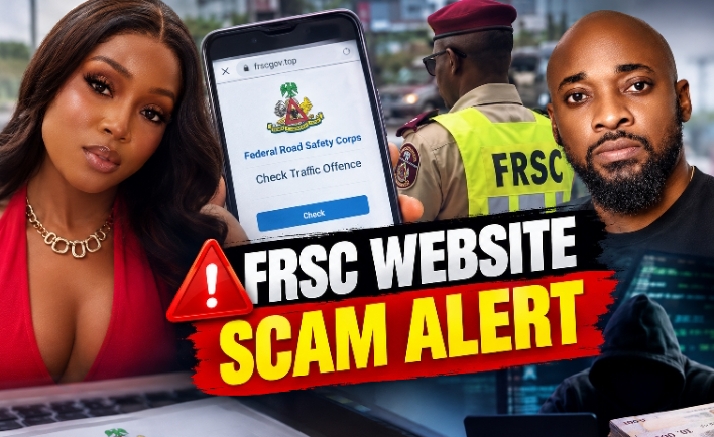
FRSC has warned that similar fraudulent messages are being circulated through mobile devices and social media platforms. The Corps specifically disowned frscgov.top/ng, stating that the website has no affiliation with FRSC.
The alleged traffic offence creates the trap
The scam works because the alleged offence gives the message a believable reason to exist. A prize notification or an unexpected request for money may immediately trigger suspicion, but a message saying a vehicle has committed a traffic offence fits into something motorists already understand.
The recipient may believe the issue needs to be resolved before it becomes more serious. That sense of urgency can encourage the person to click the link before independently checking whether the message actually came from FRSC.
Once the website opens, the recipient is presented with an apparent explanation for the notification. The page can show an alleged offence, a fine and instructions for payment. The entire interaction is designed to feel like an official process rather than a conversation with a fraudster.
The danger is that the motorist may provide information believing it is necessary to settle a traffic matter. The same information can then be used for a financial transaction or other fraudulent activity.
Eva Ibiam’s reported ₦364,574.36 debit

Actress Eva Ibiam’s experience provides one of the clearest reported examples of how the fake FRSC operation can turn a traffic message into a financial loss. She said she received a message concerning a traffic offence after recently being stopped by road safety officers who photographed her vehicle’s number plate.
That recent interaction made the subsequent message appear credible. The notification seemed to fit something that had actually happened to her, making it easier to believe that the message was connected to the road safety encounter.
Ibiam followed the link and reportedly encountered a website designed to resemble an FRSC traffic portal. The page displayed an alleged speed limit violation, a supposed fine and a payment process.
The financial consequence came later. A reported bank alert associated with the case showed a debit of ₦364,574.36. The transaction was reportedly linked to an international web purchase and carried a merchant description involving SERIOUS FIX MACHINERY in Dubai.
The case has since drawn attention because the amount was far greater than the small traffic payment a motorist might expect from such a notification.
The 15:27 OTP before the debit
Another detail from the investigation into Ibiam’s case concerns the one time password sent by her bank. According to the reported sequence, an OTP was issued at about 15:27 before the disputed transaction occurred minutes later.
The timing has raised questions about the information entered during the interaction with the fraudulent website. A fake payment portal can be designed to collect card information and other authentication details while making the victim believe those details are required to complete a legitimate government payment.
The reported sequence points to a scam that may be designed to obtain more than the stated traffic fine. Once a victim enters financial credentials into the fraudulent platform, the attackers may have information capable of facilitating a much larger transaction.
The precise way every credential was obtained or used in the Ibiam case has not been established. The OTP detail nevertheless adds another layer to the investigation into how the reported debit occurred.
Adekanla Desalu’s ₦2,500 traffic payment attempt
Adekanla Desalu has separately shared an account involving the same type of traffic offence scam. According to his account, he received a message about an alleged traffic offence and was directed to a website where he was asked to make a payment of about ₦2,500.

The amount appeared small enough to seem like a normal traffic related charge. Rather than looking like a demand for a large amount of money, the payment presented itself as a relatively minor fine that could be settled quickly.
Desalu said he proceeded with the transaction believing he was paying the stated ₦2,500 charge. The situation changed when he discovered that his account had instead been debited $2,500.
His account provides another example of the potential danger attached to the fraudulent portals. The amount displayed on the website may not reflect the financial exposure created when a victim enters card or banking information into the system.
Desalu’s experience also adds a personal account to the wider warning issued by FRSC about fraudulent traffic messages and websites impersonating the Corps.
Multiple FRSC domains have surfaced
The investigation has uncovered several suspicious domains carrying FRSC themed messages and traffic related content. They include frscgov.top, fctevreg.cam, frsac-govt.cc, fctevregonline.click and fctevreg-gov.top.
The presence of several domains makes the operation more difficult for motorists to identify by relying only on a single website address. A suspicious domain can disappear after being exposed while another website carrying similar content remains available.
The reported messages also share similar wording and presentation, pointing to a wider campaign targeting motorists through the same basic deception. The changing domain names allow the fraudulent operation to continue using different web addresses while maintaining the traffic offence theme.
The existence of multiple suspicious domains does not establish that every website is controlled by one person or organisation. It does, however, show that motorists are encountering more than one fraudulent website using FRSC’s identity.
FRSC disowns frscgov.top
FRSC has specifically warned motorists about frscgov.top/ng, stating that the website is not affiliated with the Corps. The warning came as fraudulent messages claiming that recipients had committed traffic offences circulated among members of the public.
The agency said motorists should be cautious of unsolicited messages and avoid clicking suspicious links. It also warned against providing banking information, card details, passwords, driver’s licence information and vehicle registration details through such platforms.
The warning is significant because the fraudulent websites are designed to exploit the trust attached to the FRSC name. A motorist who sees the Corps’ identity on a website may assume that the platform has been authorised to process traffic related payments.
FRSC’s position is that motorists should use established official channels when verifying traffic information instead of relying on links received through suspicious messages.
The official FRSC verification channels
FRSC identifies frsc.gov.ng as its official website and provides the national toll free number 122 for motorists seeking assistance or information.
The difference is important when dealing with an unexpected traffic notification. A motorist who receives a suspicious message can independently access the recognised FRSC website rather than clicking the link supplied by the sender.
The same approach applies when a message contains a specific offence or payment amount. Instead of assuming that the notification is genuine, the motorist can verify the claim through an established FRSC channel.
That removes the fraudulent website from the process and gives the motorist an opportunity to establish whether the alleged offence actually exists.
Did the scammers hack FRSC’s database?
The question of how the scammers obtained information about motorists remains one of the most important unanswered issues surrounding the campaign. The issue became more noticeable in Ibiam’s case because of her recent encounter with road safety officers before receiving the fraudulent message.
There is currently no established evidence showing that FRSC’s database was hacked. There is also no established evidence that an FRSC employee supplied Ibiam’s information to the scammers.
The timing of her road safety encounter and the subsequent message is notable, but it does not establish the source of the information. The scammers could have obtained motorists’ phone numbers or vehicle related information through other channels.
Further investigation would be required to determine exactly how the targeted motorists were identified and where the information used in the messages originated.
Was an FRSC officer involved?
The available reporting has not established that an FRSC officer was involved in supplying motorists’ information to the scammers. The possibility has attracted attention because some victims may receive messages containing information that appears connected to genuine road traffic activity.
The existence of a genuine interaction before a fraudulent message does not establish a connection between the two events. Evidence would be needed to show that information moved from an FRSC official or system to the people operating the fraudulent websites.
FRSC has instead described the websites and messages as fraudulent and said it intends to work with relevant law enforcement and cybersecurity authorities over the impersonation scheme.
The investigation therefore has two separate issues to address, the fraudulent websites themselves and the source of any personal or vehicle information used to make the messages convincing.
How the fake payment process works
The fraudulent process follows a recognisable pattern. The motorist first receives the message claiming that a traffic offence has been recorded. The message then directs the recipient to a website where the alleged offence can supposedly be resolved.
The website presents the next stage by displaying the alleged violation and an amount described as a fine. The motorist is then taken towards payment, often under the impression that completing the transaction will settle the supposed offence.
At that point, the victim may be asked to provide card or banking information. Other sensitive information can also become part of the process, depending on how the fraudulent website has been designed.
The traffic offence therefore becomes the entry point into a financial phishing operation. The payment is no longer simply about collecting the supposed fine. The information entered by the victim can become the more valuable target.
Why the messages look believable
The fraud relies heavily on familiar government language. The name of FRSC, the reference to traffic offences and the appearance of an official looking website all work together to reduce suspicion.
The scam can become even more convincing when the recipient has recently driven through an area where traffic enforcement is common or has interacted with road safety officers. A person may already be thinking about traffic rules and possible penalties when the message arrives.
Ibiam’s account illustrates this problem. Her recent interaction with road safety officers gave the subsequent message an apparent connection to a real event, even though the fraudulent website was not connected to FRSC.
The scammers therefore do not necessarily need to know everything about their targets. They need enough believable information to make the recipient continue through the process.
The difference between ₦2,500 and $2,500
Desalu’s account brings attention to one of the most disturbing aspects of the reported scam. He said the website presented a payment of about ₦2,500, but he later discovered a $2,500 debit.
The difference between those amounts is substantial. A motorist approaching a small traffic payment may not expect that the transaction could expose the account to a much larger charge.
That is why the payment page itself deserves as much caution as the original SMS. A website can display one amount while the actual transaction being processed may involve something entirely different.
The reported ₦364,574.36 debit in Ibiam’s case similarly shows how a traffic offence message can be followed by a significant financial transaction.
The two accounts involve different amounts and circumstances, but both centre on the same basic deception, a supposed traffic offence leading the victim towards a fraudulent payment process.
FRSC’s warning to motorists
FRSC has urged motorists to exercise caution when receiving unsolicited traffic related messages. The Corps has specifically warned against clicking suspicious links and against sharing sensitive personal or financial information through such platforms.
The warning covers bank information, card details, passwords, driver’s licence information and vehicle registration information. These details can be valuable to fraudsters even when the original message appears to concern nothing more than a small traffic fine.
Motorists are also encouraged to verify information through established FRSC channels rather than through links supplied in unexpected messages.
The Corps has said it will work with relevant law enforcement and cybersecurity authorities regarding the fraudulent impersonation.
The campaign goes beyond one website
The discovery of multiple suspicious domains changes the picture from a single fake website to a wider pattern of online impersonation. Motorists may encounter different addresses while receiving messages that follow the same traffic offence theme.
Some of the reported domains use combinations of terms associated with FRSC, government services, vehicle registration or traffic enforcement. That naming strategy can make the address appear official to someone viewing it quickly on a mobile phone.
The problem becomes more difficult when the website itself carries familiar branding. A domain name that looks questionable can still appear convincing once the page opens and displays government logos, alleged vehicle details and a payment form.
That combination is why FRSC’s warning focuses on independent verification rather than appearance.
The figures attached to the reported cases
The reported figures tell two very different stories. Eva Ibiam’s case involved a reported debit of ₦364,574.36 after she interacted with the fake traffic portal.
Adekanla Desalu’s account involves an apparent ₦2,500 traffic payment followed by a reported $2,500 debit.
The figures highlight the potential financial consequences of entering sensitive information into a fraudulent payment platform. They also show why motorists should not assume that a small amount displayed on a website limits the possible loss.
FRSC has not announced a nationwide financial loss figure from the campaign. The total number of motorists affected also remains unknown.
What remains unanswered
The investigation has established the existence of fraudulent FRSC messages and websites, but several questions remain open. The exact number of motorists who have received the messages has not been established, while the total number of people who entered financial information into the fake portals is also unknown.
The source of the information used to target particular motorists remains another unanswered question. The available evidence does not establish that FRSC’s database was breached or that an FRSC employee supplied motorists’ details.
The full network of websites is also still developing. Several suspicious domains have been identified, but that does not necessarily represent every website being used in the campaign.
The identity of the people behind the operation has not been established in the information currently available.
How motorists can avoid the trap
The safest response to an unexpected FRSC traffic message is to avoid the supplied link until the information has been independently verified. A genuine looking website does not establish that it belongs to FRSC.
Motorists should independently access the official FRSC website or contact the Corps through 122 when they need to confirm a traffic related notification. They should also avoid entering card details, passwords, banking information or authentication codes into suspicious platforms.
A message that creates urgency deserves extra caution. The more a notification pushes the recipient to act immediately, the more important it becomes to pause and verify the claim through a separate official channel.
The same principle applies when the alleged offence appears highly specific. Details about a vehicle, a location or a supposed traffic violation can make a message look convincing without proving that the sender is genuine.
The warning behind the reported losses
The fake FRSC campaign has turned an ordinary government identity into the central tool of a sophisticated phishing operation. The fraudulent messages give motorists a reason to click, the websites give them a reason to trust what they see and the payment process creates an opportunity to collect sensitive information.
Eva Ibiam’s reported ₦364,574.36 debit shows how the process can lead to a substantial financial transaction. Adekanla Desalu’s account of a ₦2,500 payment followed by a $2,500 debit shows another possible outcome.
FRSC has now publicly disowned the fraudulent websites and warned motorists against responding to unsolicited traffic offence messages. The Corps’ official website remains frsc.gov.ng, while 122 is the national toll free number provided for motorists seeking assistance.
The fake traffic fine may be the first thing a motorist sees, but the financial information entered afterwards is where the real danger begins. A message can look official, a website can look familiar and a payment can look small, yet the reported cases show how quickly the situation can become far more expensive.
For motorists receiving these messages in September 2026, the safest habit is simple: stop before clicking, verify through FRSC’s official channels and keep financial information away from unsolicited traffic links.