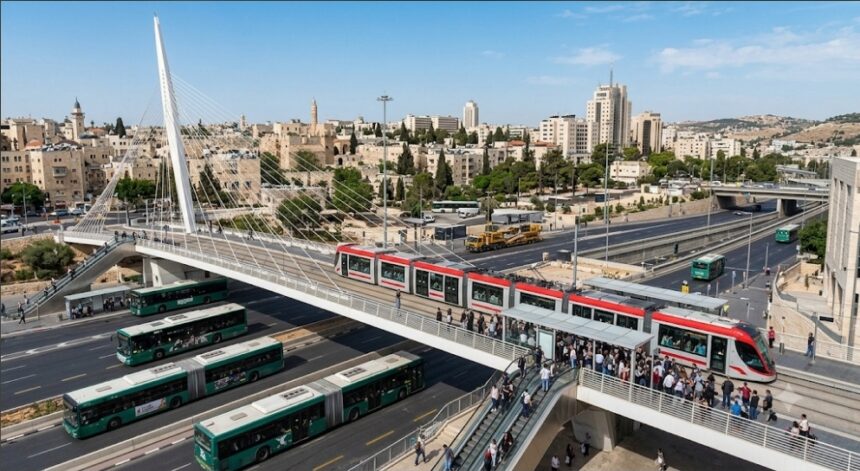
Public transportation remains a major part of daily life in many countries, providing millions of people with alternatives to private cars for commuting, business, education and other activities.
Buses, trains, trams, metro systems, ferries and other shared services help connect communities while offering relatively affordable ways to move within and between urban areas.
Countries with extensive public transport networks can also provide residents with alternatives to private vehicles, particularly in densely populated cities where congestion and long journeys can make driving less convenient.
A ranking of countries based on reported public transportation use places Israel and Monaco at the top, while eight other nations complete the list.
Israel and Monaco lead the ranking
1. Israel — 100.0
Israel occupies the first position with a score of 100.0, reflecting the prominent role of public transportation in the movement of residents and visitors.
Its transport network includes extensive bus and rail services serving major cities and urban centres, giving commuters alternatives to private vehicles.
2. Monaco — 100.0
Monaco shares the highest score of 100.0 despite being one of the world’s smallest countries.
The principality’s dense population, steady inflow of workers and large number of visitors create significant demand for transportation, with connections to neighbouring parts of France also supporting daily movement.
3. Maldives — 98.8
The Maldives records a score of 98.8, with its geography playing a major role in how people travel.
Because the country consists of hundreds of islands scattered across the Indian Ocean, boats and other forms of shared marine transportation are particularly important for movement between populated areas and islands.
Public transport dominates urban mobility
4. Turkey — 97.6
Turkey ranks fourth with a score of 97.6 and has developed extensive public transportation systems across several major cities.
Istanbul illustrates the scale of the network, with buses, metro services, trams, ferries and other rail connections providing different options for residents navigating the sprawling city.
5. Qatar — 97.4
Qatar follows with a score of 97.4, supported by significant investment in public transportation infrastructure, particularly around Doha.
The Doha Metro has become an important component of the network, while buses and other services provide additional connections across the country.
6. Luxembourg — 97.4
Luxembourg also records 97.4 and has made public transportation a central part of its approach to mobility.
The country introduced free public transportation nationwide, allowing passengers to use buses, trains and trams without paying fares and making shared transport more accessible.
7. Malta — 97.3
Malta ranks seventh with a score of 97.3, with buses serving as the mainstay of its public transportation system.
The relatively compact island and its high population density make buses an important option for residents, while tourists also rely heavily on the network to move between destinations.
European countries dominate the remaining places
8. Spain — 97.2
Spain records 97.2, with public transportation particularly significant in its major urban centres.
Cities including Madrid and Barcelona operate extensive networks incorporating buses, metro systems, commuter trains and other rail services, giving residents several alternatives to private cars.
9. Austria — 96.8
Austria takes ninth place with a score of 96.8 and has an established system connecting major cities with smaller communities.
Vienna is particularly notable for its combination of underground trains, trams, buses and commuter rail services, which form an important part of everyday urban transportation.
10. Portugal — 96.5
Portugal completes the ranking with a score of 96.5, supported by a mixture of buses, trains, trams and metro systems.
Lisbon has an extensive network that includes its well-known trams alongside metro, bus and suburban rail services, with public transportation also widely used by visitors exploring the capital and other destinations.
The ranking highlights how geography, urban density, infrastructure and government transport policies can shape the extent to which people depend on shared mobility rather than private vehicles.