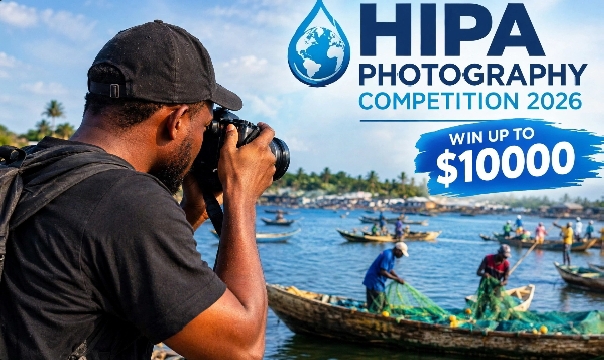
For photographers looking beyond the usual photography contests, the opportunity currently open from the Hamdan bin Mohammed bin Rashid Al Maktoum International Photography Award could be worth paying close attention to, especially because the winning opportunity is not built around simply producing one beautiful picture and uploading it before a deadline. There is a much bigger story behind the competition, and photographers who understand the brief before reaching for their camera will have a clearer idea of the kind of submission expected, the technical rules that must be followed and the documents that could become important later in the process.
The competition is centred on one of the most basic parts of everyday life, water, but the official brief takes the subject far beyond photographs of rivers, beaches, waterfalls or oceans. HIPA wants photographers to explore the relationship between water, people, communities, the planet, innovation and challenges through a visual story made up of multiple photographs. That requirement changes the way an applicant needs to approach the opportunity because the submission is expected to work as a connected body of images rather than a collection of unrelated photographs.
For photographers in Nigeria, the subject also opens several possible directions without requiring them to travel outside the country. A photographer could build a story around fishermen, farmers, water vendors, coastal communities, flooding, sanitation, pollution, wetlands, conservation or the daily search for clean water, provided the final portfolio genuinely reflects the competition’s theme and follows its rules. The interesting part comes when the photographer begins looking at the subject as a story rather than simply searching for an attractive frame.
Understand the competition first
The current HIPA opportunity is titled Water: Our Shared Story 2026, and it is separate from the organisation’s regular annual photography award season. This distinction is important because HIPA runs different competitions, themes and award structures, so applicants should make sure they are preparing for the Water: Our Shared Story competition rather than relying on information from another HIPA award cycle.
The competition is being organised by HIPA in collaboration with the UAE Ministry of Foreign Affairs and the 2026 United Nations Water Conference. The wider focus is therefore connected to the importance of water in human life, communities, ecosystems, development and environmental sustainability, giving photographers room to approach the theme from several real world angles while still keeping the portfolio coherent.
Rather than asking applicants to submit one standalone photograph, HIPA requires a portfolio containing between 5 and 10 photographs. The applicant must also provide a title for the portfolio and a description explaining the story being presented. This means the photographer is not simply competing with a single image, because the entire collection needs to communicate an idea that can be understood when the photographs are viewed together.
The official theme provides 5 broad areas that can guide a photographer’s approach, namely Water and People, Water and Communities, Water and Planet, Water and Innovation, and Water and Challenges. These areas can be explored individually or combined where the photographer has a strong reason for connecting them within one visual story.
Know the deadline
The submission period officially opened on September 16, 2026, giving photographers an opportunity to prepare their portfolios before the final closing date. The deadline is October 15, 2026, at 11:59 PM UAE Standard Time, which converts to 10:59 PM on October 15, 2026, in Nigeria because Nigeria operates on GMT plus 1 while the UAE operates on GMT plus 4.
That time difference is worth paying attention to because the Nigerian deadline is not midnight. A photographer who waits until the final minutes could therefore find themselves working against a deadline that arrives earlier than expected from a Nigerian perspective. HIPA’s rules state that submissions received after the closing deadline will not be accepted, making the final upload time an important part of the application process rather than a minor detail.
Photographers should ideally complete their files before October 15, 2026, and allow enough time for uploading, checking the information entered on the platform and confirming that the photographs meet the required specifications. A portfolio that is ready but cannot be successfully submitted before the closing time would not solve the problem, so preparation should include the submission process itself.
Check your eligibility
The competition is open internationally to individuals who are at least 18 years old at the time they submit their photographs. This means Nigerian photographers are eligible to participate provided they satisfy the age requirement and the other conditions contained in the official rules.
There is no nationality restriction stated on the current competition information that limits participation to photographers from the UAE or any particular country. The international nature of the competition gives photographers from Nigeria the opportunity to enter with stories photographed in their own communities, provided the work fits the brief and meets HIPA’s submission requirements.
Applicants should also understand that eligibility is not limited to photographers using expensive professional equipment. HIPA expressly allows photographs taken with mobile phones, while drone photography is also permitted. The important issue is whether the final submission satisfies the competition’s technical and authenticity requirements.
That creates room for photographers who may not own a professional camera to participate, although the quality of the final files still matters. A mobile phone photograph does not receive a different technical standard simply because it was captured with a phone, so applicants should check the resulting files carefully before submission.
Build the story before taking pictures
The most important part of this competition may be understanding the difference between a photography collection and a photographic story. HIPA requires between 5 and 10 photographs, but simply selecting 5 attractive photographs containing water does not automatically create a convincing portfolio.
A stronger approach is to identify the story first and then determine which photographs are necessary to tell it. A photographer documenting a community’s relationship with water, for example, could begin by establishing the location, showing the main source of water, documenting the people who depend on it, revealing the difficulties they face and showing the consequences or responses connected to the issue.
That does not mean HIPA requires applicants to follow that exact sequence. The competition does not prescribe a fixed storytelling formula, so photographers have room to develop their own structure. The important point is that the photographs should have a meaningful relationship with one another and should collectively communicate a chosen subject.
A Nigerian photographer could, for example, follow a group of fishermen whose livelihoods depend on a particular waterway and build a story around their daily routine, the surrounding environment, economic pressures and relationship with the water. Another photographer could document a community’s water collection process, showing where water comes from, who collects it and how it is used.
Choose one strong direction
HIPA provides 5 broad areas that can help applicants decide where their story belongs. Water and People can focus on individual lives and livelihoods, while Water and Communities can explore how groups of people share, access or depend on water.
Water and Planet opens the door to environmental stories involving rivers, wetlands, mangroves, coastal areas, pollution, conservation and changing ecosystems. Water and Innovation can focus on practical ideas or systems designed to improve water collection, storage, purification, distribution or conservation.
Water and Challenges gives photographers an opportunity to examine difficulties connected to water, including flooding, pollution, sanitation, limited access and other environmental or community problems. These areas are not rigid subjects that force photographers into one particular style, but they provide useful directions for developing a coherent story.
The safest approach is to avoid forcing unrelated subjects into one portfolio simply because they all contain water. A story becomes easier to follow when the photographer has a clear central idea and every image contributes something useful to that idea.
Prepare between 5 and 10 photographs
The portfolio must contain at least 5 photographs and no more than 10 photographs. That requirement should shape the project from the beginning because applicants need to think about how many images are necessary to tell the story properly without filling the submission with photographs that add little to the overall narrative.
A portfolio containing 5 strong photographs can satisfy the basic requirement if those photographs create a complete visual story. A photographer can also submit more, up to 10 photographs, where additional images genuinely contribute to the story.
The portfolio should also have a title and a description. The title should identify the central idea without becoming unnecessarily complicated, while the description should help explain the story being presented. The description should complement the photographs rather than attempting to replace what the photographs are supposed to communicate.
Photographers should therefore select the images carefully before uploading them. If 2 photographs communicate almost exactly the same information, there may be little reason to include both when another image could introduce a different part of the story.
Check the technical requirements
Technical compliance is another stage applicants cannot afford to overlook. HIPA’s published requirements state that photographs must be submitted as JPEG files, with a minimum file size of 5 MB, a minimum of 2,000 pixels on the longest edge and a quality requirement of at least 300 dpi.
These requirements mean that photographers should not simply assume that any image saved from a phone or camera will automatically qualify. The final files should be checked before submission to make sure they meet the required specifications.
The original RAW files or unedited photographs may also be required by HIPA. This is particularly important because the competition has rules concerning authenticity and manipulation. Photographers should therefore preserve their original files rather than deleting them after exporting the JPEG versions used for submission.
Keeping the original files also provides useful evidence of the photographic process if HIPA asks for additional material during the judging or verification stages. Applicants should organise their files properly so they can locate the originals quickly if requested.
Keep the photographs authentic
HIPA permits basic technical editing, but the rules restrict advanced manipulation that changes the authenticity or genuineness of the photograph. Applicants therefore need to understand the difference between normal photographic adjustments and editing that creates an artificial scene.
Basic adjustments can be used to improve technical presentation while maintaining the reality of the photograph. Heavy manipulation, compositing, deceptive alterations, creative retouching and techniques designed to create an illusion do not fit comfortably within the stated rules.
The safest approach is to treat the competition as documentary photography. Capture the real situation, make sensible technical adjustments where permitted and avoid adding or removing important elements simply to make the photograph more dramatic.
That approach is particularly useful for documentary stories because the strength of the portfolio should come from the reality being photographed rather than from artificial effects added during editing.
Remove watermarks before submission
Photographers who normally place their Instagram handles, names or logos on their work should pay particular attention to this requirement. HIPA states that submitted photographs must not contain participant added tags, signatures, initials, frames, borders, logos or other marks or references.
A photographer may normally use a watermark to protect photographs when publishing them online, but that practice should not be carried into the competition submission where the rules prohibit such marks.
The final files should therefore be checked before uploading. Look at the corners, edges and other areas of each photograph to ensure that no watermark, signature, logo or added border remains on the submitted version.
Understand the rule on AI images
The competition requires the submitted photographs to be original photographic works created or taken by the participant, while also restricting manipulation that compromises authenticity. The rules are therefore built around genuine photography rather than artificially generated visual material.
Photographers should not approach this as an opportunity to create an image with an AI image generator and present it as a photograph. The requirement for original photographic material, together with the restrictions on manipulation and compositing, points clearly toward photographs that were actually captured by the participant.
The same principle applies to heavily altered photographs that no longer represent the scene that was actually photographed. Applicants should keep the work as close to genuine photographic documentation as possible.
Pay attention to identifiable people
A photographer documenting real communities will often have people appearing in the photographs, and this creates another responsibility. HIPA’s rules state that photographers may be required to provide signed consent or releases from identifiable individuals whose likeness appears in submitted photographs.
This can become particularly relevant when a portfolio follows specific people rather than photographing a general public scene. A photographer should therefore keep proper records of the people who appear prominently in the project and consider obtaining appropriate permission where practical.
HIPA can request written consent authorising the use of a person’s picture or likeness, and the rules state that when such documentation is requested, the photographer has 7 calendar days to provide it.
That deadline means photographers should not wait until a request arrives before trying to remember who appeared in the photographs. Keeping basic records while producing the project can make the process much easier later.
Check private property rights
The responsibility does not stop with identifiable people. HIPA’s rules also address situations involving copyrighted artwork, private property and other third party material that may appear within photographs.
Where a photograph contains material requiring permission, the photographer may be required to provide appropriate written consent, licences or other documentation. The photographer is responsible for obtaining those permissions.
This is another reason to think carefully about the location before photographing the entire project. A photographer who chooses a setting containing significant private property or copyrighted material should understand the possible permission requirements before building the entire portfolio around it.
Understand the prize structure
The competition has 3 announced cash prizes. The first place winner receives $10,000, the second place winner receives $8,000 and the third place winner receives $5,000.
The combined value of those 3 stated cash prizes is $23,000. The phrase up to $10,000 therefore refers to the first place prize and should not be interpreted as meaning that every successful participant receives $10,000.
The prize structure also makes clear why applicants should pay attention to the complete competition rather than focusing only on one photograph. The submission must satisfy the rules, present a coherent visual story and survive the judging process before a photographer reaches the winning stage.
Applicants should also remember that any applicable federal, state, provincial, territorial or local taxes, fees or surcharges associated with the prize are the responsibility of the winner.
Know what happens after judging
HIPA states that winners will be contacted by its team after the results are announced. A winner may be required to provide bank account details and personal information requested by HIPA, and the rules state that the requested information must be supplied within 7 days of the request.
The prize is then expected to be delivered within 2 months after the announcement of the competition results, according to the published rules.
The judging panel also has the authority to reject photographs or submissions where the rules are not satisfied, while HIPA reserves the right to disqualify participants who breach the competition conditions. The published rules state that the judging panel’s decision is final and binding in matters relating to the competition.
For that reason, applicants should treat every part of the entry requirements seriously rather than concentrating only on the artistic side of the project.
Understand the copyright licence
One section photographers should read carefully concerns the rights granted to HIPA. Entering the competition does not simply mean handing over copyright ownership of the photographs to HIPA, but reaching the final stage of judging triggers a broad licence.
According to the published rules, the photographer grants HIPA a perpetual, worldwide, non exclusive, royalty free and sub licensable licence covering the use, publication, reproduction, display, adaptation, distribution and promotion of the submitted photographs in connection with the competition, HIPA promotional materials and HIPA’s wider activities.
That distinction matters because a licence is different from an outright transfer of copyright ownership. The photographer does not simply surrender ownership because the photograph is entered, but the licence granted to HIPA is broad and continues permanently under the stated terms.
Photographers should therefore understand these conditions before submitting their work, especially if they intend to use the same photographs commercially elsewhere.
Explore a Nigerian water story
Nigeria offers photographers a wide range of possible stories that could fit the competition without requiring an artificial interpretation of the theme. Water touches transportation, agriculture, fishing, sanitation, housing, environmental protection, livelihoods and everyday community life.
A photographer could follow a group of fishermen whose income depends on a waterway and build a story around their daily routine, the surrounding environment, economic pressures and relationship with the water. Another photographer could document a community’s water collection process, showing where water comes from, who collects it and how it is used.
Flooding could provide another possible direction, particularly where residents have developed ways of adapting to recurring water problems. A photographer could also explore pollution, coastal erosion, wetlands, mangroves, conservation projects or local efforts to improve access to clean water.
Water and Innovation could lead to a completely different kind of project, particularly where a community, organisation or individual has developed a practical method for collecting, storing, treating or conserving water.
Think visually before writing the description
The portfolio description should support the photographs rather than carrying the entire story. A photographer should therefore ask whether the images themselves communicate the central idea before attempting to explain everything with words.
A useful portfolio can introduce the setting, establish the people or environment involved, reveal the relationship with water, show the challenge or activity and bring the viewer to a meaningful point by the final photograph. The exact structure will depend on the story, but every image should have a reason for being there.
The title can then give the portfolio a clear identity while the description provides the necessary context. Applicants should avoid turning the description into an essay that overwhelms the visual work because the competition is fundamentally about photography and visual storytelling.
The strongest approach is usually to let the photographs carry the emotional and documentary weight while the written description gives the viewer enough context to understand the subject.
Prepare the submission carefully
Once the photographs have been selected, the photographer should create the final JPEG files and check their size, dimensions and resolution. The applicant should also confirm that the photographs contain no watermarks, logos, signatures, borders or other prohibited marks.
The portfolio title and description should then be prepared, while original RAW files or unedited versions should be kept safely. Where identifiable people are central to the story, records of consent should also be maintained so that any later request from HIPA can be handled within the stated 7 day period.
The final step is to submit through HIPA’s online members platform before October 15, 2026, at 11:59 PM UAE Standard Time. For photographers submitting from Nigeria, that is 10:59 PM Nigerian time on the same date.
Follow the competition’s wider purpose
The connection with the 2026 United Nations Water Conference adds another layer to the competition. The conference is scheduled to take place from December 8 to December 10, 2026, in Abu Dhabi and is being co hosted by the United Arab Emirates and Senegal.
The conference is connected to efforts around Sustainable Development Goal 6, which focuses on ensuring the availability and sustainable management of water and sanitation for all. HIPA’s photography competition therefore sits within a wider international conversation about how water affects people, communities and the environment.
That context does not mean photographers need to produce a political or technical report. The competition remains a photography opportunity, but understanding the wider purpose can help applicants recognise why HIPA has chosen stories involving people, communities, the planet, innovation and challenges rather than focusing only on scenic photographs.
Complete the application before October 15
The final stage is straightforward, but it should not be rushed. A photographer needs to be at least 18 years old, prepare between 5 and 10 photographs, provide a portfolio title and description, meet the technical requirements, preserve the original files, follow the editing restrictions and submit through HIPA’s members platform before the deadline.
For Nigerian applicants, the key time to remember is 10:59 PM on October 15, 2026. The official UAE deadline is 11:59 PM UAE Standard Time, so applicants should work with the Nigerian equivalent rather than assuming that the competition closes at midnight in Nigeria.
The prize structure gives the competition a clear financial incentive, with $10,000 for first place, $8,000 for second place and $5,000 for third place, but the application itself is built around the quality and coherence of the visual story. A photographer does not need to own the most expensive camera to enter, since HIPA permits mobile phone photography and drone photography, but the resulting files must still satisfy the stated technical requirements.
The most useful way to approach the opportunity is therefore to start with a genuine water story that can be documented through real photographs, identify the people or environment at the centre of that story, decide how the images will connect, photograph the project carefully and then prepare the final portfolio around the official requirements. The competition opened on September 16, 2026, and closes on October 15, 2026, giving photographers a defined period to turn a real situation into a carefully constructed visual story.
For anyone considering entering from Nigeria, the opportunity is not limited to oceans, beaches or dramatic landscapes. The story could be much closer to home, possibly around a river, a fishing community, a flooded street, a farm, a water source, a wetland, a sanitation problem or a practical solution that people already use every day. The important part is that the photographs must work together, remain authentic and present a genuine relationship between water and the people, communities, environment or solutions being documented.
The HIPA Water: Our Shared Story 2026 competition is therefore best approached as a complete photographic project rather than a quick contest entry. With the first prize set at $10,000, a second prize of $8,000 and a third prize of $5,000, the opportunity offers a substantial reward, while its international eligibility gives photographers in Nigeria and elsewhere the chance to present a locally rooted story to an international photography audience. The deadline is October 15, 2026, at 11:59 PM UAE Standard Time, or 10:59 PM Nigerian time, and applicants who intend to participate should have their portfolio, technical files and supporting material ready well before the final submission window closes.