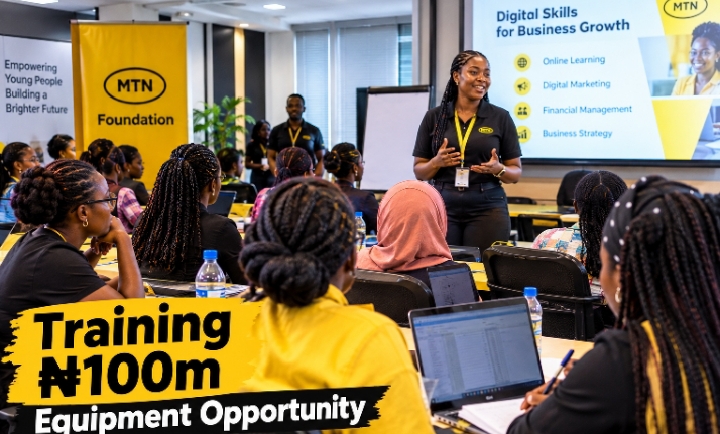
For thousands of young women running small businesses across parts of Nigeria, a new opportunity has opened that goes beyond the usual application for financial support. The programme comes with a structured training period, access to digital and business learning, support for participation, and a further opportunity attached to performance during the programme.
The details surrounding the current phase make it particularly relevant to women who have already started building a business but are still within the early stages of that journey. With applications now open, attention is turning to who can enter the programme, how the selection works, what participants are expected to complete, and where the bigger opportunity comes in for those who perform strongly.
Phase 8 Opens For Young Female Business Owners
The MTN ICT and Business Skills Training Programme has entered Phase 8 with a new focus on 3,000 female microbusiness owners between the ages of 18 and 35. The current phase is being organised by the MTN Foundation as part of its wider effort to support young entrepreneurs with practical digital, ICT and business skills. Unlike an ordinary grant application where applicants submit their details and wait for a funding decision, this programme places training at the centre of the opportunity, while equipment support comes later for participants who emerge at the top of the cohort.
Applications for Phase 8 are currently open, with the official MTN Foundation programme information giving October 11, 2026 as the closing date. That deadline places the opportunity firmly within the list of programmes available to eligible Nigerians looking for business support between late September and October 2026. Anyone considering applying therefore has a limited period to check the requirements, confirm that the business meets the conditions, complete the application and prepare to participate fully if selected.
The programme is also not open to every Nigerian entrepreneur. The current Phase 8 eligibility structure is focused on Nigerian women between 18 and 35 who own and manage a microbusiness that has been operating for no more than 2 years. There is also a location requirement, with only businesses located in Rivers, Abia, Ogun, Kwara, Kano or Gombe State included in the current phase. That location condition is one of the first details applicants need to check before spending time on the application.
The Main Opportunity Behind The Programme
The headline figure attached to Phase 8 is ₦100 million, but understanding how that money is structured is important for anyone preparing an article, sharing the opportunity or considering an application. MTN Foundation says the top 100 participants will receive equipment grants of up to ₦1 million each from the total ₦100 million equipment grant fund. The funding therefore sits within the programme as a competitive reward for participants who perform strongly during the training and related assessment process.
The arrangement means the 3,000 women targeted for the training should not be presented as 3,000 people who will each receive ₦1 million. The 3,000 figure represents the planned training cohort, while the equipment grant is reserved for the top 100 participants. A participant can therefore gain access to the training, learning resources, masterclasses, data support and capstone experience without automatically becoming one of the 100 equipment grant recipients.
The phrase equipment grant is also important because the support should not be described as an unrestricted ₦1 million cash payment. MTN Foundation specifically describes the financial support as an equipment grant, meaning the purpose is connected to providing equipment that can support business development and the adoption of digital or technology based practices. The official information does not describe the opportunity as ₦1 million free cash that every successful applicant can withdraw and spend without restrictions.
Who Phase 8 Is Designed For
The eligibility structure starts with nationality and gender. Applicants must be Nigerian females who fall within the required age range of 18 to 35 years. The programme is therefore not open to male business owners, and women who are below 18 or above 35 do not fall within the stated age requirement for the current phase.
The next requirement concerns the applicant’s business. She must own and manage a microbusiness, which means the programme is intended for people who are already actively running a small business rather than people who are simply considering starting one. This distinction is useful because prospective applicants need to look at the current state of their business before applying. The opportunity is built around helping young business owners strengthen an existing enterprise through ICT, digital skills and business development training.
The age of the business is another important condition. The business must have been operating for no more than 2 years. That makes Phase 8 particularly relevant to entrepreneurs who have already taken the first steps but are still building systems, customers, visibility, digital capacity and business management experience. An established business that has been operating beyond the permitted period would not satisfy this particular condition even if the owner falls within the required age range.
The 6 States Covered By Phase 8
Location is one of the clearest restrictions attached to the current programme. Eligible businesses must be located in Rivers, Abia, Ogun, Kwara, Kano or Gombe State. These 6 states form the geographical focus of Phase 8, meaning an applicant’s business location needs to fall within the listed states before the other requirements can be considered.
The restriction is worth highlighting because MTN Foundation’s wider ICT and Business Skills Training Programme has previously reached a much broader geographical area. The broader programme has operated across 29 states and the Federal Capital Territory during its previous phases, creating a history that may make some entrepreneurs assume that the current application is nationwide. Phase 8, however, has its own eligibility structure and is focused on the 6 states currently listed by MTN Foundation.
A young female entrepreneur running a business in Ogun State, for example, can proceed to check the remaining conditions because Ogun is one of the eligible locations. The same does not apply to a woman running the same type of qualifying business in Lagos State, Abuja or another state outside the current list. Her age, nationality and business status would not remove the location restriction.
The Business Must Already Be Operating
The programme is aimed at business owners who have already started operating. This means an applicant should be able to identify the microbusiness she owns and manages rather than applying solely with a future business idea. The requirement gives the training a practical foundation because the skills acquired during the programme can be connected to an existing business, its customers, its operations, its digital presence and its growth needs.
The business age requirement also keeps the current phase focused on relatively young enterprises. Businesses that have operated for no more than 2 years fall within the stated window, while older businesses fall outside the current Phase 8 requirement. Applicants should therefore pay attention to the actual period their business has been operating rather than simply describing themselves as new entrepreneurs.
MTN Foundation has not published a narrow official list of specific industries that can apply on the main Phase 8 information available for the programme. That means applicants should be careful about treating lists circulating elsewhere as an official sector restriction. Independent opportunity listings may mention areas such as retail, services, agribusiness, creative businesses or ICT services, but the core official requirements focus on the applicant’s status as a female Nigerian microbusiness owner, her age, the age of the business and the location of the business.
The 5 Week Training Structure
Selected participants are expected to take part in a 5 week training programme designed around digital, ICT and business skills. The training uses a blended learning structure, bringing together different forms of learning instead of relying entirely on one format. Participants are expected to combine self paced online learning with instructor led sessions and other activities designed to help them apply the knowledge they gain.
The self paced component gives participants room to work through learning materials within the structure of the programme. This is particularly useful for business owners who may have daily responsibilities and need to balance learning with running their enterprises. The programme also includes instructor led sessions, providing participants with direct learning experiences rather than leaving the entire process to independent online study.
Entrepreneur masterclasses form another part of the programme. These sessions are designed to expose participants to practical lessons from experienced entrepreneurs and business professionals. The purpose is to take the learning beyond basic ICT use and connect digital knowledge with the wider realities of running and developing a business.
The Capstone Project
The training also includes a capstone project challenge. This provides participants with an opportunity to put some of the knowledge gained during the programme into practical use. Rather than treating the training as a series of lessons that end when the modules are completed, the capstone element gives participants a structured task through which they can demonstrate their understanding.
The capstone project is particularly relevant because performance within the programme is connected to the competitive equipment support available to the top 100 participants. Applicants should therefore understand from the beginning that participation is not simply about registering and attending a few sessions. The programme has a learning and assessment dimension, making active participation important for anyone hoping to progress toward the equipment grant stage.
Participants who enter the programme should approach the training as a business development exercise rather than viewing it solely as a route to financial support. The skills, masterclasses, instructor sessions and capstone experience form part of the overall value of the programme, while the equipment grant represents an additional opportunity available to the strongest participants.
Data Support For Participants
MTN Foundation says participants will receive data support to facilitate their participation in the training. This is relevant because the programme includes online learning and other digital activities that require internet access. Providing data support can reduce one of the practical barriers that may otherwise make it difficult for some selected participants to complete the required learning activities.
The data support also fits with the broader digital focus of the programme. Participants are being trained in ICT and digital business skills, so access to the internet is part of the practical requirements of taking part. The support is therefore presented as part of the training experience rather than as a separate cash benefit.
Applicants should still pay attention to the programme instructions after selection because participation requirements, learning schedules and other details will determine how the training is completed. Registration alone should not be treated as completion of the opportunity, particularly because the top 100 equipment grant recipients are selected from among participants who go through the training and related assessment process.
How The ₦100 Million Equipment Fund Works
The total equipment grant fund for Phase 8 is ₦100 million. MTN Foundation says the top 100 participants can receive up to ₦1 million each. The basic calculation behind the announced fund is straightforward, with 100 recipients multiplied by ₦1 million producing ₦100 million.
The use of the words up to is also important. It means applicants should not automatically interpret the announcement as a guarantee that every person who reaches the top 100 will receive exactly ₦1 million. The stated maximum is ₦1 million per recipient, while the overall equipment support fund is ₦100 million.
The equipment grant is intended to support successful participants in strengthening their businesses. The distinction between equipment support and unrestricted cash should remain clear throughout any report about the opportunity. Calling it an ₦1 million cash grant could give readers the wrong impression about the nature of the benefit and could lead potential applicants to overlook the training and performance requirements attached to it.
3,000 Participants Versus 100 Grant Recipients
One of the easiest details to misunderstand about Phase 8 is the relationship between the 3,000 participants and the 100 equipment grant recipients. MTN Foundation is targeting 3,000 female microbusiness owners for the training, but the equipment grant is reserved for the top 100.
That means the training opportunity is substantially broader than the equipment funding opportunity. A woman who meets the eligibility requirements may apply to join the 3,000 person cohort, but she should understand that entry into the training does not automatically mean she has secured the equipment grant.
The competitive stage comes after participants have entered the programme and gone through the learning process. Their participation, assessment and capstone performance form part of the pathway toward identifying the top 100. Anyone applying mainly because of the ₦1 million figure should therefore read the opportunity as a training programme with a competitive equipment support component rather than as a simple grant application.
The Programme Has A Longer History
Phase 8 is part of an existing MTN Foundation programme that has been running since 2018. MTN Foundation says 7 previous phases have been completed, showing that the current programme is a continuation of an established youth business development initiative rather than a newly introduced opportunity appearing for the first time in 2026.
The programme has also been implemented with a number of technology, consulting and digital education partners during its previous phases. MTN Foundation lists organisations including Google, Oracle, KPMG, IBM, Digital Bridge Institute, Cisco, Meta and Microsoft among the partners associated with the programme’s development and delivery over time.
According to MTN Foundation, 15,362 young microbusiness owners have completed the programme since it began. The wider initiative has reached 29 states and the Federal Capital Territory during its previous phases, giving some context to the scale of the programme and its development before the launch of Phase 8.
Why Previous Phases Should Not Change The Current Eligibility Check
The history of the programme provides useful context, but applicants still need to use the current Phase 8 requirements when checking whether they qualify. Previous phases may have covered different locations or groups, while the current phase has its own specific target audience and geographical restrictions.
The fact that the wider MTN Foundation programme has previously operated across the Federal Capital Territory and other parts of Nigeria does not mean every business owner in those locations can apply for Phase 8. The current programme information identifies Rivers, Abia, Ogun, Kwara, Kano and Gombe as the eligible states.
Applicants should therefore avoid relying on old social media posts, previous programme announcements or general descriptions of the MTN Foundation initiative when deciding whether they qualify. The Phase 8 announcement is the relevant reference for the current application period ending October 11, 2026.
Application Is Free
There is no stated application fee attached to the official Phase 8 application. Applicants should not be required to pay money simply to submit an application for the programme. The official MTN Foundation information provides an application route through the MTN platform.
This is also a useful point for people sharing the opportunity with others because application scams often develop around popular grants and business support programmes. Anyone who is told to pay a fee to secure the MTN equipment grant should treat that request with caution and return to the official MTN Foundation application information before providing money or personal details.
The safest approach is to begin from the official MTN Foundation Phase 8 programme page and use the application route provided there. This helps applicants avoid relying on unofficial links circulated through WhatsApp groups, social media pages or opportunity listing websites.
October 11, 2026 Is The Deadline
The official application deadline for Phase 8 is October 11, 2026. As of September 23, 2026, applicants have roughly 18 days before the stated closing date. That gives eligible women a relatively short window to check their business status, confirm their location, review the requirements and submit their applications.
Applicants should avoid waiting until the final hours of the deadline before attempting to register. Online application platforms can experience heavy traffic when a deadline approaches, while applicants may also discover that they need information they did not have readily available. Completing the application early provides more room to review the information before submission.
The October 11 deadline also means that the opportunity remains relevant for Nigerians compiling business support and funding opportunities whose deadlines fall from September 28 onward. However, the state and gender restrictions remain essential because the programme is not a general opportunity for every Nigerian entrepreneur.
How To Check Eligibility Before Applying
The first check is simple. The applicant must be a Nigerian female between 18 and 35 years old. The second check is whether she owns and manages a microbusiness that is already operating. The third check is the age of that business, which must be no more than 2 years old under the stated Phase 8 requirements.
The fourth check is the business location. The enterprise must be located in Rivers, Abia, Ogun, Kwara, Kano or Gombe State. Applicants whose businesses are located in Lagos, Abuja, Oyo, Enugu, Kaduna or other states outside the current list should not assume that previous nationwide coverage makes them eligible for this phase.
The final practical check is whether the applicant can commit to the 5 week training programme and its learning activities. Since the programme involves self paced learning, instructor led sessions, entrepreneur masterclasses, a capstone project and data supported participation, applicants should be prepared to take the training seriously if selected.
The Opportunity Beyond The Application Form
Phase 8 should be viewed as a process rather than simply an application form. The first stage is eligibility and selection into the 3,000 person training cohort. The next stage involves the 5 week learning experience, where participants receive ICT and business education alongside masterclasses, instructor led activities, online modules and a capstone challenge.
The equipment support comes further along the process. The top 100 participants can receive equipment grants of up to ₦1 million each from the ₦100 million fund. This makes the programme relevant both to women seeking business training and to entrepreneurs interested in competing for equipment support that could strengthen their existing businesses.
The structure also gives the programme a practical progression. Participants enter with an existing microbusiness, acquire new digital and business skills, work through the training activities and apply their knowledge through the capstone project. The strongest participants then have an opportunity to receive equipment support that can be directed toward their businesses.
What Applicants Should Keep In Mind
Applicants should make sure the information supplied during registration accurately reflects their personal and business circumstances. Age, nationality, business ownership, business age and location are not minor details because they form the foundation of the eligibility requirements. Providing incorrect information could create problems during the selection or verification process.
Participants should also understand that joining the training is different from securing the equipment grant. The programme is targeting 3,000 women, while the equipment support is for the top 100. Anyone applying should therefore be prepared to participate fully in the training rather than assuming that registration alone guarantees financial support.
The wording of the grant itself should also remain clear. MTN Foundation describes the support as an equipment grant of up to ₦1 million, not an unrestricted ₦1 million cash payment. That distinction is important for applicants who are planning their expectations around the programme and for anyone reporting the opportunity to other potential beneficiaries.
The Key Figures For Phase 8
The current phase targets 3,000 female microbusiness owners between 18 and 35 years old. Their businesses must have been operating for no more than 2 years and must be located in Rivers, Abia, Ogun, Kwara, Kano or Gombe State. Selected participants will go through a 5 week blended learning programme covering ICT and digital business skills, supported by instructor led sessions, entrepreneur masterclasses, a capstone project and data support.
The equipment opportunity sits at the top of the programme structure. The top 100 participants can receive up to ₦1 million each from the ₦100 million equipment grant fund. The use of the phrase up to means the maximum amount is ₦1 million, rather than a statement that every recipient is guaranteed exactly that amount.
The application itself is free and the official closing date is October 11, 2026. The programme is being delivered under the MTN Foundation’s ICT and Business Skills Training initiative, which began in 2018 and has already completed 7 previous phases. MTN Foundation says 15,362 young microbusiness owners have completed the programme since its launch.
How To Apply Through The Official Route
Eligible applicants should use the official MTN Foundation Phase 8 application route rather than depending on links forwarded through informal channels. The programme page contains the application option and provides the relevant information for the current phase. Starting from the official source also makes it easier for applicants to distinguish the current Phase 8 requirements from information belonging to earlier editions.
The application should be approached as an entry point into a 5 week business development programme rather than simply as a request for ₦1 million. The training is the main programme experience for the selected 3,000 participants, while equipment support is an additional competitive opportunity for the top 100 performers.
Applicants who satisfy the age, nationality, gender, business ownership, business age and state requirements should therefore check the official application page before the October 11, 2026 deadline. The opportunity is particularly relevant to young women whose businesses are still within their first 2 years and who want to strengthen their digital and business capabilities while competing for equipment support.
Final Breakdown
MTN ICT and Business Skills Training Programme Phase 8 combines business education with a competitive equipment support opportunity for young female entrepreneurs. The current phase is targeting 3,000 Nigerian female microbusiness owners aged 18 to 35 whose businesses have operated for no more than 2 years and are located in Rivers, Abia, Ogun, Kwara, Kano or Gombe State.
Those selected for the programme will take part in 5 weeks of blended learning that includes self paced online modules, instructor led sessions, entrepreneur masterclasses, a capstone project and data support. The programme therefore offers a structured learning experience even before the equipment grant stage is considered.
The bigger financial opportunity is the ₦100 million equipment grant fund. MTN Foundation says the top 100 participants can receive equipment grants of up to ₦1 million each. The funding should therefore be reported as equipment support rather than an unrestricted cash grant, while the 3,000 participant figure should be kept separate from the 100 potential equipment grant recipients.
With applications closing on October 11, 2026, eligible women in the 6 participating states have a clear deadline to work toward. The application is free, the programme forms part of an initiative that has been running since 2018, and MTN Foundation says more than 15,000 young microbusiness owners have completed previous phases. For anyone who meets the current requirements, the first step is to confirm eligibility and complete the official application before the deadline.