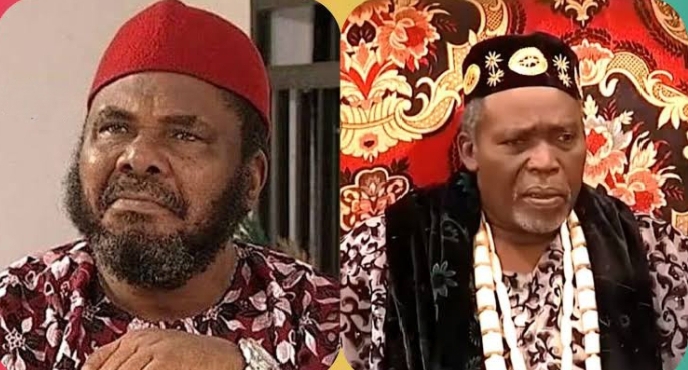
For years, a particular story about Pete Edochie and Olu Jacobs has remained one of those Nollywood stories that refuses to disappear completely, especially whenever conversations about culture, traditional rulers and the old generation of Nigerian actors return to the spotlight. The story has often been reduced to a simple claim that Edochie objected to Jacobs playing an Igwe, with the reason sometimes presented as a disagreement over ethnic identity and the right person to portray an Igbo traditional ruler. Yet, behind that familiar version is an account that is far more specific, personal and revealing, particularly when Edochie’s own words are placed beside his memories of one of the most respected actors of his generation.
The question became relevant again following the death of Olu Jacobs on September 16, 2026, aged 84, as tributes poured in from colleagues, friends, fans and members of the Nigerian film industry. Among the tributes was one from Edochie, a fellow veteran whose relationship with Jacobs stretched back many years and whose comments offered more than the usual public remembrance of a colleague. His tribute brought back memories of their friendship, their shared experiences in the movie industry, the losses suffered by their generation and an emotional encounter in which the two men reportedly confronted the reality that many of their colleagues were already gone.
Yet, buried within the history of their relationship is the old Igwe controversy. Did Pete Edochie really oppose Olu Jacobs playing an Igwe? Did he believe a Yoruba actor should not portray an Igbo traditional ruler? Or was his complaint about something completely different? Edochie himself addressed the claim in a 2014 interview, and his explanation provides the clearest route through the controversy while his 2026 tribute adds another deeply personal layer to the story of the 2 veteran actors.
The question that brought the old controversy back
The claim surrounding Edochie and Jacobs did not begin with the 2026 tribute. It had been discussed years earlier, particularly around the way traditional rulers were portrayed in Nigerian movies. Edochie had become closely associated with the role of the Igwe, partly because of the number of productions in which he played traditional rulers and partly because of his detailed understanding of the customs he believed should accompany such characters. That reputation eventually became connected to a story that he had objected to Jacobs taking similar roles.
The allegation was put directly to Edochie during a 2014 interview when he was asked whether it was true that he had been against Olu Jacobs acting as an Igwe in Nollywood movies. His first response was direct and left little room for interpretation. Edochie said, “First of all, I didn’t say that.” Rather than allowing the conversation to remain at the level of a rumour, he went on to explain the actual issue that had concerned him about Jacobs’ performances as an Igwe.
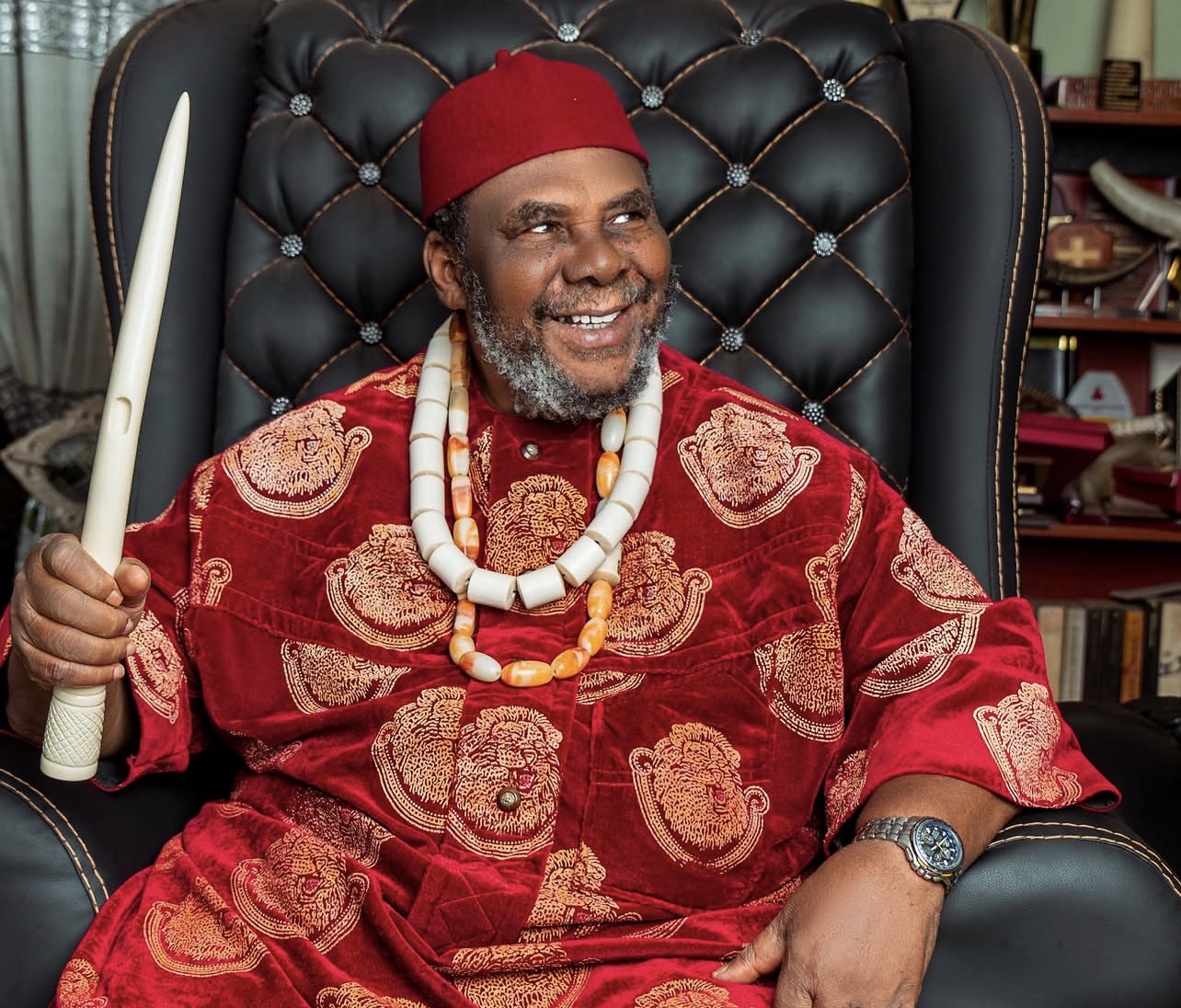
Edochie said, “The people who direct those movies with Olu are not fair to him because they are not grounded in the culture; therefore they make him do the wrong things.” That explanation changed the focus of the controversy. His complaint, according to his own account, was not that Jacobs was playing an Igwe, but that directors sometimes failed to give him the cultural guidance required for the role. Edochie even said, “People just want to destroy my friendship with Olu Jacobs,” showing that he believed the story was being used to create tension between 2 actors who had a longstanding relationship.
Edochie directly rejected the ethnic interpretation
The most important part of Edochie’s 2014 explanation came when he addressed the suggestion that his position was based on Jacobs being Yoruba. That interpretation had apparently circulated strongly enough for someone to tell him that he had been reported online as saying Yoruba men should not play Igwe roles. Edochie made it clear that this was not his position and asked that his denial be emphasised.
He said, “I never said that a Yoruba man should not play Igwe.” He then questioned the logic behind such a position by pointing to the nature of acting itself. Edochie explained that actors are expected to portray people from backgrounds and cultures different from their own, and he gave examples from his own career to reinforce the point. He recalled travelling to the North where he played an Emir in a production, showing that he did not regard acting across ethnic or cultural lines as something inherently wrong.
Edochie also referred to Jacobs’ own experience playing Hausa characters. He said, “Olu speaks Hausa and he also did a production where he played a Hausa man.” He then asked, “Why are we acting?” before adding, “This is why we are actors for God’s sake.” Those comments are important because they show that his position was not built around excluding actors from roles because of their ethnic background. His concern was about authenticity in the way cultural roles were presented on screen.
The horse whip became part of the argument
Edochie’s criticism became more specific when he discussed the details he believed were being mishandled in some of Jacobs’ Igwe performances. One example involved the way an Igwe holds a horse whip. To an ordinary viewer, the detail might appear insignificant, especially in a fictional movie where the character is already dressed as a traditional ruler, but Edochie regarded such gestures as part of the cultural language of the role.
He explained that the way the horse whip was held in the Igbo tradition he was referring to was different from the way it could be handled in Yoruba tradition. According to Edochie, Jacobs was sometimes not properly instructed about that distinction, which meant that he could perform the role using a manner that Edochie considered culturally incorrect. He said, “When Olu plays Igwe, they don’t tell him that, so he holds it like a Yoruba man, which is wrong.”
The important point was not simply that Edochie noticed the difference. It was that he placed the responsibility on the people directing the production rather than on Jacobs himself. His argument was that an actor cannot automatically know every cultural detail required for a role, particularly when the director is responsible for guiding the performance. Edochie’s criticism therefore went deeper than the question of who should wear the traditional crown, because he was talking about the gestures, conduct and customs that should accompany the character once the actor had accepted the role.
The way an Igwe addresses his cabinet
Another example Edochie gave concerned how an Igwe should address members of his cabinet. He believed the traditional ruler should remain seated on the throne when addressing his cabinet rather than moving around in a manner he considered inconsistent with the position of the Igwe. For Edochie, the throne was not merely a prop placed behind the actor. It formed part of the authority and protocol surrounding the character.
He said, “As the Igwe, you sit down on the throne.” Edochie then contrasted that approach with some of the scenes he had seen involving Jacobs, arguing that the actor was sometimes directed to behave differently. He added, “Go and watch me play the Igwe; I am in perfect control.” His confidence in his own portrayal reflected the experience he had accumulated through years of playing traditional authority figures in Nigerian productions.
Edochie also said, “People don’t shout or haggle when I play the Igwe.” The statement was less about comparing his acting ability with Jacobs than it was about explaining the behavioural code he believed should accompany the character. His argument was that an Igwe should project authority through the established cultural structure of the palace rather than behave like an ordinary character who could simply move around, argue loudly or leave the throne whenever the scene required it.
The native doctor scene raised another concern
Edochie gave another example involving the relationship between an Igwe and a native doctor. He objected to movie scenes in which an Igwe leaves the palace to consult a native doctor, arguing that such a portrayal did not reflect the tradition he was describing. His explanation was that the traditional ruler occupied a position in which the native doctor would ordinarily be summoned to the palace rather than the Igwe leaving the palace to seek him out.
He said, “You do not leave the palace to go out and consult the native doctor as the Igwe.” Edochie continued, “The native doctor is one of your subjects; you summon him to the palace to do his divination.” Once again, the emphasis was on the conduct expected from the traditional ruler rather than on the ethnicity of the actor portraying him.
These examples also explain why the controversy may have been misunderstood over time. Someone who heard Edochie complain about Jacobs’ Igwe performances could easily repeat the story as a disagreement between 2 actors. But Edochie’s own explanation was much narrower. He was discussing cultural accuracy, directing and the way traditional authority was represented in movies, while repeatedly making it clear that Jacobs himself was not the person he blamed for every decision made on screen.
Edochie defended Jacobs more than he attacked him
One of the strongest parts of the 2014 interview was Edochie’s defence of Jacobs. After criticising the directors responsible for some of the performances, he explained that Jacobs should not be blamed for everything viewers saw in a movie. His reasoning was straightforward. The actor performs according to the instructions and direction provided by the production team.
Edochie said, “These youngsters who direct Olu don’t know these things.” He then explained, “So, when people watch these things, they come to me and say how can you be there and this man is killing our culture, and I tell them that it is not his fault. It is the fault of those who are directing him and they don’t know these things.” The statement is significant because it directly separates Jacobs from the cultural mistakes Edochie believed were being made.
He also said, “What the director tells you is what you do.” That sentence provides perhaps the simplest explanation of his position. If a director tells an actor how a character should behave and the actor follows that direction, responsibility for the cultural details cannot automatically be placed on the actor. Edochie’s criticism therefore focused on the filmmaking process, especially the knowledge of directors handling stories rooted in specific traditions.
Edochie described Jacobs as an accomplished actor
The relationship between the 2 men becomes even clearer when Edochie’s personal comments about Jacobs are considered alongside the Igwe controversy. He did not describe Jacobs as an inferior actor or an outsider who had no place in the portrayal of traditional rulers. Instead, he praised him as an accomplished professional and spoke warmly about their long friendship.
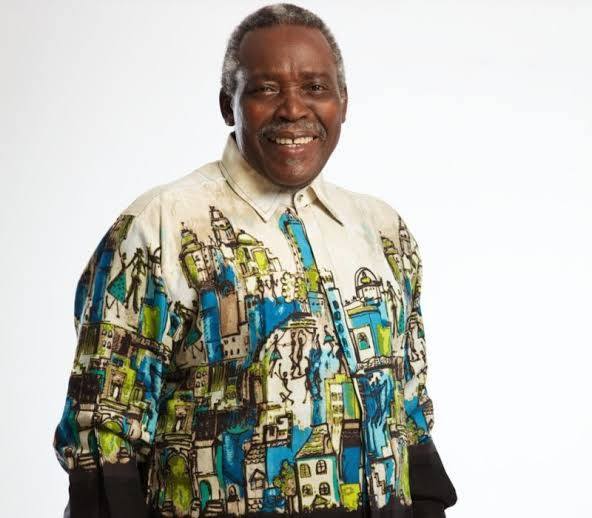
Edochie said, “Olu has been my friend for God-knows-how-many-years.” He also described him as “an accomplished actor.” Those words do not erase the cultural criticism he made, but they provide context for it. Edochie could disagree with the way a role was directed while still respecting the actor performing it and maintaining a close personal relationship with him.
He also said, “I respect my good friend, Olu Jacobs, because his diction is impeccable.” That was not the language of someone presenting Jacobs as an actor who had no place in serious Nigerian cinema. Edochie’s comments showed admiration for his colleague’s professional ability, while his concerns about cultural details existed separately from that admiration.
The private bond involving Joke Silva
Edochie’s tribute to Jacobs in September 2026 revealed another dimension of the relationship that was not immediately visible through their professional work. He described a private connection between himself, Jacobs and Joke Silva, Jacobs’ wife and longtime acting partner. Edochie said, “Olu created a life that is known to only himself, Joke and I.”
That statement is one of the more personal revelations in the tribute because it suggests that the friendship between the 2 veteran actors extended beyond movie sets, premieres and public appearances. Edochie was describing a private world shared by the 3 of them, a world that included jokes and memories that outsiders did not necessarily understand. He also referred to “jokes that are peculiar only to two of us” when speaking about his friendship with Jacobs.
The available account does not reveal the details of those private jokes, and there is no reason to invent them. The significance lies in Edochie’s description of the relationship itself. His words presented Jacobs not merely as a senior colleague from the movie industry, but as someone with whom he had developed a personal history strong enough to survive decades of professional life and the changing fortunes of Nollywood.
The emotional meeting that changed the tone
Another part of Edochie’s recollection became particularly important after Jacobs’ death. He remembered an encounter between the 2 men in which they appeared to recognise that their generation was gradually disappearing. According to Edochie’s account, they had come from separate film locations and unexpectedly encountered each other around Asaba.
Edochie said Jacobs looked at him with tears in his eyes and told him, “Our mates are gone.” Those words reportedly affected Edochie immediately. He said, “And immediately he said this, the tears came to my eyes. We just held each other like this.” The moment was not described as an ordinary greeting between 2 actors who happened to meet after a long time. Edochie remembered it as an emotional confrontation with the loss of their colleagues and the passing of their generation.
He added, “We were being photographed. And we were there, mourning ourselves.” That line captured the unusual nature of the encounter. They were not simply mourning people who had already died. They were 2 surviving veterans looking at each other and recognising that the same passage of time that had taken their colleagues would eventually take them too.
The generation behind “Our mates are gone”
The phrase “Our mates are gone” carried a particular meaning because Edochie belonged to a generation of Nigerian actors whose careers stretched across different stages of the country’s film industry. Among the colleagues associated with that period were Sam Loco Efe, Justice Esiri, Pete Eneh and Enebeli Elebuwa, names that Edochie connected with the wider sense of loss expressed during his encounter with Jacobs.
Edochie remembered responding to Jacobs with a prayer for the remaining members of their generation. He said, “Olu, well, may the good Lord keep us, so we can represent those who are gone until He thinks it’s time to go.” His response showed how deeply he understood the responsibility of surviving members of that generation. They were no longer simply building careers. They were also carrying memories of colleagues who had already passed away.
That memory gives additional meaning to Edochie’s 2026 tribute. His words were coming from someone who had shared decades of professional history with Jacobs and had personally watched the industry change. The tribute therefore carried references to friendship, mortality, family, acting and legacy rather than simply being a conventional condolence message.
The 2026 tribute to Olu Jacobs
Following Jacobs’ death on September 16, 2026, Edochie reflected on the circumstances surrounding his final years and the fact that he had endured a prolonged period of health difficulties. Edochie described Jacobs as a fighter and connected that quality to the image of the soldier he had always known him to be.
He said, “Olu, my brother, you fought like a man, like the soldier I’ve always known you to be. Rest in peace, my brother.” Edochie then referred to what Jacobs had endured over a period of 6 years, saying, “Today, I commiserate with you for what you had to endure over a period of six years.” The tribute therefore recognised not only Jacobs’ career but also the difficult final stage of his life.
Edochie also described Jacobs as “a humorous personality” and “a very peaceful colleague.” Those descriptions added another layer to the public image of the veteran actor. Beyond the characters he played and the awards associated with his career, Edochie remembered the man he knew personally as someone who brought humour and peace into his interactions with colleagues.
Edochie’s message to Joke Silva
Joke Silva occupied a central place in Edochie’s tribute because she had shared much of Jacobs’ life and had remained beside him during his later years. Edochie addressed her directly and acknowledged the effort she had made during the difficult period surrounding Jacobs’ health.
He said, “Joke, you did your best.” Edochie then encouraged her and the family to remember that while grief was unavoidable, Jacobs’ life also deserved to be celebrated. He said, “And while we must mourn that Olu has gone, we should also be glad and celebrate Olu’s life.” His message moved beyond the immediate pain of losing Jacobs and toward the wider legacy he left behind.
That part of the tribute also connects with Edochie’s earlier description of the private bond between himself, Jacobs and Silva. Their relationship had existed beyond the public world of Nollywood, and his message to Silva showed that he was not speaking only as another actor mourning a colleague. He was also addressing someone who had shared the most intimate years of Jacobs’ life.
The age reference requires careful handling
One detail in the tribute requires particular care because the available reports contain an apparent discrepancy. Edochie was reported as saying, “Of all our senior colleagues who have gone, Olu was the only one who got to 89 and beyond.” Yet the same reporting identifies Jacobs’ age at death as 84.
Jacobs died on September 16, 2026, at the age of 84, according to the information surrounding his death. Because of that discrepancy, the 89 reference should not simply be presented as his confirmed age. It is better treated as a line attributed to Edochie’s tribute without using it to alter the established age reported at the time of Jacobs’ death.
Edochie’s wish for Olu’s child
One of the most revealing parts of the tribute concerned Edochie’s hope that Jacobs’ legacy would continue through one of his children. He said, “My one prayer is that one of Olu’s children takes to acting so that whenever we look at him, we’ll remember what Olu meant to all of us.”
The statement showed that Edochie’s idea of legacy was connected directly to acting. Rather than simply asking that Jacobs’ films continue to be watched, he expressed a wish that one of his children might enter the same profession. For Edochie, seeing one of Jacobs’ children on screen could create a living reminder of the veteran actor and the impact he had on Nigerian cinema.
He also spoke about Jacobs’ position as a senior figure in the movie industry, saying, “Olu was our movie senior, and he reacted that way to everybody he interacted with on audition.” That description placed Jacobs within the hierarchy of an industry where experience, seniority and professional reputation mattered greatly to younger actors coming through the system.
The final words about seeing each other again
Edochie’s tribute eventually returned to the question of death and the possibility of reunion. After spending much of his message remembering Jacobs’ personality, career, friendship and final years, he ended with a reflection that connected his grief to the possibility of seeing his friend again.
He said, “If it is true that people recognise one another after they have gone then there’s a possibility that we will meet again.” The line carries particular weight when placed beside his earlier memory of Jacobs saying, “Our mates are gone.” Their relationship had already been shaped by the deaths of colleagues, and Edochie’s final thought was that death might not necessarily represent the absolute end of recognition between people who had shared a lifetime.
That ending also makes the Igwe controversy look very different when viewed against the full history Edochie described. The old disagreement was about cultural details in film production. The later memories were about friendship, ageing, colleagues disappearing, family and the emotional weight of watching an entire generation move through time.
The answer to the Igwe question
So, did Pete Edochie ever oppose Olu Jacobs playing an Igwe? Edochie’s own public explanation says no, at least not on the basis that Jacobs was Yoruba. His 2014 response was explicit: “I never said that a Yoruba man should not play Igwe.” He also rejected the idea that he and Jacobs had a personal disagreement over the role, saying, “I have never disagreed with Olu for one day. No.”
What Edochie did object to was the way some directors handled cultural details when Jacobs played an Igwe. He mentioned the horse whip, the manner in which the traditional ruler addressed his cabinet and scenes involving a native doctor. His criticism was that directors did not properly understand the cultural practices they were asking Jacobs to portray, leaving the actor to perform according to instructions that Edochie believed were inaccurate.
That claim is supported by Edochie’s own defence of Jacobs. He called him an accomplished actor, described him as a longtime friend and explained that an actor follows the director’s instructions. The available account therefore does not support the simpler version of the story in which Edochie was campaigning against Jacobs because of his Yoruba background or trying to prevent him from playing Igwe roles.
A friendship that survived the rumour
The relationship described by Edochie over the years tells a much fuller story than the old rumour. The 2 actors belonged to the same broad generation of Nigerian performers, shared professional spaces for decades and maintained a friendship that Edochie described as longstanding. He remembered private jokes, personal encounters and an emotional meeting in which they held each other while reflecting on colleagues who had died.
The September 2026 tribute brought those memories together after Jacobs’ death on September 16. Edochie remembered his friend as a fighter, a peaceful colleague, a humorous personality and an accomplished actor. He spoke about Joke Silva, acknowledged the 6 years of difficulty Jacobs had endured, expressed a wish for one of his children to enter acting and ended by imagining that the 2 friends might recognise each other again after death.
Jacobs’ funeral programme was subsequently announced with a Night of Tributes scheduled for September 30 and a funeral service scheduled for October 2. Those events were set to provide another public moment for colleagues, friends, family members and admirers to remember a career that stretched across decades of Nigerian entertainment.
The part of the story that remains clear
The Igwe controversy can therefore be separated from the friendship itself. Edochie did not deny that he had criticised aspects of Jacobs’ Igwe performances. He did. He gave detailed reasons for those criticisms and was particularly concerned about cultural accuracy in productions dealing with Igbo traditional institutions. But he also repeatedly explained that the responsibility belonged to directors who failed to properly guide the actor.
His words from 2014 remain the clearest explanation because he was responding directly to the allegation at the time. He denied saying that Yoruba men should not play Igwe and used his own experience playing an Emir to explain why actors could portray characters from cultures different from their own. He also pointed to Jacobs’ ability to speak Hausa and his experience portraying Hausa characters as another example of what acting involves.
The later tribute does not introduce evidence that changes that explanation. Instead, it provides a much more personal picture of the man Edochie was talking about when he referred to Jacobs as his friend. It shows 2 veterans who had shared a long professional journey, lost many colleagues, confronted their own mortality together and maintained a bond that Edochie described as deeper than what audiences saw on screen.
The final picture of Pete Edochie’s words
The strongest reading of Edochie’s account is therefore not a story about 2 actors fighting over who had the right to play an Igwe. It is a story about an actor who cared deeply about cultural accuracy, another accomplished actor who was sometimes directed in ways Edochie believed were culturally inaccurate and a friendship that continued despite the existence of those professional disagreements.
Years later, the death of Olu Jacobs brought the relationship back into public attention. Edochie’s tribute carried memories of friendship, private jokes, family, professional seniority, mortality and the gradual disappearance of their generation. His recollection of Jacobs saying, “Our mates are gone,” now sits alongside his final message that there may still be a chance for them to meet again.
For a man whose career became closely associated with the portrayal of traditional rulers, Edochie’s comments about Jacobs were ultimately about how such characters should be presented, not about closing the door on actors from other ethnic backgrounds. His own words remain the clearest evidence. He denied opposing Yoruba actors playing Igwe roles, defended Jacobs from blame for directors’ decisions and continued to describe him as a friend whose professional talent he respected.
The old claim may continue to circulate because it makes for a simple story, but Edochie’s own explanation was more specific. He criticised cultural inaccuracies, identified the directing decisions he believed caused them and separated those concerns from his personal relationship with Jacobs. His September 2026 tribute then revealed just how much history existed behind that relationship, turning an old Nollywood controversy into part of a much larger story about 2 veteran actors, the colleagues they lost, the generation they represented and the memories that remained after Olu Jacobs’ death.