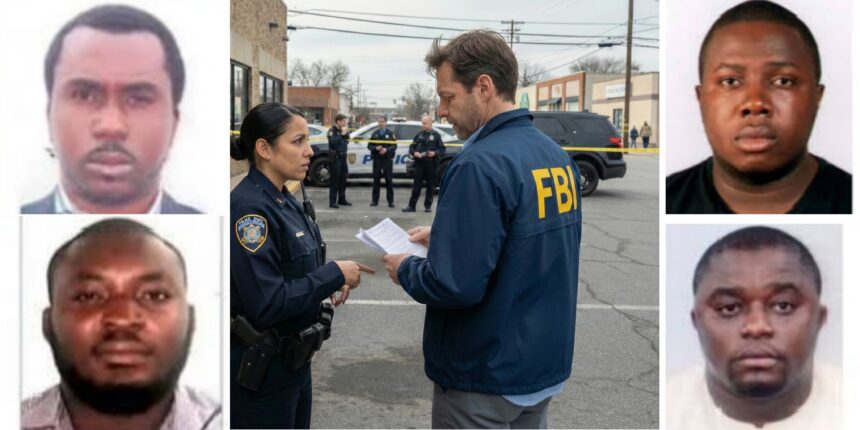
More than 70 American businesses were allegedly caught in a fraud operation that investigators say involved deceptive emails, fraudulent bank transfers and networks of accounts used to receive money. The alleged losses exceeded $6 million, while a separate strand of the investigation involved online romance scams that reportedly cost victims more than $1 million. Years after the cases began, the names and photographs of 4 Nigerian nationals remain on the United States Federal Bureau of Investigation’s wanted list.
The men are Richard Izuchukwu Uzuh, Felix Osilama Okpoh, Nnamdi Orson Benson and Micheal Olorunyomi. According to the FBI, their alleged roles ranged from coordinating fraudulent payment requests to supplying bank accounts used to receive money, with investigators also linking some of the allegations to romance fraud and advance fee scams.
The case dates back several years, with indictments and arrest warrants issued between 2016 and 2019. A report published on September 1, 2026, renewed attention on the 4 men, whose alleged activities form part of a wider investigation into fraud targeting American businesses and individuals.
How the Alleged Fraud Operation Began
The investigation centres on Business Email Compromise, commonly known as BEC, a form of fraud that exploits business communications to persuade employees to send money to accounts controlled by criminals. Rather than relying on a physical robbery or directly taking cash from a company, the scheme allegedly used deceptive messages and fraudulent payment instructions to make legitimate businesses transfer their money to the wrong destinations.
According to the FBI, Richard Izuchukwu Uzuh and his alleged co conspirators sent deceptive emails to thousands of businesses, requesting wire transfers under false pretences. The messages were designed to persuade recipients that the payment instructions were genuine, allowing the alleged perpetrators to exploit the trust businesses place in email communications and established financial procedures.
The alleged operation affected more than 70 American businesses, with combined losses exceeding $6 million. The FBI’s account places Uzuh at the centre of the alleged scheme, while the other cases describe individuals accused of helping receive or move money connected to fraudulent transactions.
The precise amount each of the 4 men allegedly obtained is not established by the overall loss figure. The $6 million represents the reported losses associated with the wider business fraud operation, rather than a confirmed personal benefit attributed equally to every individual named in the case.
How Business Email Compromise Works
Business Email Compromise is particularly dangerous because it can exploit ordinary business activities, including supplier payments, invoices, executive instructions and transfers between companies. Employees who handle payments may receive messages that appear to come from trusted colleagues, senior executives or established suppliers, making fraudulent instructions difficult to recognise when the communication appears convincing.
A typical operation may begin with criminals identifying a business and learning how it communicates with suppliers or processes payments. They may then impersonate a trusted person, use a deceptive email address or gain access to an existing email account before sending instructions designed to divert a legitimate payment into an account controlled by the perpetrators.
An employee who believes the request is genuine may authorise the transfer without realising that the account details have been changed or that the sender is an impostor. Once the money reaches the receiving account, those involved may attempt to transfer it elsewhere, making it more difficult for investigators to trace and recover the funds.
The FBI alleges that Uzuh and his associates used deceptive emails to request fraudulent wire transfers from American businesses. The investigation also identified alleged connections to people who supplied bank accounts for receiving the proceeds, indicating that the operation extended beyond sending fraudulent messages to include arrangements for handling the money.
Richard Izuchukwu Uzuh: The Suspect Accused of Coordinating the Scheme
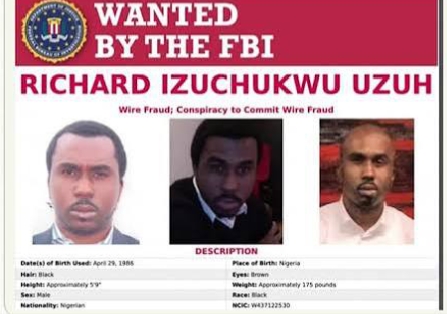
Richard Izuchukwu Uzuh is accused of coordinating a Business Email Compromise operation that allegedly defrauded more than 70 American businesses of over $6 million. The FBI says he worked with alleged co conspirators who sent deceptive emails requesting fraudulent wire transfers, while other individuals allegedly helped move the resulting proceeds through networks of accounts in the United States and abroad.
Investigators also allege that Uzuh worked with individuals involved in money laundering, romance scams and other Business Email Compromise operations. These alleged connections form part of the broader picture presented in the FBI’s wanted notice, which describes a network involving fraudulent payment requests and the movement of money obtained through those transactions.
Uzuh was indicted on October 18, 2016, and an arrest warrant was issued on October 19, 2016. His FBI profile lists his date of birth as April 29, 1986, identifies Nigeria as his birthplace and nationality, and names wire fraud and conspiracy to commit wire fraud among the alleged offences.
The FBI says Uzuh is believed to be residing in Nigeria. His case is the earliest of the 4 individual cases listed in the report, with the indictment and arrest warrant predating the renewed public attention in September 2026 by almost a decade.
Felix Osilama Okpoh: The Alleged Supplier of Bank Accounts
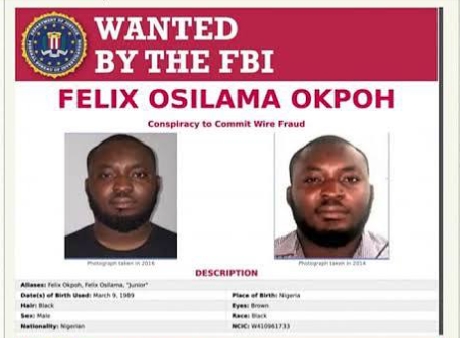
Felix Osilama Okpoh is accused of supplying bank accounts used to receive money transferred fraudulently from American businesses. According to the FBI, he provided hundreds of bank accounts to Uzuh and other alleged co conspirators, including Nnamdi Orson Benson, giving investigators a separate alleged role to examine within the wider operation.
The FBI alleges that accounts provided by Okpoh received fraudulent wire transfers totalling more than $1 million from victim businesses. The figure relates to money received through the accounts described in the allegations and should not automatically be interpreted as the amount Okpoh personally kept.
His alleged role illustrates why receiving accounts can be an important part of a fraud investigation. A deceptive email may persuade a business to authorise a payment, but the scheme also requires a destination for the funds, and investigators may examine the people who provide or control those accounts to establish how the money moved.
Okpoh was indicted on August 21, 2019, and an arrest warrant was issued the following day, August 22, 2019. His FBI profile lists his date of birth as March 9, 1989, and identifies him as Nigerian, with aliases including Felix Okpoh, Felix Osilama and Junior. The alleged offence listed on his profile is conspiracy to commit wire fraud, and the FBI says he is believed to be residing in Nigeria.
Nnamdi Orson Benson: Allegations Involving Multiple Fraud Schemes
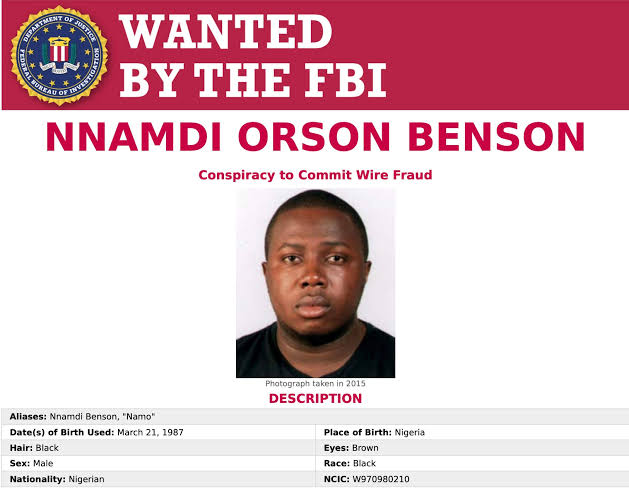
Nnamdi Orson Benson is also accused of supplying bank accounts used to receive fraudulent wire transfers connected to the alleged operation. The FBI further alleges that he conducted romance fraud and advance fee fraud schemes, extending the allegations beyond payments diverted from businesses to financial deception involving individual victims.
Benson’s case is linked to the same federal proceedings as Okpoh’s, with both men indicted on August 21, 2019, in the United States District Court for the District of Nebraska in Omaha. Arrest warrants for both individuals were issued on August 22, 2019.
His FBI profile lists his date of birth as March 21, 1987, and identifies Nigeria as his birthplace and nationality. The aliases recorded on the notice include Nnamdi Benson and Namo, while conspiracy to commit wire fraud is listed as the alleged offence connected to the federal case.
The FBI says Benson is believed to be residing in Nigeria. The allegations against him also show why investigators may examine relationships between different types of fraud, particularly where accounts supplied for one scheme are allegedly used to receive money from another.
Micheal Olorunyomi: Romance Scams Allegedly Cost Victims More Than $1 Million
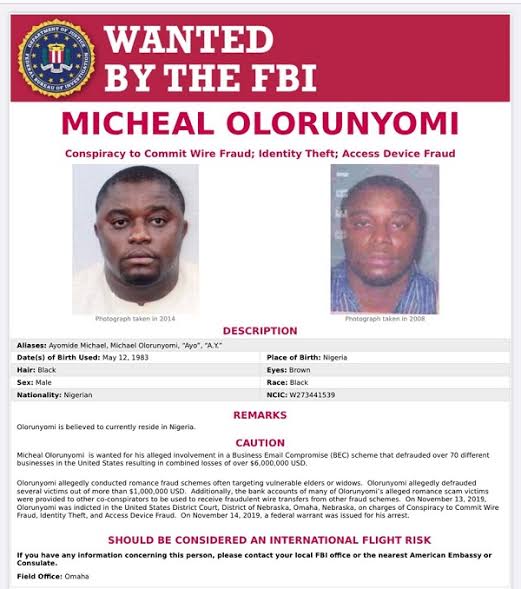
Micheal Olorunyomi faces allegations involving the wider Business Email Compromise operation and separate romance fraud activities. According to the FBI, he allegedly targeted vulnerable older people and widows through romance scams that defrauded several victims of more than $1 million.
Romance scams typically involve a fraudster creating a false identity online and developing a relationship with a victim through dating platforms, social media or other communication channels. After building trust over time, the perpetrator may request money under false pretences, invent an emergency or persuade the victim to provide financial information or access to bank accounts.
The FBI alleges that some bank accounts belonging to Olorunyomi’s romance scam victims were subsequently provided to other alleged co conspirators to receive money connected to separate fraudulent operations. If established in court, that connection would show how accounts associated with individual victims could allegedly become part of a wider network used to receive funds from different schemes.
Olorunyomi was indicted on November 13, 2019, and an arrest warrant was issued on November 14, 2019. His FBI profile lists his date of birth as May 12, 1983, and includes the aliases Ayomide Michael, Michael Olorunyomi, Ayo and A.Y. The alleged offences listed include conspiracy to commit wire fraud, identity theft and access device fraud.
The FBI says Olorunyomi is believed to be residing in Nigeria, and his wanted notice includes photographs taken in 2008 and 2014. The more than $1 million attributed to the alleged romance scams is a separate figure from the losses exceeding $6 million associated with the wider Business Email Compromise operation, and the available information does not establish that the 2 amounts should be added together.
How the Alleged Schemes Moved Beyond Email Fraud
The allegations against the 4 men describe different roles within a wider pattern of financial deception. Uzuh is accused of coordinating fraudulent email activity, Okpoh and Benson are accused of providing bank accounts, while Olorunyomi faces additional allegations involving romance scams and the use of victims’ accounts in other fraud operations.
These alleged roles help explain why investigations into Business Email Compromise often extend beyond the person who sends a fraudulent email. Investigators may need to establish who prepared the messages, who directed the payments, who supplied receiving accounts and who controlled the funds after the money left a victim’s account.
The use of multiple accounts can also complicate efforts to recover money. Funds may be moved between accounts or across jurisdictions, while businesses and individuals may discover the fraud only after a transfer has been completed. The FBI’s allegations describe an operation involving people in the United States and abroad, although the public wanted notices do not provide a complete transaction by transaction account of every alleged payment.
The reported losses of more than $6 million underline the financial impact of the alleged business fraud. The separate romance fraud allegations also show how online relationships can be exploited for financial gain, particularly when victims believe they are helping someone they know and trust.
The Federal Indictments Date Back to 2016
The cases against the 4 Nigerians were not first initiated in September 2026. The dates listed on their FBI wanted notices show that the federal proceedings began years earlier, with Uzuh indicted in October 2016 and the other 3 men indicted in August and November 2019.
Uzuh’s indictment was filed on October 18, 2016, followed by an arrest warrant on October 19, 2016. Okpoh and Benson were indicted on August 21, 2019, with warrants issued on August 22, 2019. Olorunyomi’s indictment followed on November 13, 2019, and his warrant was issued the next day.
The dates are important because a renewed report about wanted individuals does not, by itself, mean that new charges have been filed or that fresh arrest warrants have been issued. The information presented in the individual notices points to cases that have remained outstanding for years.
The September 1, 2026, report brought renewed attention to the names and photographs of the 4 men, while the FBI’s wanted pages continued to describe the allegations and outstanding warrants. The available information does not establish that a new arrest took place or that the FBI announced a new investigation on that date.
The US Government Previously Named 6 Nigerians
The wider investigation also attracted attention in June 2020, when the United States Department of Justice announced the unsealing of indictments charging 6 Nigerian nationals in connection with Business Email Compromise schemes and related fraud allegations.
The 6 individuals named in the announcement were Richard Uzuh, Micheal Olorunyomi, Alex Afolabi Ogunshakin, Felix Osilama Okpoh, Abiola Ayorinde Kayode and Nnamdi Orson Benson. The announcement connected the cases to alleged schemes involving individual victims and businesses in Nebraska and other states.
The Department of Justice also announced that the United States Treasury Department’s Office of Foreign Assets Control had imposed financial sanctions on the 6 individuals. Those sanctions blocked property and financial interests subject to US jurisdiction and generally prohibited US persons from conducting transactions with them, subject to applicable legal provisions and authorisations.
The announcement acknowledged assistance from Nigerian law enforcement partners, including the Economic and Financial Crimes Commission, the Federal Ministry of Justice and Nigeria’s National Central Bureau of INTERPOL. Their involvement reflected cooperation between US authorities and Nigerian agencies in addressing alleged financial crimes with international connections.
The 2020 announcement provides important background to the more recent report featuring 4 of the 6 Nigerians. It also establishes that the wider investigation and public identification of the individuals predated the September 2026 report by several years.
What the Alleged Offences Could Mean Under US Law
The charges described in the cases include wire fraud, conspiracy to commit wire fraud, identity theft and access device fraud. These offences cover different forms of alleged wrongdoing, ranging from using electronic communications to advance fraudulent schemes to the unauthorised use of another person’s identity or financial access information.
The US Department of Justice’s June 2020 announcement cited potential penalties of up to 20 years in prison and a fine of up to $250,000 for wire fraud and conspiracy to commit wire fraud under the applicable provisions discussed in that announcement. It also cited potential maximum penalties of up to 10 years in prison and a fine of up to $250,000 for identity theft and access device fraud in the cases described.
The actual penalties in any individual case would depend on the charges of conviction, the applicable law, the facts established in court and the sentencing decision. The maximum penalties cited in the announcement are not sentences imposed on the 4 men, and the FBI’s wanted notices do not establish that they have been convicted.
The 4 Men Remain Wanted Over Alleged Fraud
The FBI’s wanted notices identify Richard Izuchukwu Uzuh, Felix Osilama Okpoh, Nnamdi Orson Benson and Micheal Olorunyomi as individuals sought in connection with alleged offences. The notices describe their alleged roles, provide identifying information and state that they are believed to be residing in Nigeria.
The central allegation is that a Business Email Compromise operation involving deceptive payment requests targeted more than 70 American businesses and caused losses exceeding $6 million. The cases also include allegations that bank accounts were supplied to receive fraudulent transfers, while Olorunyomi is separately accused of romance scams that cost victims more than $1 million.
The indictments and warrants date from 2016 and 2019, while the September 2026 report renewed public attention on the individuals. The available information does not establish that all 4 men personally obtained the full amount reported as lost by businesses, nor does it establish that the men have been convicted.
For businesses, the case highlights the financial risks associated with fraudulent payment instructions and the importance of independently verifying requests to change bank details or authorise unusual transfers. For individuals, the romance fraud allegations serve as a reminder that online relationships can be exploited to obtain money or financial access.
The legal cases remain allegations unless proven in court. An indictment is a formal accusation, and the defendants are presumed innocent unless and until guilt is established through the legal process.