


There are nights, they say, when the Lagos skyline hums like a choir rehearsing for a concert no one will attend. The air along Victoria Island thickens with the pulse of unsaid things — memories, echoes, and ghosts wearing fame as fragrance. In one of those quiet nights, inside a dimly lit room lined with glass, a boy who became a god stares at himself in the mirror. The reflection looking back isn’t smiling. It doesn’t move when he moves. It watches him instead — studying, questioning, almost accusing.
For a moment, Wizkid doesn’t see the platinum-selling artist, the arena conqueror, or the father of modern Afrobeats. He sees Ayodeji — the boy from Surulere who once sang barefooted in church, dreaming of sound as salvation. But the mirror doesn’t remember the boy. It remembers the man who became an echo of a generation, the man who traded sleep for spotlight and simplicity for solitude. The reflection blurs. The room feels smaller.
Every great artist, it seems, reaches a point where applause sounds like static and silence feels louder than success. Wizkid, in his stillness, embodies that paradox — the superstar who hides more than he shows, whose calm is mistaken for coldness, whose fame became both shield and prison. What people see on stage is rhythm and control; what he sees in private is the quiet war between his emi (soul) and his ara (body) — a Yoruba duality that defines how a person’s spirit wrestles with their worldly self.
Outside, Lagos never sleeps. But inside, Wizkid has stopped moving, caught between what he was, what he became, and what the world insists he should remain. The mirror offers no answers. Only the unspoken truth that to fight one’s reflection is to fight one’s destiny — and perhaps, that is where all great art begins.

The Boy Who Dreamed in Noise
In Surulere, the sounds were never still. Car horns, hawkers, church drums, and the occasional radio spilling Fela’s defiance from a neighbor’s window — everything felt alive, like Lagos itself was a song still being written. Ayodeji Ibrahim Balogun grew inside that noise. He was a small boy in a large world, always listening. When he sang, his mother said it wasn’t just voice — it was inheritance. His tone carried the grain of his father’s prayers and his mother’s sighs.
Surulere was not kind to dreamers, but it taught them rhythm. The cracked pavements became rehearsal floors. The boys in his street were not born with silver spoons but with sharp tongues and faster feet. Music was both escape and proof — proof that the invisible could be heard, that survival could have melody. Wizkid’s earliest songs were less about fame and more about freedom. They were whispers of a boy who didn’t yet know he was teaching his lungs how to breathe against the noise of the world.
Yoruba culture sees music as spirit work — orin that opens the road between the living and the unseen. To sing is to invoke something older than oneself. In those teenage years, Wizkid’s voice carried that ancient vibration, even when his lyrics were tender or mischievous. He didn’t yet understand it, but he was already conversing with his emi, his inner self, through song. He was calling himself out of hiding.

He joined a church choir, learned to layer harmonies, and later slipped into studio sessions where older boys rapped about Lagos hustle and heartbreak. They called him “Lil Prinz,” and he carried notebooks filled with half-formed dreams. By seventeen, those notebooks had become blueprints. By twenty, he had a sound. And by twenty-one, that sound would explode beyond Lagos — into London, into the world — carrying the story of a boy who first heard destiny through cracked speakers in Surulere.
The Lagos Sky Was the First Stage
Lagos doesn’t just make stars; it tests them. Every corner is an audition, every night a lesson in survival. When Wizkid stepped into the city’s sonic bloodstream — through Mo’Hits, Banky W’s Empire Mates Entertainment, and the chaotic energy of early 2010s Afrobeats — he didn’t just chase recognition; he demanded redefinition. “Holla at Your Boy” wasn’t merely a breakout song; it was a manifesto from a generation that wanted to dance its pain away without forgetting the street beneath its feet.
At EME, Wizkid found both mentorship and mirror. Banky W taught him the language of showmanship — how to turn sound into spectacle, how to wear humility like armor. But beneath the smiles and hit singles, Wizkid began to see how success could stretch a man thin. The more the world chanted his name, the less he could hear his own thoughts. Fame, he would later learn, doesn’t arrive gently; it crashes in waves, washing away what came before.
Each performance in those early years felt like an act of becoming — a young man burning through versions of himself. Behind the charm and calm was hunger: not for money or glamour, but for validation, for silence to mean peace and not invisibility. Lagos gave him applause, but it also took privacy, rest, and sometimes joy. Still, he smiled, danced, and kept moving, unaware that he was slowly building a wall around his soul.

For Yoruba artists, fame is not just career; it is covenant. To rise is to carry your lineage on your back, to become living proof that your ancestors’ prayers were not wasted. Wizkid carried that weight lightly, but it was there — the sense that his success was both gift and duty. Every song, every arena, every stage light was another conversation with his reflection — a reminder that he had to keep singing loud enough to silence the shadows forming inside him.
The Calm Before the Storm
By 2014, Wizkid’s name had crossed oceans. “Ojuelegba” wasn’t just a hit; it was scripture. It told of hustle, of gratitude, of a boy who made it out — and in that song, Lagos finally recognized its mirror. Yet behind the global success, there was a strange stillness. Interviews became shorter. Smiles became studied. The boy who once lived for noise now found comfort in silence.
Friends said he started traveling differently — not as a tourist but as a pilgrim. He would spend nights in hotel rooms staring at city lights, headphones off, in total quiet. To most, this was the calm of a man enjoying his success. But to those who knew him closely, it looked more like distance. Something was shifting. The more he achieved, the less he seemed interested in proving anything.
In Yoruba cosmology, this is when ori — a person’s inner head, their spiritual compass — begins to speak louder than applause. For some, it feels like revelation; for others, it feels like restlessness. Wizkid was somewhere in between. He was learning that growth often feels like loss, that the price of transcendence is detachment. The reflection in the mirror was no longer the wide-eyed boy from Surulere; it was an enigma wrapped in stillness.

He began pulling away — not from music, but from noise. “Made in Lagos” wasn’t just an album; it was a ritual of self-definition, a sonic baptism. It stripped away excess, replacing volume with intimacy, energy with essence. It was Wizkid talking to his reflection through melody — not fighting it, not fearing it, but finally listening.
The War Between Silence and Sound
After Made in Lagos, Wizkid entered what Yoruba elders might call iponri iṣọkan — the phase where a man meets himself in solitude. To outsiders, it looked like triumph. The Grammys, the tours, the millions of streams — proof that Afrobeats had crossed the Atlantic and found a permanent home in the global soundscape. But to Wizkid, something else was happening beneath the glory. He was beginning to feel the silence between the notes, the ache that fame could not sing away.
The louder the world got, the quieter his spirit became. He began to speak less in interviews, post sparingly on social media, and appear in public with a composure that bordered on ghostliness. Fans called it mystery; insiders called it detachment. In truth, it was neither. It was a man learning to breathe differently — away from the oxygen of constant validation. Every time he stepped on stage, he fought to stay present, to not disappear into the lights that wanted to consume him.
There’s a Yoruba proverb that says, “Bi o ba r’ẹni tí o n gun igi ayé, rán an lọwọ, nítorí pé igi ayé le gbe subu.” — “If you see someone climbing the tree of life, help him, for that tree is slippery.” Wizkid had climbed too high for anyone to reach. The higher he rose, the fewer people could speak to him plainly. His reflection, however, remained within reach — always watching, always reminding him that peace was not something to be won, but remembered.

In that war between silence and sound, he found rhythm again. His performances became meditative; his songs began to breathe. Essence was not just music — it was release. It sounded like surrender, like a man making peace with his reflection even as the world danced to his confession. Yet the war was far from over. Because every time the lights dimmed, and the cheers faded, the mirror waited — unblinking, patient, and honest.
The Father, the Flesh, the Flame
When fatherhood arrived, it did not announce itself with fanfare. It came quietly — through the eyes of his children, through sleepless nights that fame could not buy away. Wizkid began to see his reflection differently then: not as a musician or legend, but as a lineage bearer. In Yoruba thought, to become a father is to become bridge — between past and future, ancestors and unborn souls. It forces a man to account for himself in new ways.
Each time he spoke about his sons, there was a softness that fame could not polish away. He saw in them both the innocence he lost and the hope he once carried. But fatherhood also deepened his solitude. Success had already separated him from the ordinary world; now fatherhood demanded privacy. Between tours and recording sessions, he began to drift further from the public narrative that once defined him.
This was when the reflection in the mirror started to shift. It no longer judged; it asked questions. What does legacy mean when the applause fades? What part of the man survives when the music stops? For Yoruba men of deep spiritual temperament, this is the point where emi begins to guide — where destiny calls louder than ego. Wizkid, consciously or not, began to live slower, speak softer, and create more deliberately.

He built his silence into art. Each hiatus became a form of meditation. The world wanted a superstar, but he wanted balance — the calm his father once prayed for, the wisdom his mother whispered into his early morning prayers. The reflection in the mirror was no longer an enemy; it was becoming a teacher. But lessons from mirrors are never gentle — they show, they never comfort.
The Shadow After the Spotlight
Fame is a light that casts long shadows. In the years following Made in Lagos, those shadows lengthened around Wizkid. The world saw the stages, but few saw the empty hotel rooms, the flights that felt endless, or the loss that came unannounced. The death of his mother in 2023 cut deeper than any heartbreak fame had taught him to hide. Yoruba tradition teaches that when a mother departs, she takes a part of her child’s ori — the spiritual compass that steadies one’s journey. For Wizkid, that compass trembled.
He paused everything — music, appearances, interviews. He disappeared, not in rebellion but in retreat. Lagos felt too loud, London too cold, and the mirror too honest. Grief, for him, was not a cry; it was silence. He wore it like a second skin, speaking only through the fragments of melody that later leaked online — raw, stripped demos that sounded like heartbreak trying to hum its way back to life.
In Yoruba cosmology, grief is a mirror too — it shows you what love looked like when it was whole. Wizkid’s grief taught him humility. The boy who once believed he could outrun the world began to walk again, one quiet step at a time. He no longer sang to dominate; he sang to survive. The reflection in the mirror softened. It no longer accused him of losing himself — it reminded him of who he still was beneath the noise.
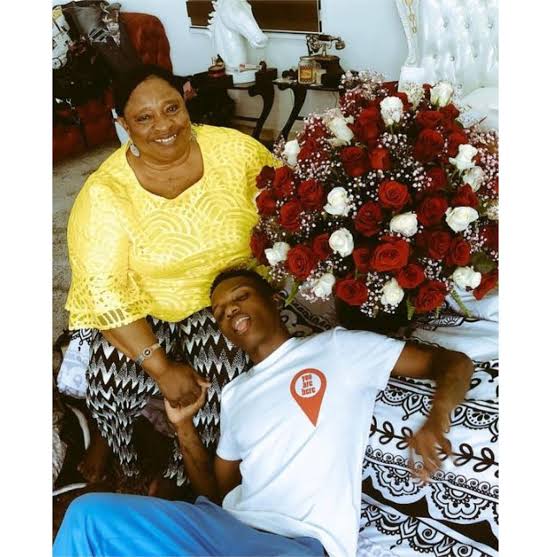
For many fans, that period of silence was confusing. But for Wizkid, it was initiation — a crossing from youthful ambition into spiritual awakening. The reflection had won, but not in defeat — in revelation. Because to truly fight one’s reflection is to admit that one’s soul has grown too large for denial.
When the World Became Small Again
In the aftermath of loss, the world often shrinks. Places that once roared with life begin to whisper. For Wizkid, stages that had once felt infinite began to feel intimate, as though the universe had folded itself back into a smaller, quieter space. Grief, instead of paralyzing him, became a filter through which he began to see life differently. The endless tours, the flashing cameras, the sound of applause — all of it started to feel distant, like echoes from another lifetime.
In Yoruba cosmology, when a man loses his mother, the bond between his ori (destiny) and emi (soul) must realign. It is said that the spirit of the mother continues to guide, often through dreams, silence, or unexpected calm. For Wizkid, this manifested in an almost spiritual detachment. He began to talk less about records and numbers, and more about energy — vibrations, gratitude, and alignment. What the world dismissed as mysticism was, in truth, a language of healing.
He began spending longer periods in silence, finding peace in solitude rather than applause. The mirror, once a battlefield, became a companion. In those quiet moments, he realized that fame could never fill the space grief had opened. He didn’t need to perform his pain; he needed to transform it. The boy who once chased sound was now being taught by silence — a strange reversal that only artists with deep souls ever understand.
The world, however, still demanded music. But the music that came after wasn’t for the world; it was for his reflection. Songs became therapy, rhythms became prayers. The stage was no longer his battlefield — it was his temple. Through grief, Wizkid found what most never find in success: the courage to be ordinary again, even in extraordinary circumstances.
The Return of the Star
The return was not loud. There were no grand announcements, no viral declarations. Just presence. When he walked into a room, people felt energy shift — not because of fame, but because of composure. Yoruba elders would call it iwa pele — gentle character, the highest form of power. It was no longer about dominance; it was about direction. Wizkid had become both the message and the medium.
Onstage, his performances were spiritual. He would close his eyes as if summoning something unseen, swaying like a priest mid-ritual. The crowd screamed, but he seemed to listen to something quieter.
Every concert became ceremony, every encore a benediction. The reflection no longer resisted him; it now moved with him — rhythm and reflection in perfect symmetry.
When Yoruba drummers play, they say the talking drum doesn’t just mimic speech — it carries spirit. Wizkid had become like that drum. His music spoke beyond language, beyond fame. It spoke in the language of peace — the peace of a man who fought his own reflection and came out whole.
The Rebirth of Sound
The album sessions that followed were less about innovation and more about revelation. In secluded studios from Accra to London, Wizkid began to record with a newfound quietness — the kind that doesn’t announce itself but fills a room with presence. His sound grew lighter, softer, almost weightless. Gone were the aggressive bass lines and dance commands; in their place came melodies that floated, like spirit songs disguised as Afrobeats.
What emerged from those sessions was a sound that felt closer to breath than beat. He was no longer chasing global dominance; he was chasing balance. Every lyric felt personal, reflective — glimpses into a man who had walked through fire and found calm on the other side. For those listening closely, the shift was obvious: Wizkid had stopped singing for people and started singing to something higher.
This sonic rebirth was deeply Yoruba in spirit. In that worldview, creation isn’t about fame; it’s about fulfillment — about letting the ase (creative power) within flow unblocked. Wizkid’s new sound felt like a return to ase — uncluttered, spiritual, alive. Where earlier records were filled with energy, these new tracks carried essence. It was as if he had finally found a way to translate the silence of his soul into music the world could still dance to.
Every great artist eventually discovers that mastery lies not in excess, but in restraint. Wizkid had reached that point. He had stopped fighting the mirror and begun learning from it. His music no longer screamed; it whispered. And yet, in those whispers, there was truth — the kind that echoed louder than stadium applause.
Lagos, London, Limbo
Between Lagos and London, Wizkid learned that home is not always a place — sometimes it’s a pulse. He became a traveler between worlds: the street poet from Ojuelegba, the global icon of Afrobeats, the quiet philosopher wrapped in designer simplicity. But with that movement came a deeper loneliness — a realization that even global success can feel like exile.

Every return to Lagos brought nostalgia and ache. The city that once shaped him now looked unfamiliar. New stars filled the airwaves, younger artists borrowed from his blueprint, and fans still screamed his name — but it all felt like watching his reflection move without him. He had become myth and man at once. Yoruba elders would say he had reached the stage of itutu — the coolness of spirit that comes after one has faced their own fire.
In London, he found calm — but calm can be deceptive. Away from the heat of Lagos, the silence could feel like isolation. The mirror followed him everywhere: in hotel elevators, backstage dressing rooms, even in the soft glow of his phone screen at 3 a.m. No matter the city, it reminded him of what he’d lost, what he’d become, and what he was still searching for.
To the public, he was still “Starboy” — the untouchable, the effortless, the icon. But to himself, he was a man still negotiating with his reflection, trying to reconcile Ayodeji and Wizkid. For Yoruba thinkers, this is the highest form of evolution — when a man becomes conscious of the many selves he must carry. Wizkid was no longer just living his destiny; he was observing it.
Beyond the Beat
There’s a stage in an artist’s life where music stops being ambition and becomes prayer. For Wizkid, that transition was seamless. He began to speak about his songs not as projects but as offerings — small rituals of gratitude to the universe that had carried him this far. Every note, every pause, every whispered lyric became part of an invisible dialogue between his spirit and the cosmos.
He had learned to detach from the weight of expectation. The fame that once defined him became background noise. He had entered what Yoruba philosophers describe as itunu inu — the inner comfort that follows years of struggle. In that stillness, his art deepened. His sound wasn’t chasing trends anymore; it was tracing truth. Even his silences began to mean something — they sounded like rest after revelation.
To outsiders, it looked like he was slowing down, perhaps losing hunger. But in Yoruba spirituality, to slow down is to see more clearly. Wizkid wasn’t fading; he was focusing. He understood now that music, like life, is cyclical — that every rhythm must return to its source. And when he performed now, his movements were smaller, his eyes more reflective. The energy wasn’t to impress; it was to connect.
Every artist must eventually confront their mirror, and Wizkid had. He had seen ego, loss, love, loneliness, and transcendence — all within the same gaze. Beyond the beat, beyond the fame, he had found what every soul secretly seeks: harmony between who he is and who he was meant to be.
Closing Reflection: The Man Who Became His Own Song
Now, when he stands before a mirror, Wizkid is still fighting, lesser now . The face staring back carries the calm of someone who has wrestled with destiny and learned to dance with it. The boy from Surulere, the global icon, the grieving son, the father, the philosopher — they all coexist within him, unarguing, unhurried. He has become, in essence, his own song.
In Yoruba metaphysics, every soul is believed to come into the world with a personal melody — orin inu — the inner song that defines one’s journey. Most people spend their lives searching for it. Few ever find it. Wizkid’s journey has been that search — through fame, silence, joy, and grief — until he finally heard his orin inu echo back from the mirror.

To fight one’s reflection is to face truth. To accept it is to attain freedom. Wizkid’s freedom now isn’t loud; it’s quiet, grounded, intentional. His legacy is not only in the music that filled stadiums, but in the silence that is still healing him. He has become what every Yoruba poet calls akikanju emi — a warrior of the soul. Not the boy who chased applause, but the man who found himself in its absence.
And so, on quiet Lagos nights, beneath the steady glow of a full moon, Wizkid still stands before the mirror — no longer searching for himself, but meeting the man he’s become.


Discussion about this post