


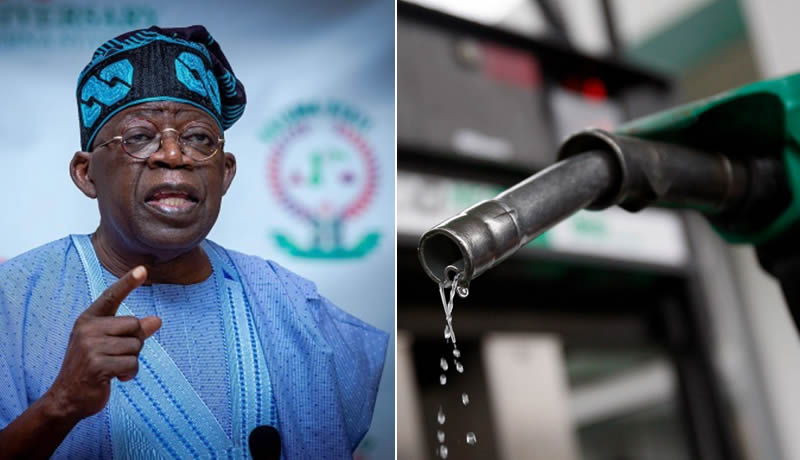

- For months on end, officials have met questions casting doubt on government assertions concerning payment of subsidy on petrol with obfuscation and fierce rebuttal
After countless denials and vehement pushbacks against those who doubt the veracity of its claims on oil subsidy, the Nigerian government has now finally admitted that it has indeed been subsidising premium motor spirit, popularly known as petrol.
For months on end, officials have met questions casting doubt on government assertions concerning payment of subsidy on petrol with obfuscation and fierce rebuttal, insisting that the draining financial buffer for citizens has since been yanked off.
In a not too surprising turn of events, the federal government has finally admitted Africa’s biggest oil-producing country will be spending up a staggering N5.4 trillion on oil subsidies in 2024.
The admission came during a presentation by Wale Edun, the minister of finance and coordinating minister of the economy on an Accelerated Stabilisation and Advancement Plan (ASAP).
The plan is designed to tackle key challenges affecting the reform initiatives and stimulate development in various sectors of the economy.
“At current rates, expenditure on fuel subsidy is projected to reach ₦5.4 trillion by the end of 2024. This compares unfavourably with ₦3.6 trillion in 2023 and ₦2.0 trillion in 2022,” a draft copy of the ASAP presented by Edun said.
The federal government had previously maintained that it would no longer subsidise fuel costs, instead opting for a deregulation policy.
“As far as I’m concerned, the President removed the subsidy and it remains removed till today. Anybody who is saying that subsidy is being paid, it is left for the person to bring the facts and then we will talk about them,” Heineken Lokpobiri, minister of state for petroleum resources (Oil) said in April
Last month, former vice president, Atiku Abubakar, challenged President Bola Tinubu to clear the air on fuel importation and the subsidy regime.
He tasked the President to make public the fiscal commitments and benefits from the fuel subsidy reform, including its effects on the Federation Accounts.
“It is curious that since April 2024, fuel queues had mounted at many filling stations across Nigeria, and the infamous ‘black market’ has sprouted in several states.
“How much PMS is being imported and distributed, and at what cost? What is the implicit subsidy?”, he queried.
Discussion about this post