


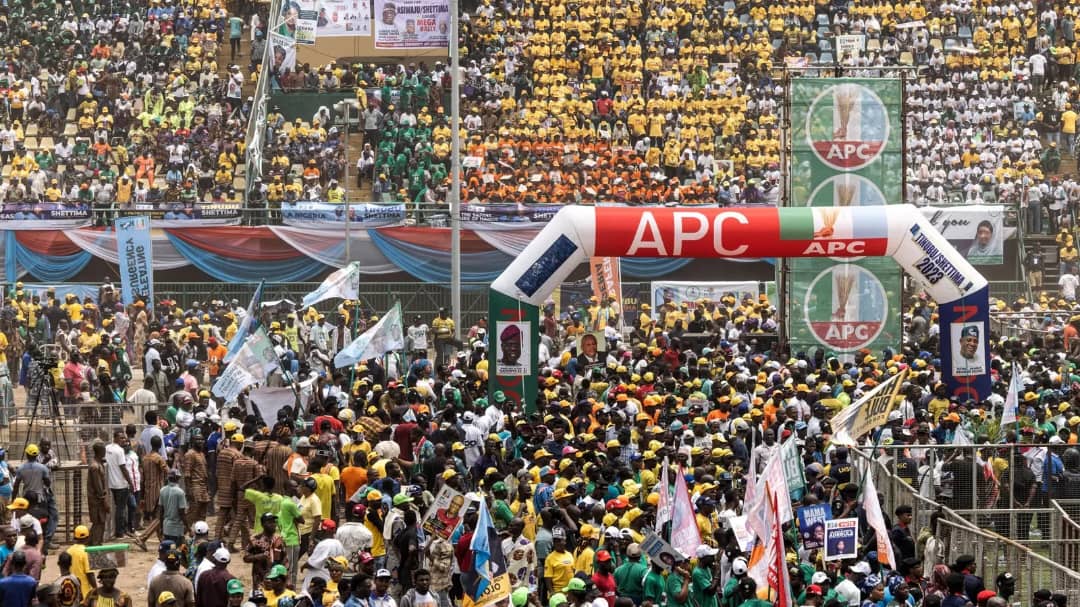

- CPC bloc members express dissatisfaction, raising concerns about their loyalty and future alignment within the APC framework.
- Northern APC members feel sidelined in appointments, fueling speculation of secret talks with emerging opposition coalitions.
As Nigeria gradually approaches the 2027 general elections, political alignments are beginning to shift across the country’s major parties.
For the ruling All Progressives Congress (APC), internal power struggles have begun to attract national attention, raising concerns over how unresolved tensions could affect the party’s cohesion, electoral performance, and its chances of retaining power.
Since its formation in 2013 through a merger of various political blocs — including the Congress for Progressive Change (CPC), Action Congress of Nigeria (ACN), and the All Nigeria Peoples Party (ANPP) — the APC has grown into Nigeria’s dominant political force, winning presidential elections in 2015, 2019, and 2023.
However, friction between these legacy blocs continues to shape the party’s internal dynamics.
FACTIONS AND LEADERSHIP CONTESTS
Although the APC has not formally split into divisions, underlying frictions persist.
A notable bloc, the CPC, which was associated with former President Muhammadu Buhari, is reportedly dissatisfied with recent developments within the party.
While some members of this bloc have reaffirmed their loyalty to the APC and President Bola Tinubu, there are ongoing rumors of discontent among others.
This dissatisfaction is not limited to the CPC wing. Some core APC members—especially those aligned with northern political interests—are reportedly aggrieved and have complained of being sidelined in key appointments by the current administration.
There are also growing allegations that these aggrieved members may be exploring options with emerging opposition coalitions ahead of the 2027 elections.
In recent months, multiple state chapters have been engulfed in open disputes over party congresses, leadership legitimacy, and control of party structures.
These struggles often pit governors, federal lawmakers, and party elders against one another, weakening party unity at critical levels.
At the national level, the resignation of Abdullahi Adamu as National Chairman in 2023 highlighted internal leadership rifts.
Though framed as a reconciliation move, his exit exposed fault lines between the Presidency and the party’s National Working Committee (NWC), further deepening intra-party mistrust.
ZONING, SUCCESSION, AND STRATEGIC ALLIANCES
Zoning and succession politics are also fueling internal unrest. With the presidency currently in the South-West, many northern stakeholders believe the region should produce the next presidential candidate.
This belief has triggered behind-the-scenes lobbying, strategic realignments, and quiet negotiations among influential power brokers.
The lack of a clearly articulated zoning formula or agreed-upon succession plan has left the party vulnerable to internal lobbying wars, with the potential to erupt during the primary process.
YOUTH DISCONTENT AND DEMAND FOR REFORM
Discontent also brews among youth blocs and grassroots supporters.
Many feel excluded from decision-making and have demanded structural reforms, including greater inclusion in executive roles and more transparent candidate selection processes.
If these issues remain unaddressed, they may lead to voter apathy or defections, particularly among young voters who played a significant role in recent electoral cycles.
DEFECTIONS AND POLITICAL REALIGNMENT
While the APC continues to attract high-profile defections from opposition parties—an advantage in past election cycles—this trend is now becoming a double-edged sword.
Some long-time APC members see the influx of defectors as a threat to their standing within the party.
For instance, in Delta State, the recent defection of nearly all key PDP figures, including the sitting governor, into the APC has triggered anxiety among the original APC stakeholders.
There is growing concern that the new entrants may be given preferential treatment over long-time members, possibly enjoying greater access to party structures and political rewards.
This perceived imbalance has reportedly led to tension and silent resentment within the party ranks.
As one APC member put it, “What’s happening is that those of us who built this party are being sidelined to accommodate new entrants who may end up getting more than we ever did.”
The fear that such developments may lead to internal sabotage or further defections to rival parties is no longer far-fetched.
The combination of rising grievances and the influx of powerful decampees threatens to destabilize internal equilibrium and fuel factional struggles.
ELECTORAL IMPLICATIONS
The Independent National Electoral Commission (INEC) has yet to release the 2027 election timetable, but political calculations are already in full swing.
If the APC hopes to retain power, it must urgently address internal conflicts, restore trust among party blocs, and maintain loyalty across regions.
Failure to do so could lead to parallel candidacies, legal tussles over primaries, and a weakened national campaign.
More importantly, the growing disaffection within its ranks could push key stakeholders into the waiting arms of a rejuvenated opposition.
As the countdown to 2027 intensifies, the APC faces its biggest test yet—not from external opponents, but from within.
Whether it emerges intact or fractured will determine not only its electoral future but also the stability of Nigeria’s ruling party system.
Discussion about this post